I recently had a heated discussion with a friend of mine after watching the film adaption of Berserk, a medieval fantasy manga. Throughout the film we were joking about how ineffective the characters armour was, as is common in popular fiction, with swords and other weapons effortlessly passing through breastplates and gauntlets, making us wonder why the characters even bother wearing it. We were in agreement that the portrayal was unrealistic until I brought up this scene which I thought was a pretty egregious example, but my friend disagreed, saying that a strong man could swing a sword through a knight's armour.
This got me curious and, while I admit my searches haven't been exhaustive, I haven't found any conclusive arguments one way or the other. So how effective was medieval armour at stopping direct attacks? How about arrows and other battlefield perils?
Short version -your friend is wrong. Swords (at least, swords for general use) were not armour-penetrating weapons. We know this through a variety of means.
Long version:
-as hborrgg points out, Dr. Alan Williams has studied the metallurgy of armour in detail (published in The Knight and the Blast Furnace) and has determined that armour had enough strength to resist a hacking blow from a sword, given the energy involved in a sword blow. Now there are all sorts of metallurgical inconsistencies in medieval armour - slag inclusions, soft spots, etc, but given the fairly un-concentrtated nature of a sword slash compared to a lance thrust, it's doubtful that armour would fail when struck with a sword even with flaws.
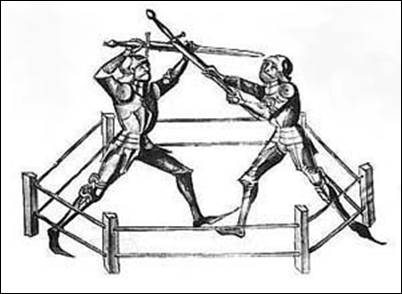
-We have surviving fencing manuals from the age of plate armour that describe how to defeat armour with a sword. And it doesn't involve hacking away at it - instead the manuals describe a 'half swording' technique of holding the sword blade halfway up and using the sword as a kind of spear to slide it through the gaps in armour. Here's an illustration from Han's Tallhoffer's manual
Swords in general are sidearms for knights/gentlemen at arms. Their primary weapon when mounted is a lance, and on foot (at least during the late middle ages and early modern period) their primary weapon was a poleaxe or another polearm. The poleaxe in particular could batter armour and even penetrate it (using one of its spikes) judging by William's calculations and the fencing manuals depictions of its use.
The blade of an axe or a sword is notwell suited for cutting through steel armor. If an armor was too weak to defend against that it likely wouldn't be very useful against spears, lances or arrows. Allan Williams' The Knight and the Blast Furnace did a pretty exhaustive study of medieval armor and found that most of them would provide superb protection from almost any sort of blow. However since an armor's strength can vary pretty considerably depending its thickness, hardness and slag content, it is possible that an extremely strong individual might be able to hack through a relatively. There is certainly no shortage of sagas and artwork from the middle ages depicting great warriors cleaving through helmets and armor. (For instance this scene from the Maciejowski Bible)