Mostly I know Quantz because he was a cool beatnik musician, backpacking around Europe and meeting famous composers and singers, and luckily for us later providing great historic records of these people. But Quantz was also a woodwind specialist when these instruments didn't get a lot of love, and I know he not only helped some composers see the potential of these instruments, but improved the flute in its design. But what exactly did he do to flutes? Also my entire knowledge of flutes comes from sitting in the same row as them in band class, as a head's up.
FINALLY something in my expertise!
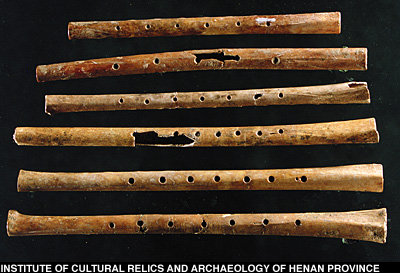
So the flute is pretty much the oldest musical instrument in history. They've found Paleolithic flutes carves from bone which date back 40,000 years. Now, when you compare the Paleolithic flute to the Renaissance flute, they're almost the exact same instrument, mostly equivalent to a modern fife, but a single piece of wood, closed at one end, with holes drilled into it.
Now, this stayed the same until early baroque times, when the addition of joints, and a single key was added, allowing the performer to play D# on the Baroque Flute. So, while this was an improvement, it still wasn't ideal, as this was an instrument that could only play in one key (typically D major, which is why a lot of early Baroque flute music is in D major). To make a chromatic scale, you had to partially cover a hole with your finger, which was inexact, and gave this flute intonation issues on non-natural notes.
So, again, this stayed the same for a while, until our good friend Quantz comes around. He was working as an oboist at the time for King Augustus II, but decided to become a flautist to make more money. He sees the obvious flaws in the flute, and decides to make changes, starting with adding a second key to the flute, to make D# better in tune. He even commissioned a portrait of himself where he's pointing to his fancy new key. From what I understand of Baroque Performance practice, there was a far greater preference towards perfect temperament vs. even temperament in tuning (since you're a musician yourself, I'm going to assume you understand those terms, but if not, let me know and I will follow up). So with these two keys, Quantz used one key for D# and another for Eb, which, while we wouldn't make a distinction today, they would have in the Baroque era, giving this Quantz flute more flexibility in intonation.
In addition, to keep pace with perfect temperament, he also very slightly altered the pitch of other notes, by moving the holes on the body to place the pitches more in line with the continuo bass. He also "invented" new fingerings for the flute to make tuning better, and so there were fewer partially covered holes for accidentals.
With all of this success, he also wrote a book called On Playing the Flute which covers all the technique he had been gathering, and how to overcome the shortcomings of the Baroque flute (or now the Quantz flute). It covers everything from ornamentation, to embouchure, how to add ornamentation and variations (very common in Baroque performance practice), intonation in low and high registers, single and double tonguing, music theory, and much more. It's about 400 pages of flute performance practice, and is still considered the definitive publication on Baroque flute performance. Today, period players still use this book to replicate original techniques. So, Quantz literally wrote the book on playing the flute.
Now if that weren't enough, he also experimented a great deal with the instrument itself. He tried many different woods to find different tones. He changed the angle of the embouchure hole to get different sounds. In fact, many of the surviving flutes Quantz himself made, often come with numerous head and/or body joints, for maximum versatility. Some headjoint configurations were better in high ranges, some had broader sounds or better low registers, so he kept a broad range of choices.
The final improvement he made was to add the modern-style tuning slide to the headjoint. Given the huge variation in tuning pitches during the Baroque era (everything from A=390 to A=420), this made the flute far more adaptive. Our modern tuning involves moving the headjoint on or off, but with the joints made of waxed thread at this time, that would not have been possible. The large number of body joints seen in the photos above would have made the gross corrections for pitch, but a tuning slide would have been immeasurably helpful for fine corrections.
As a result of all this, it made the flute a FAR more versatile instrument, able to play more flexibly in all keys, and play chromatic notes better. It's similar in the innovation from a natural horn to a keyed horn - you open up a massive amount of notes, keys and repertoire that previously would never have been possible.
http://www.jstor.org/stable/3127517?seq=1#page_scan_tab_contents
http://www.jstor.org/stable/842324?&seq=2#page_scan_tab_contents
https://books.google.ca/books/about/On_Playing_the_Flute.html?id=K--ZaCLuVGAC
http://www.flutehistory.com/Players/Johann_Joachim_Quantz/TRAV94.pdf