Considering they traded regularly with each other was there any cultural exchanges or embassies established?
Buddhism is a good example of cultural exchange between the two regions. The [Kushan Empire] (https://upload.wikimedia.org/wikipedia/commons/thumb/e/e5/Kushanmap.jpg/800px-Kushanmap.jpg) (~2nd century BC – 3rd century AD ) may interest you as it culturally absorbed influences from older Greek kingdoms there, which trace back to Alexander’s empire, as well as ones from various groups like the Parthians (from modern Iran) and ones from Central Asia. The empire also occupied an important place in Silk Road and Indian Ocean trade, allowing goods to flow from the Mediterranean to China and back. (Overland trade routes through Central Asia had been extended into China about ~130 BC, so it wasn’t as if China was completely unaware of the goings on in Central Asia at this time.)
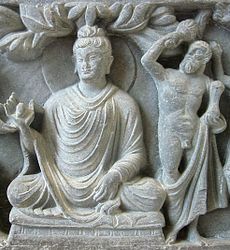
Anyway, [Gandhara Greco-Buddhist art] (http://www.metmuseum.org/toah/hd/gand/hd_gand.htm) displays these mixed influences in the Kushan empire's history via characteristics like certain styles of hair and posturing, costuming, and motif usage. (Apparently such influences eventually impacted East Asian Buddhist art as well, but I can't talk about that.)
Buddha with his protector depicted as the Greek figure Heracles:
The Kushan ruler Kanishka (127 AD) in particular supported Buddhism, building stupas and learning centers, as well as patronizing syncretic art styles like that of the Gandhara school. He also expanded his empire so that it lay more closely by China’s borders in Central Asia; many early Buddhist missionaries to China came from the Kushan Empire and travelled along the Silk Road. One of the first people responsible for translations of Buddhist texts into Chinese was Lokaksema, who was born in the Kushan Empire and lived during Kanishka’s reign. He was not Chinese, but eventually moved to the Han dynasty’s capital to set up a translation ‘agency’ there, and had students to carry on his work. As I said, other early translators of Buddhist texts were not Chinese either, but were responsible for introducing translations of mainly Mahayana Buddhist texts into China. In the 3rd century, as opposed to just missionary activity going into China, you start to see Chinese Buddhist monks travelling from their home country into India in order to collect and translate texts, and visit important sites. A notable episode was later around the 5th century, where the monk Faxian travelled for over a decade, translating texts from Sanskrit, recording his observations on life in North India, and reporting on the state of Buddhism there.
So besides just facilitating the flow of goods, trade routes running from the Mediterranean to China also created syncretic cultures (Gandhara art) and aided the transmission of ideas (Buddhism) across the various regions.