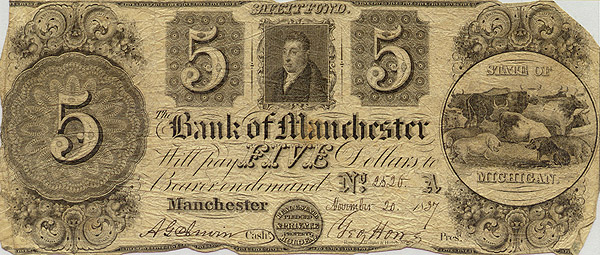
Someone made this claim during my class, and I was very surprised by it. I'd never heard anything about state currency. He mentioned that state militias in the Civil War were paid in state dollars, e.g. Massachusetts soldiers would be paid in Massachusetts dollars instead of US dollars.
For my part, I suspect they were paid in scrip because the state couldn't immediately cover their war debts, but I'm not certain of this.
His broader claim was that the US wasn't in a monetary union - with a common currency - until the Reconstruction era (he mentioned 1871).
Well, that's partly true.
The US had a "common currency" throughout its history following the ratification of the Constitution; that is, each paper note printed by state-chartered banks had to be redeemable for one dollar's worth of gold and/or silver. Until 1863, the US government was only able to issue currency in the form of coins, though "greenbacks" had begun to be issued during Polk's administration in an attempt to fix the issue of state-issued paper currencies.
Before 1863, the paper bills printed by each state could essentially be considered their "own" currency in that each bank could print its own notes for circulation. The notes, as mentioned, had to be redeemable for gold/silver, or the bank could face charges of fraud. This kept each banks bills on roughly the same footing in value, though disputes still happened. Because the bills were essentially the same value (or were supposed to be), a person could buy goods in South Carolina with bills printed by banks in Massachusetts, a situation that had not been possible under the Articles of Confederation, when the state currencies were not linked to federal coinage (which was itself linked to gold and silver - all federal currency was, with a few interruptions, until Nixon abandoned the gold standard in 1971). The government, however, could not tell the banks when to print or stop printing money, which created problems in several economic panics in the 1800s and friction whenever the government passed new currency laws that changed how bills were to be changed for specie (actual gold and/or silver).
In 1863, Lincoln signed the National Banking Act (originally called the National Currency Act), which put the power to print paper money in the hands of the federal government. Another National Banking Act in 1864 took the ability to charter banks away from the states and gave it to the government; this is the chartering system currently in use.
The bills printed by the banks would generally have the name of the issuing bank and the state on them - here are some examples from the 1830s-40s:
http://www.deerrunmercantile.com/images/products/detail/mdNAChafee1dolVarVG.jpg http://academicmuseum.lafayette.edu/special/marquis/CelebratingLafayette/Ephemera/box2folder23.JPG http://www.ohiochannel.org/UserContent/107477/126763.jpg
So, for tl:dr:
True: State-chartered banks printed their own paper money until 1863 (bound to a national dollar value), so it's possible that Massachusetts soldiers could be paid only with bills printed there.
False: The common currency as we know it was established in 1863, and the US had a common currency in the form of coins since 1791 or so.