e.g.: https://upload.wikimedia.org/wikipedia/commons/3/3e/World_around_1900.jpg
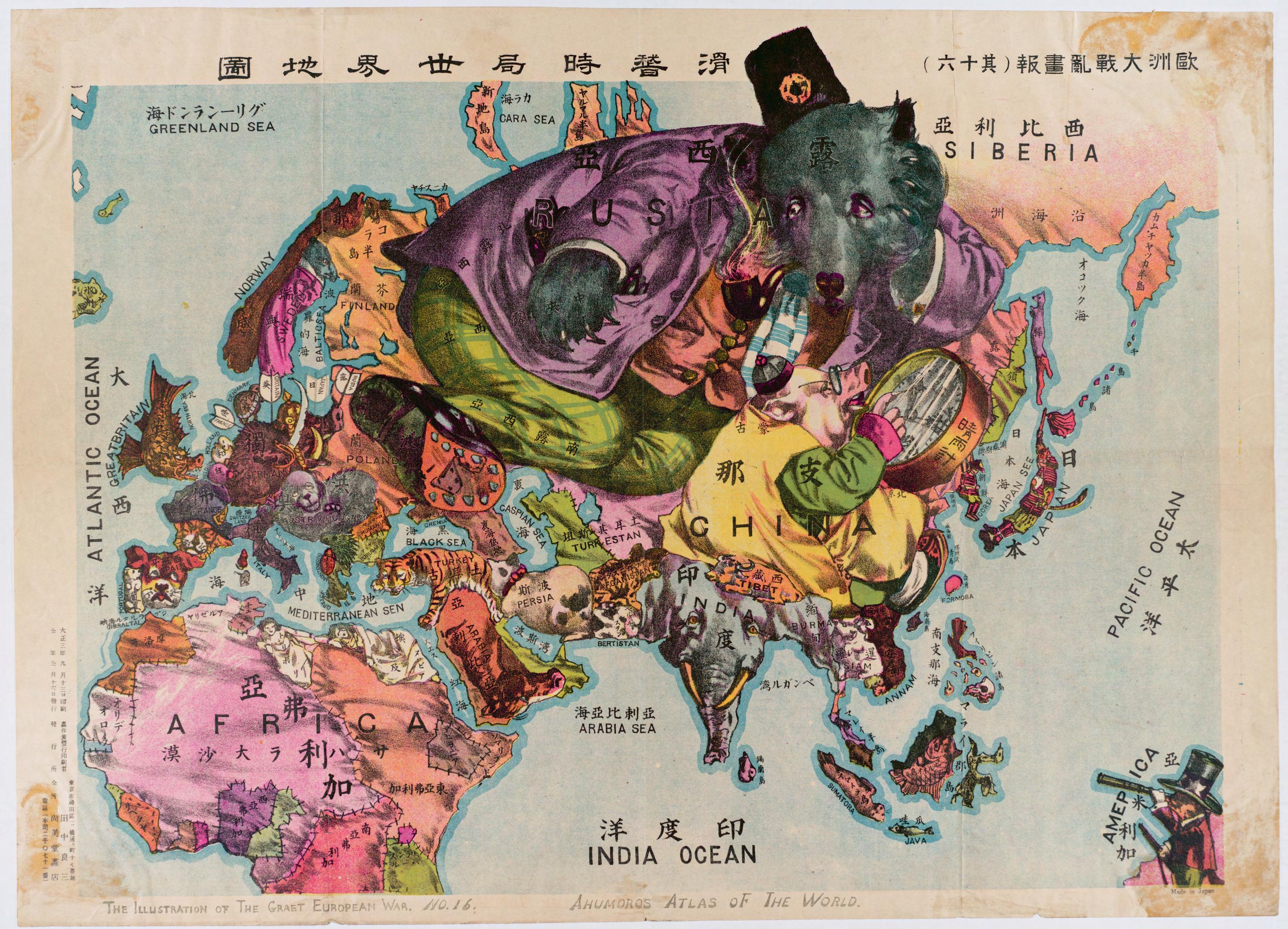
And what's with the bear riding a unicycle?
The heraldic arms of Novgorod include two bears - that is, they are not supporters, they are among the charges: "dexter and sinister two bears respectant sable". In fact the bear appears very common in the heraldry of northern Russia; apart from Novgorod, we have bears in:
Of course bears are not exactly an uncommon charge in any European country, but it appears to be a bit overrepresented in this Baltic region - especially the bear rampant. In very broad terms, with many exceptions, it appears that Russian cities and nobles used the bear where those of western Europe would have preferred a lion, and central Europe liked eagles. (This in turn may go as far back as the Rus settlers - the bear is "king of the animals" in Scandinavian folklore, as one might expect of the biggest land predator.) Novgorod and the Baltic region would be the "Russia" that English-speakers came into contact with first; and heraldry is a natural place to look for a quick nation-identifying metaphor. Hence also "the English Lion", "die Vlaamse Leeuw", "the Lion and the Unicorn", and "the Bear Republic" for California.
Finally, no discussion of bears in Russian heraldry is complete without a pointer to the gorgeous arms of Zheleznogorsk: Gules a bear or, armed argent, enclosed and supported by three electron orbitals argent, bearing and opening a nucleus argent. (It's beautiful but a bit difficult to blazon.) Zheleznogorsk was an important center for nuclear research.
Why is China a giant Pig?
Heart-rending details of Russian mores on the Russian way of life, about the cities and towns, in which bears roam, are contained in the classical works of Sigismund Herberstein ("Notes on Muscovy", 1549) and Adam Oleary ("Description Muscovy", 1647), - it appears that to a large extent these bestsellers, translated into all European languages, the West formed a number of the stereotypes that have survived to the present day.
Throughout the next hundred years this message Gerberstein repeated many writers: first Italian R. Barberini, writing in 1565, but published only in 1658 r .; then Polish citizen A. Gvanini in 1578 .; Englishman George. Fletcher in 1591 .; anonymous German in 1630, and even the Dutch sailmaker Ian Streiss in 1676 Random news of the harsh winter of 1526 turned into everyday use anecdote about bears, running around the Russian city.
What is Norway supposed to be? a piece of wood?