You see this happen once in a while in the movies. An actor become so iconic for a single role that he struggles to find other acting roles afterwards.
Did this ever happen to the actors under Shakespeare?
Not that I am aware of.
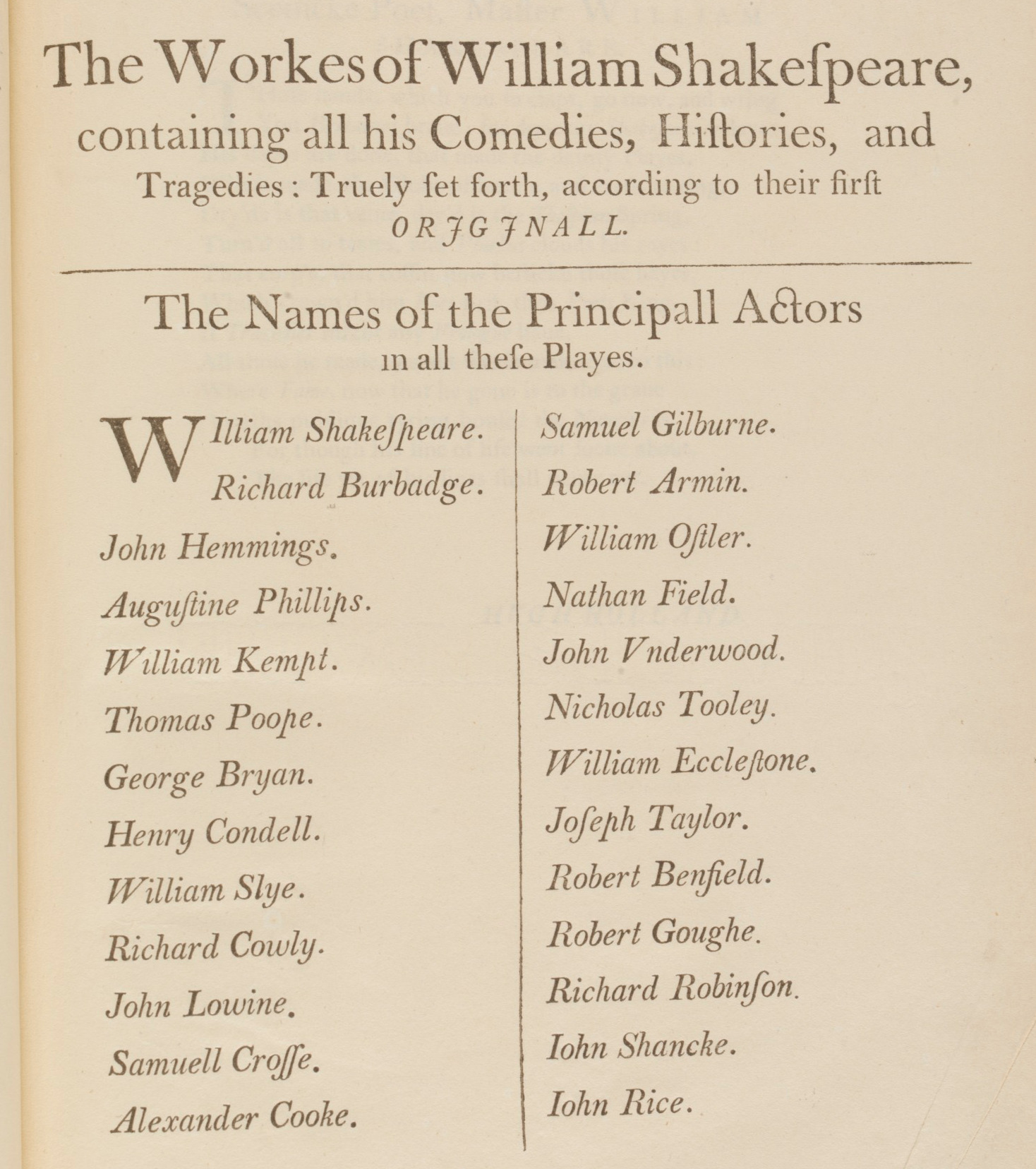
After 1594 Shakespeare's plays were written for and performed by The Lord Chamberlain's Men (renamed The King's Men in 1603) so the same group of actors would have been used over and over from that time onward. Their names are recorded in the First Folio of 1623. The plays believed to have preceded Shakespeare's membership in the LCM are The Two Gentlemen of Verona, The Taming of the Shrew, the three parts of Henry VI, Titus Andronicus, Richard III, and possibly the anonymously published Edward III which is sometimes attributed to Shakespeare but to date is rarely included in any Complete Works.
However, certain actors were typecast (used over and over in similar roles according to their unique acting strengths or physical type) just like in modern theatre companies.
Probably the most famous example would be William Kempe (sometimes spelled Kemp or Kempt). Kempe was a character actor often typecast as a clown within the LCM and he was famous/infamous for ad-libbing his lines on stage. Kempe is known (from script line notes that mention him by name) to have originated the roles of Dogberry in Much Ado About Nothing and Peter in Romeo and Juliet. It is also very likely (though not certain) that he was the first to play Costard in Love's Labours Lost, Lancelot Gobbo in The Merchant of Venice, and Bottom in A Midsummer Night's Dream as well as Cob in Ben Johnson's Every Man in His Humour. It is sometimes conjectured that he was the first to play Falstaff in the two parts of Henry IV, but Falstaff is a far more complex character and it seems unlikely that it would have been offered to Kempe. There is a section of prose in Hamlet that is believed by some scholars to have been a personal jab against Kempe's frequent antics and ad-libbing:
And let not your clowns say more than is set down for them- for there be of them that will themselves laugh, to set on some quantity of barren spectators to laugh too, though in the meantime some necessary question of the play be then to be considered. That's villainous, and shows a most pitiful ambition in the fool that uses it.
Despite being a core actor and a shareholder, Kempe left (or was forced out of) the Lord Chamberlain's Men for unknown reasons in early 1599. The above quote may indicate why he was let go from the company. Kempe died in poverty in 1603.
EDIT: I am sorry, I did not see the last line of your question. I answered for a very different time period. I'll leave the comment up in case it interests you anyway.
In the nineteenth century it was quite common in the United States and Great Britain (perhaps in other countries, but I am an Anglophone and the bulk of my expertise is in Anglophone countries) for actors to specialize. This was not "typecasting" as we know it today, but rather a strategic decision by actors to increase their drawing power. At the time the theater system, especially in the United States, was that a single star would travel the country, performing with local troupes called 'stock companies.' A stock company would have various men (and sometimes women) who played the old man, the clown, etc etc., who would then be plugged in around the star. The stars often brought the plays with them, and the stock players had to learn the lines quickly in order to get things going correctly.
Shakespeare was the single most popular playwright in nineteenth century America. No one else even came close, and Shakespeare was beloved by people of all social classes. Individual actors often specialized in characters who suited their styles. For example, the American actor Edwin Forrest was known for the brutal forcefulness of his acting, and thus became well-known for his powerful depiction of MacBeth. His rival the English actor William MacReady was known for his more cerebral approach to MacBeth, and also for his sensitive Hamlet.
Put another way, the star actors knew what the best parts were, and they made sure they always got to play them. It increased their celebrity and made them wealthy, besides, when few were becoming wealthy from the theatre.
Sources: Lawrence Levine, Highbrow/Lowbrow David Grimsted Melodrama Unveiled Ackerman, The Portable Theater
Not quite what you're looking for but Harry H. Corbett was a Shakespearian actor who played Richard II to great critical acclaim. Who later found fame on the BBC's 1962-1974 (with breaks) sit-com Steptoe and Son. Unfortunately for him despite being an amazing actor he was stereotyped as his role in Steptoe as a "rag and bone man" or scrap dealer. When he returned to the stage in 1970 to play Hamlet, the audience didn't take him seriously, going so far as calling out during the performance to play Hamlet in his Steptoe voice. In 1975 largely as a result of his work for the British Labour party, the Prime Minister wanted to award him an OBE (Order of the British Empire, which is lower than a Sir but higher than a commoner), unfortunately for him there was also a puppeteer on telly called Harry Corbett who presented the Sooty show. The award was initially given to the puppeteer by accident and it ended up with both of them being given the OBE on the same day. Which naturally caused some merriment in the press.
His on air co-star Wilfred Brambell was an alcoholic who regularly forget his lines and hadn't rehearsed and has since been accused of being a paedophile. Which led to the show's cancellation and scuppered a theatre tour of Australia.
http://www.screenonline.org.uk/people/id/544633/
Harry H. Corbett: The Front Legs of the Cow, Susannah Corbett
Acting in the '60s, Hal Burton