I've never read much about them. The island fighting really didn't lend it self to tanks very well.
The problem with evaluating Japanese tank units is that the overwhelming qualitative superiority the Allies had in battles against Japanese tank units makes it hard to evaluate them outside of this scope, the island tank units were rarely ever deployed in proper mass as well:
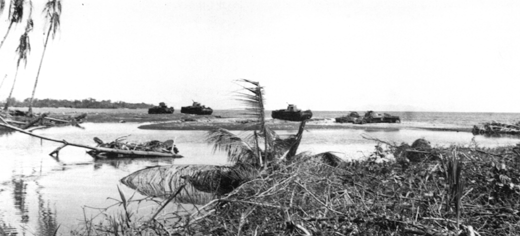
The Japanese would launch their second major attack on the US Marine Perimeter on October 23 [1942]....[the 1st Independent tank company] would attack the western end of the Marine permiter, across the mouth of the Matanikau River....
Company commander Maeda knew that the clear ground around the river mouth would be completely exposed to US fire; he therefore proposed that the infantry should cross first with artillery support, and secure the opposite bank before the tanks crossed...
However, his proposal was rejected....in the face of this decision Captain Maeda accepted that he was going to his death. The earlier probes had naturally alerted the Marines to be ready for a tank attack; they had positioned more 37mm AT guns....
At 1430....the ten tanks moved out and down the beach together with the infantry. During the approach march [Maeda's] tank broke down...when the tanks reached the bank of the Matanikau at around 1700 they were unsupported....
(Rottmann & Takizawa, pgs. 50-51)
The attack of the 1st Indep. Tank Co. ended in complete and utter disaster with the unit wiped out. The outright obsolescence of Japanese armor, highly vulnerable to 37mm cannon fire, coupled with shoddy combined arms co-operation spelled the doom of the unit. Japanese branch jealousies and lack of proper integration meant that this was the norm, despite there being a well-thought out doctrine for the employment of tanks:
If attacking a strong antitank defense the tanks would be disposed in attack waves; if the defenses were light, they would be massed forward. The infantry would follow closely behind the tanks, with artillery neutralizing defenses with high explosive and smoke shells. In some instances infantrymen rode on the backs of tanks. Tank objectives included the positions of enemy machine guns and other frontline crew-served weapons; they were to create gaps through barbed wire; and once they broke through the forward positions, tanks would attack command posts and artillery positions....
(Ibid, pg. 19)
Theoretically nothing in the Japanese tank doctrine was flawed or outright different than say, German or American armored doctrine; tanks could be an arm of decision. They could support, be supported, lead attacks, exploit gaps, conduct security, etc. They were in theory their own combat arm, but the lack of firm combined arms integration, as evidenced by the aforementioned attack in the Guadalcanal reveals problems in reality. Japanese tanks were often relegated to glorified 'flying guns' or to dug-in anti-tank units, robbing armor of its key asset, supported and co-ordinated mobility. Technological problems (vast as they are) aside, this already puts Japanese tank units on the 'wrong foot.'
They could, of course, have successes. In the initial invasion of the Philippines, the attached Japanese tank units had their first armor-on-armor battle with the US Provisional Tank brigade, armed largely with M3s. Despite the parity or qualitative edge of the American equipment, several M3s were destroyed while attempting to maneuver off road, and the unit was forced to break contact.
There could even be successes at the local level late-war, especially in China, where the principle of mass could be more easily followed:
The goal of the "Ichi-Go" offensive, between April and December 1944, was to conduct a series of attacks from the main Japanese-occupied area in northeast China....on April 30, 1944, the 37th Division attacked Xuchang, supported by....13th Tank Regiment; the rest of 3rd Tank Division was held in reserve...
The tanks broke through the gates of Xuchang and Japanese infantry flooded in; in bitter street fighting some 3, 000 Chinese troops were killed and the city occupied. General Yamaji then swung his tank divsion westwards, dividing it into three groups..."
...the 'Dash-Forward' Group was ordered to advance rapidly on Baisha, ignoring any small Chinese forces encountered en route. The [Right Group] advanced on Jiaxian. The [Left Group] and 'Dash-Forward' Group advanced to Jiaxian via Xiangcheng, and on the afternoon of May 2 they attacked....
That night the Reconnaissance Unit advanced to the west of town by stealth; coordinated with the night attack by the main body of the [3rd Tank division], they attacked the Chinese from behind and drove them from Jiaxian in a rout...
(Ibid. Pages 41-42)
The exploitation would eventually net 10, 000 Chinese casualties and numerous more POWs. At certain points, small pockets of Chinese infantry would be bypassed for mop-up by infantry, who after the initial assault had firmly taken up a support role. The tanks would deal with anti-tank guns, pockets of resistance and urban centers with their organic strength. The lack of organic mechanized infantry certainly would've been a detriment to their ability to keep the exploitation moving over greater distances, but in this example the Japanese combined arms co-operation was robust and well-thought out. The local success of the action proves that when fighting an enemy that was relatively par technologically, and when the doctrine was actually followed, results could be had.
The successes of the Japanese tank units were few and far between however for previously discussed reasons. Technological and doctrinal shortcomings all but guaranteed that the Japanese would fare worse in mobile operations against an enemy with the same or greater level of understanding of combined arms warfare. Japanese tanks were not very reliable either; in the above action, the 3rd Division lost almost a third of its tanks due to breakdowns over the span of a week's fighting, rather than to direct enemy action.
Lastly as a caveat, the evaluation of Japanese armored units is also further hampered by the stunning lack of English-language sources on this subject.
Source: World War II Japanese Tank Tactics by Rottmann, Gordon L. and Takizawa, Akira.
How useful were the tanks in the early stages of the war? Specifically the Malaysian offensive. Was there success due to usefulness or just the general lack of mobility on the part of the british.