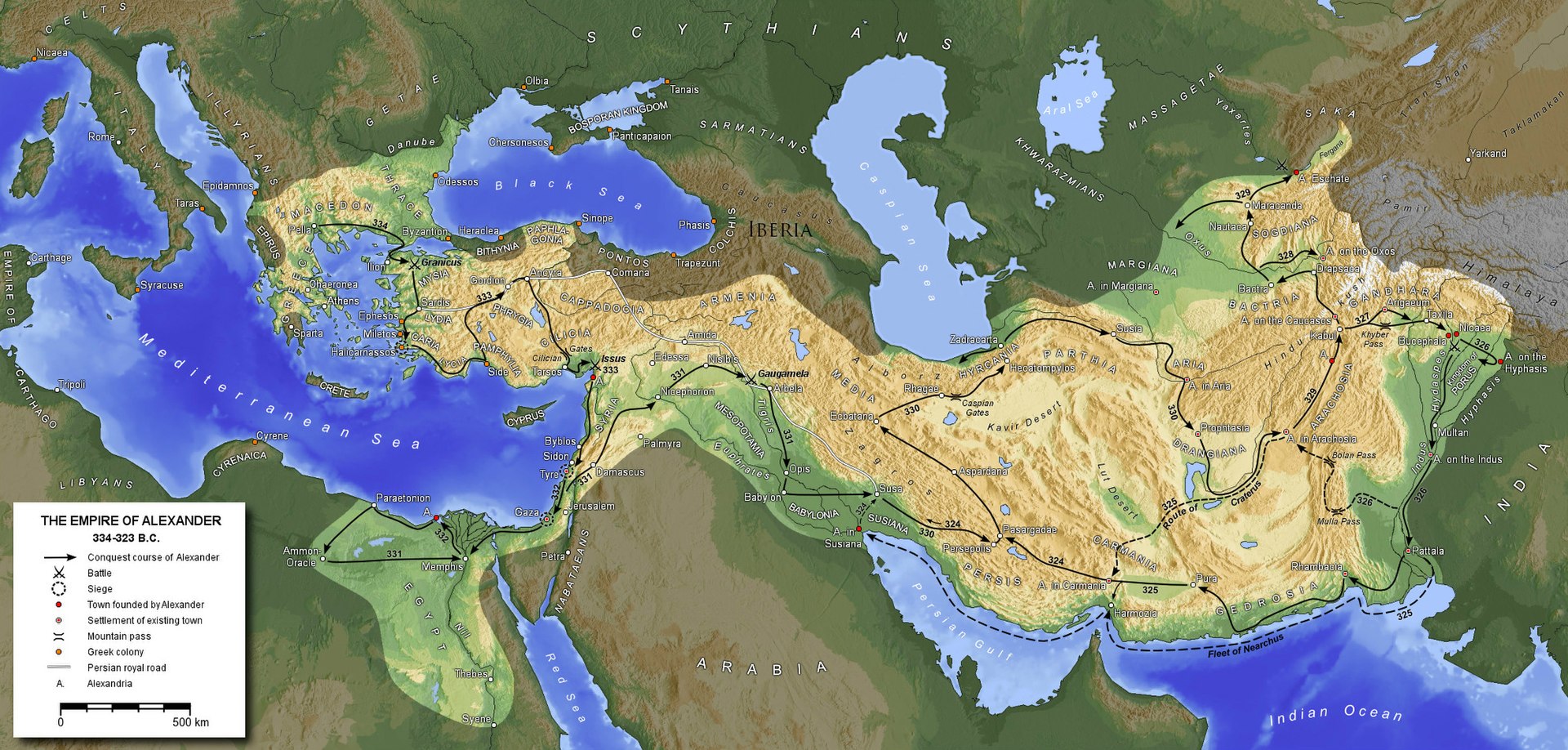
Of course nobody could doubt the man's great success in battles. But I was looking at this map from wiki
https://upload.wikimedia.org/wikipedia/commons/thumb/4/40/MacedonEmpire.jpg/1920px-MacedonEmpire.jpg
It really seems to me like a quick romp around Asia winning battles. The amount of victories is certainly stunning, but it seems strange to me to call this a Macedonian Empire in the same way we talk about the Roman Empire.
I mean even just looking at Caesar's conquering of the relatively small territory of Gaul, he won many battles but hadn't truly conquered it until years afterwards at the final crushing of the final rebellion of Vercingetorix. Looking at the map of Alexander's territories, it's hard to imagine that he could have kept any of that territory for very long at all. Is this the case?
It's better to look at what happened in the aftermath of his death, when the empire was split between his generals.
Seleucus had the largest portion, which was known as the Seleucid Empire which lasted from 312 BC to 63 BC. That's a long time.
Ptolemaic Egypt started with another general, Ptolemy I, that empire lasted until 30 BC.
So there must have been a solid structure to these areas after they were conquered, otherwise they would have quickly disappeared as soon as Alexander died, but as we know they lasted hundreds of years.
Well, he defeated their armies and the lands were then subject to his law and rule, and the rule of his successors post mortem. I don't see how it could be thought he didn't conquer them.
Alexander conquered a region that was already subject to a centralised government, under the Persian Empire - effectively, all the conquering had already been done for him, and all he did was change the king. Caesar conquered an area that was composed of multiple tribes, and although some did fight together under Vercengetorix at one point, they had individual territories and reactions to the conquest, and each needed to be 'conquered' (whether through paying tribute, military force, treaties etc) individually.
The Persian empire was highly centralized whereas Gaul consisted of many independent tribes. Alexander replaced Darius as the head of this political entity and didn't need to make many changes, in fact Alexander was renowned for adopting many Persian customs. Julius Caesar on the other hand had to bring each of them under and set up a system that the Gauls had never seen before, demonstrating Roman power again and again whenever a tribe or a confederation of tribes decided to challenge it.