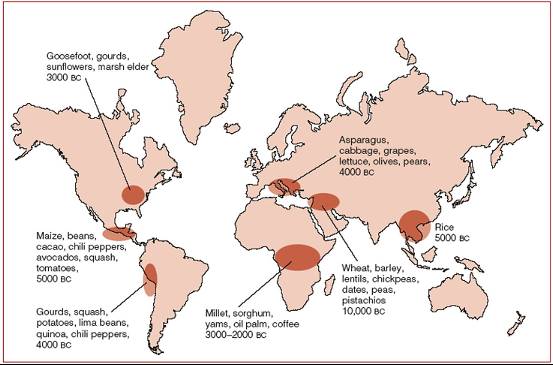
I'm basing it on this map. There are a lot of maps with various differences like this and this, but they're all roughly the same.
According to Wikipedia, "...gave rise to anatomically modern Homo sapiens in Africa about 200,000 years ago". So why, after all that time, was there such a rush of agriculture around the world, from 10,000BC to 3,000BC?
I suppose I can understand some cultures learning of it from others, and then having their own revolutions. (eg. fertile cresent to Sahel, or mesoamerica to the Mississippi), but I can't imagine this for more far apart revolutions (eg. fertile cresent and China, or a Eurasian revolution and an American one.
I'd reckon the 5.9 kiloyear event had a large impact.
It was one of the most intense aridification events of it's era which put significant strain on populations, forcing them to move near river beds and closer together. The difficulty to make or find food, coupled with the fact they were all close together, created a need for complex societies. [Brooks, Nick (2006). "Cultural responses to aridity in the Middle Holocene and increased social complexity".] Being a world wide event, I feel that it would explain how the neolithic revolution would happen independently yet universally.
Here's the wiki if you want to read more: https://en.wikipedia.org/wiki/5.9_kiloyear_event
Ask Anthropology Might be able to help you better!
Agriculture did not spring up fully formed out of nowhere. Archaeologists agree that agriculture sprang up independently in different parts of the world. Whether or not agriculture was independently invented in different parts of the Americas is a different story. As far as I know, the evidence points to the domestication of maize in Mexico, and the spread of that domesticate throughout large parts of North America. Clearly, rice, wheat and barley only spread to the Americas after European colonization. Therefore, agriculture was not invented in one place and spread outwards, but invented in multiple places. Irrigation is an even more complex invention. Different regions require different methods of irrigation, the raised fields of the Maya are different from the pumice gardens of the Pueblo which are different from the canals of the Inca.
Prior to agriculture people practiced horticulture, where people knew enough about plant reproduction and life cycles to facilitate growth. People were nomadic to varying extents and practicing horticulture. Then people became more sedentary and then they began to aggregate into larger groups (I'm still talking about the southwest US). Larger groups require more food, but they also provide more localized labor to produce that food. As people aggregated into towns, agriculture and irrigation became more complex.
Agriculture is a much more efficient means of feeding large numbers of people on a given plot of land than hunting and gathering. A hunter/gatherer lifestyle generally requires some mobility. According to archaeological theory, a given amount of land can only support so many hunters and gatherers. Aggregation can cause a focus on agriculture, or the invention of agriculture may cause aggregation (this is one of those chicken-egg arguments that archaeologists have with themselves).
Further, agriculture did not appear everywhere across the world at the same time, nor did it even appear everywhere in the world. The Pacific Northwest of the US, for example, did not practice agriculture in prehistory. In regions of the world without agriculture, people clearly felt that had sufficient means to feed themselves without farming.
Dynamics of Southwest Prehistory by Linda Cordell
The Incas and Their Ancestors by Mike Moseley
I'm so curious, why do people keep posting anthropology questions to this sub? How could historians have an answer to something that happened pre-historically? We don't bite over at r/AskAnthropology, I promise!