I heard this specifically when reading about Corte's native counselor La Malinche, who although did speak the Aztec's language of Nahuatl, had little to no knowledge of the customs and elegant manners of Aztec diplomatic discussion.
So what would this "flowery" sort of talking be like?
Just to clear up the issue of Malinche/Malinalli, while Nahuatl was her native language, she herself was from the Southern Gulf region. Cortés et al., specifically encountered her in the Tabasco area, an area was at the boundary, and actually beyond Aztec control. We know there was and is variation in Nahuatl by region, with what we call "Classical Nahuatl" being based on the Central Mexican Nahuatl spoken in the Aztec core area. Malinalli most likely would have been a native speaker of a different dialect Nahuatl, though we don't know precisely which or how substantially different from it would have been from the Central version.
Moreover, Mallinali had also been living as a slave in Tabasco. While slavery in Mesoamerica did not have the connotations that it now does (i.e., subhuman chattel slavery), and the position did mean that she would not necessarily have had the education in or exposure to more "courtly" forms of Nahuatl. This is again, hard to judge since while she is acknowledged as a translator, the Spanish accounts tend towards direct quotes without acknowledging who or how is translating. Take this passage from Motecuhzoma Xocoyotl's (in)famous speech welcoming the Spanish to Tenochtitlan:
"... I am aware that the Cempoallans and Tlascalans have told you much evil of me, but believe no more than you see with your own eyes, especially from those who are my enemies, some of whom were once my subjects, and having rebelled upon your arrival, make these statements to ingratiate themselves in your favor. These people, I know, have informed you that I possessed houses with walls of gold, and that my carpets and other things in common use were of the texture of gold; and that I was a god, or made myself one, and many other such things. The houses you see are of stone and lime and earth."
And then he opened his robes and showed his person to me, saying, "You see that I am composed of flesh and bone like yourselves, and that I am mortal, and palpable to the touch," at the same time pinching his arms and body with his hands;
"I see," he continued, "how they have deceived you. It is true I have some things of gold, which my ancestors have left me ; all that I have is at your service whenever you wish it. I am now going to my other houses where I reside; you will be here provided with every thing necessary for yourself and your people, and will suffer no embarrassment, as you are in your own house and country."
That's some ornate fancy talking indeed, but we have to keep in mind that this "direct quote," as it is presented, was spoken by Motecuhzoma in the most courtly of central Mexican Nahuatl, then translated from that by Malinalli into Mayan (probably Chontal) to Aguilar, then translated into Spanish by Aguilar. Malinalli had spent, at max, about 6 months with the Spanish at that time, and could not be considered to be a fluent translator into that language. Aguilar was a Spaniard who had been taken captive by a Maya group years earlier, and could reasonably be said to be proficient in Mayan. Regardless of the exact proficiencies and the process by which this message was conveyed to Cortés, he wrote it down in a way that most resembles the literature of Spain at the time. Go figure.
A typical example of Classic Nahuatl would be Sahagún's General History of the Things of New Spain, which was written by Nahua scribes under his direction in both Nahuatl and Spanish. We can see the more poetic stylings of the language, particularly the use of repetition and parallelism in this passage describing some of the festivities of the month of Tlaxochimaco:
And as they danced, they did not keep leaping nor did they make great movements; they did not go make dance gestures; they did not go throwing themselves continually about, they did not go dancing with arm movements, they did not continually bend their bodies, they did not continually go whirling themselves, they did not keep going from side to side, they did not keep turning their backs.
It was quite quietly, quite calmly, quite evenly that they went going, that they went dancing. Very much as a serpent goeth, as a serpent lieth, was the dance. None disturbed, non intruded, none encircled, none broke in.
And those who embraced the women were only the great, brave warriors. But those who were only masters of the youths did not embrace them.
And when there was an end to the dancing, there was only a little sun; already the sun was about to set. There was dispersing, there was going on the part of each one.
Now, this is written Nahuatl, recorded a couple decades after the fall of Tenochtitlan, and not the spoken Nahuatl of a lord (though these scribes would have been of the upper class). Aztec society, however, was a distinctly oral society. In part, yes, because of the pictorial proto-writing they possessed, but also because oration was absolutely a skill they valued, particularly among the upper class. Song and poetry were taught at the schools for noble children and, to quote Sahagún again, a trait of the "esteemed noble" was "what he says, mentions, repeats, composes, is all wholesome, good, and honorable," whereas a negative trait for a noble was that his "speech is twisted, incoherent, disorganized, stupid."
Nahua pride in their language is, in fact, intrinsic to the name of their language. Nahuatl basically translates to "clear speech," and the Aztec were not above casually denigrating other languages. A common phrase used in english texts for how the Aztecs described non-Nahuatl speakers was to say they spoke a "barbarous" language. The Nahuatl term, popoloca, which translates to mean someone who is speaking poorly, unintelligibly, stutteringly. So it makes sense that when a ruler would be greeting another ruler (i.e., Monty to Hernie), the former would pull out all the stops and adopt the very stylized oratory seen above.
ninja edit: I meant to work in some of poetry attributed to Nezahualcoyotl, but didn't get around to it. For your edification.
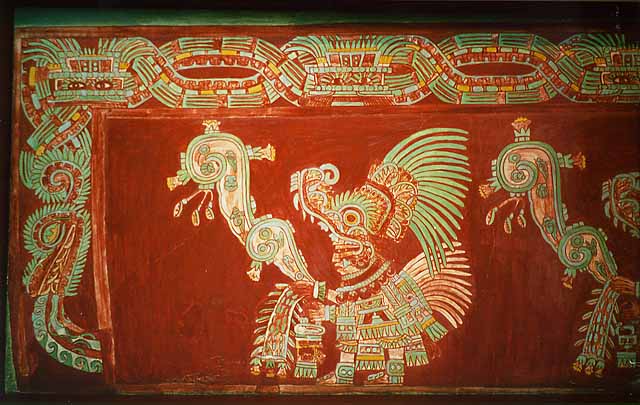
Someone with more Aztec expertise can comment specifically about Aztec diplomacy, but the description of speech being flowery is very common in Mesoamerica, not just among the Aztec. For instance, speech in artwork is often depicted used "speech scrolls", or scrolls emanating from the hands or mouth of characters. Often, these speech scrolls include lower volutes hanging from them sometimes indicating the nature of the speech. For instance, see the characters in this mural from Teotihuacan or from this mural and note the flowers attached to the dotted speech scrolls emanating from the hands of the figures.
That said, the flowers may have less to do with the character of the speech as elegant and more to do with the religious significance of speech by deities and other divine or semi-divine beings (such as priests or kings). In many Mesoamerican cultures (including among the Maya and Aztec), breath (and so by extension, speech) is associated with wind and is considered an expression of the soul. In the Maya creation story of the Popol Vuh, the creator deities breath life into the lifeless corn effigies that become humans, ensouling them with their breath. When recounting royal chronologies, a Maya phrase translating as "he released his white flowery breath" means that someone has died. Here we see the connection between flowers (as well as jewels and beads) and this breath used as an expression of the soul.
The connection with divinity is through the widespread Mesoamerican concept of the upperworld and home of the gods being a place of sunlight and brightly colored things, such as flowers, jewels, and birds. The soul (or breath) of special individuals and deities is therefore associated with these things. You can see the flowers and jewelry included in and around the speech scrolls in the Teotihuacan murals.
In particular, the speech of Aztec royalty was considered sacred and associated with jewels and flowers. I'm taking this from this excellent book that covers the subject, but the Aztec Florentine Codex says that:
...only as precious things do the spirit, the words of our lords come forth. For they are the words of rulers; for they are considered as precious green stones, as round, reed-like precious turquoise. (Houston, Stuart, and Taube 2013: 154).
In summary, while I'm sure someone else can cover the specifics of that quote and context, in general flowers are associated with royal and elite speech throughout Mesoamerica not because of the quality of the speech being highly rhetorical or elegant, but because the flowery afterlife and upperworld is associated with elites. In brief:
Speech is the oratorical privilege of the lord and appears to underpin his titles: Nahuatl tlahtoani, the term for "lord" among the Aztec, comes from a word meaning "to speak, to issue proclamations and commands"... The flower and precious attributes of the breath soul and the afterlife are strongly linked to rulers and gods... (Houston, Stuart, and Taube 2013: 153, 154)
Edit: Spelling, grammar, and additional content.
I'm in no way an expert in that area, but rhetorical style was described throughout the middle ages as 'flowery' or 'colorful.' Some handbooks on stylistic embellishment were known as colores rhetoricii, or colors of rhetoric. The description of 'flowery language' may be a commonplace way of describing highly rhetorical language.
See, for example, James J. Murphy, Rhetoric in the Middle Ages