They are closely related, different languages in the same way that English and German, or Spanish and Portuguese are closely related, different languages.
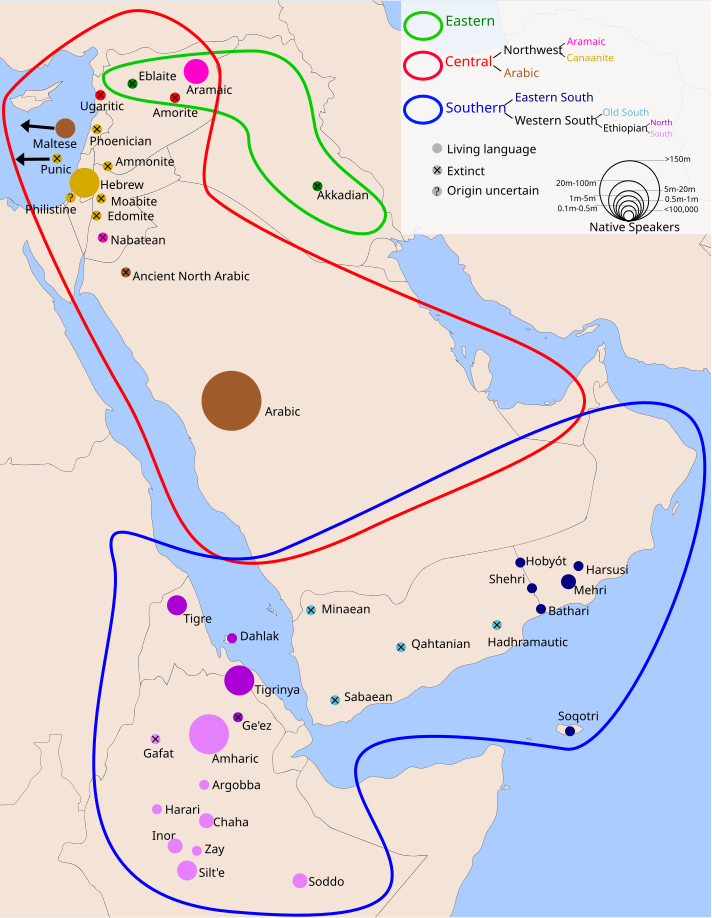
Check out this cool map, which shows the distribution and relationship between the Semitic languages (that's the language family Aramaic and Hebrew belong to, among other languages).
You can see Aramaic and Hebrew are both on the Northwest Semitic branch, but there are also other languages (like Nabataean and Phoenician) on those branches (incidentally, the only language in this part of the family that isn't dead is Aramaic, so there's one difference - Aramaic has a continuity that Hebrew doesn't, since it was revived).
Aside from genetic differences, if you mean differences in sound system and other patterning - because Hebrew is a revived language, and because the Ashkenazim had/have a lot of power in modern Israel, modern Hebrew has quite a bit of influence from European languages, particularly German. Germany was home to the communities of Jews that are now called Ashkenazi, and they developed their own Germanic language called Yiddish (not related to Hebrew, but uses the Hebrew writing system). One of the features they picked up in Germany that pervades Iraeli Hebrew today is a uvular rhotic. This is not how the rhotic in the Semitic languages is typically pronounced (rather as an alveolar tap or trill), and it is not how it was pronounced in ancient Hebrew.
Hebrew has also lost a lot of features, like pharyngeals, and undergone some shifts, like coda spirantization. I'm not sure when these changes occurred in time, though. Spirantization may have occurred very early, and some communities still speak Hebrew with some amount of pharyngealization even today. Conversely, Aramaic still has a full set of pharyngealized consonants (like Arabic).
Morphologically, Hebrew still uses the "templatic" structure that is the hallmark of the Semitic languages (tri-consonantal roots with vowels inserted and affixes attached), so that would be something Hebrew and Aramaic have in common.
Ok, there is a much more fleshed-out answer on this thread already, thanks to /u/superkamiokande
But a simplified version is that Aramaic appears to have been adopted by the Jews during the diaspora in Babylon, with Hebrew kept as a language of religious texts. When the Jews returned to Judah and Israel after Cyrus the Great freed them, they kept Aramaic, as it had become their main day-to-day language.
After the diaspora following the Jewish Revolt against the Romans, and other revolts well into the 2nd century, Aramaic appears to have merged with Middle-High German and certain Hebrew loan words to form Yiddish, but that's a whole other kettle of fish.
After the Holocaust, the Zionist movement gained widespread support and the state of Israel was created. They "revived" Hebrew, which in itself is astonishing, but it is unlikely to be very close to what Hebrew originally was: it seems to borrow partially from Yiddish, which is a far later language.
More complete analysis has been done by smarter people here and here
Edit: Clarification of what I meant. /u/wizardStick is correct.