Ive been reading a bit about Asia around the 1930's and later on, and I think I am seeing a trend of policy names always starting with a number,
Some examples:
Four Olds and the corresponding the "Four News"
The "Decision Concerning the Great Proletarian Cultural Revolution", later to be known as the "Sixteen Points"
A Japanese Example: Three Alls
Is it something to do with how mandarin works, and how far back does the tradition go?
The Chinese proclivity for coining numbered phrases in the Chinese political context serves a political purpose in disseminating rhetoric. Earlier usage, however, is probably just an idiosyncrasy.
I must admit that I have never considered this question before. In my mind it seemed perfectly natural to coin phrases with numbers in them. So I must thank you for this insight that only an outsider can provide because I don't think I would ever have considered it otherwise.
You can think of it as a Chinese method of listing (an equivalent to those articles that purport to list the "Five Best Songs of All Time").
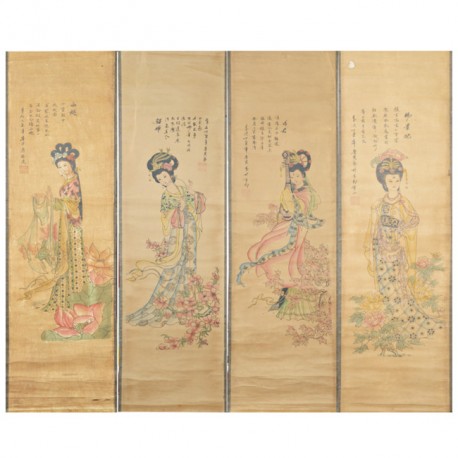
Actually, this method of naming isn't confined just to policy names. It's far more pervasive, and quite pedestrian in subject matter — We have lists for the hottest chicks of all time 四大美人 , the greatest love stories [四大民族传说] and the best Cantopop stars (四大天王).
Such coinings are not a contemporary phenomenon. You asked for the earliest incidence of such a naming scheme. I am no historian, so I can't presume to know the earliest occurrence, but the aforementioned “hottest chicks of all time” list was coined before 1500 AD or thereabouts, as an artist Tang Yin (唐寅) drew an ancient painting depicting all four hotties, showing that at the very least the phrase was already in the Chinese zeitgeist during that time.
With regard to chinese policy names in particular, take a look at these:
During the Cultural Revolution:
破四旧 — 旧思想, 旧文化, 旧风格, 旧习惯
(Breaking the four Olds — old thought, old cultures, old customs, old habits)
More recently:
三农问题 — 农村, 农民, 农业
(Not sure how to translate this one and preserve the effect)
Observe the anaphora where the first word is repeated in every list item.
Such a format is, if you think about it, excellent for political slogans/dogma. The number at the front tells you how many list items there are, and the repetition/anaphora helps you recall each item, excellent for embedding rhetoric into the minds of uneducated peasants.
I am almost certain that these slogans were deliberately constructed by the Party for maximum rhetorical effect.
To sum up, the Chinese naming scheme goes back quite a long ways, but has been co-opted effectively by the CCP.