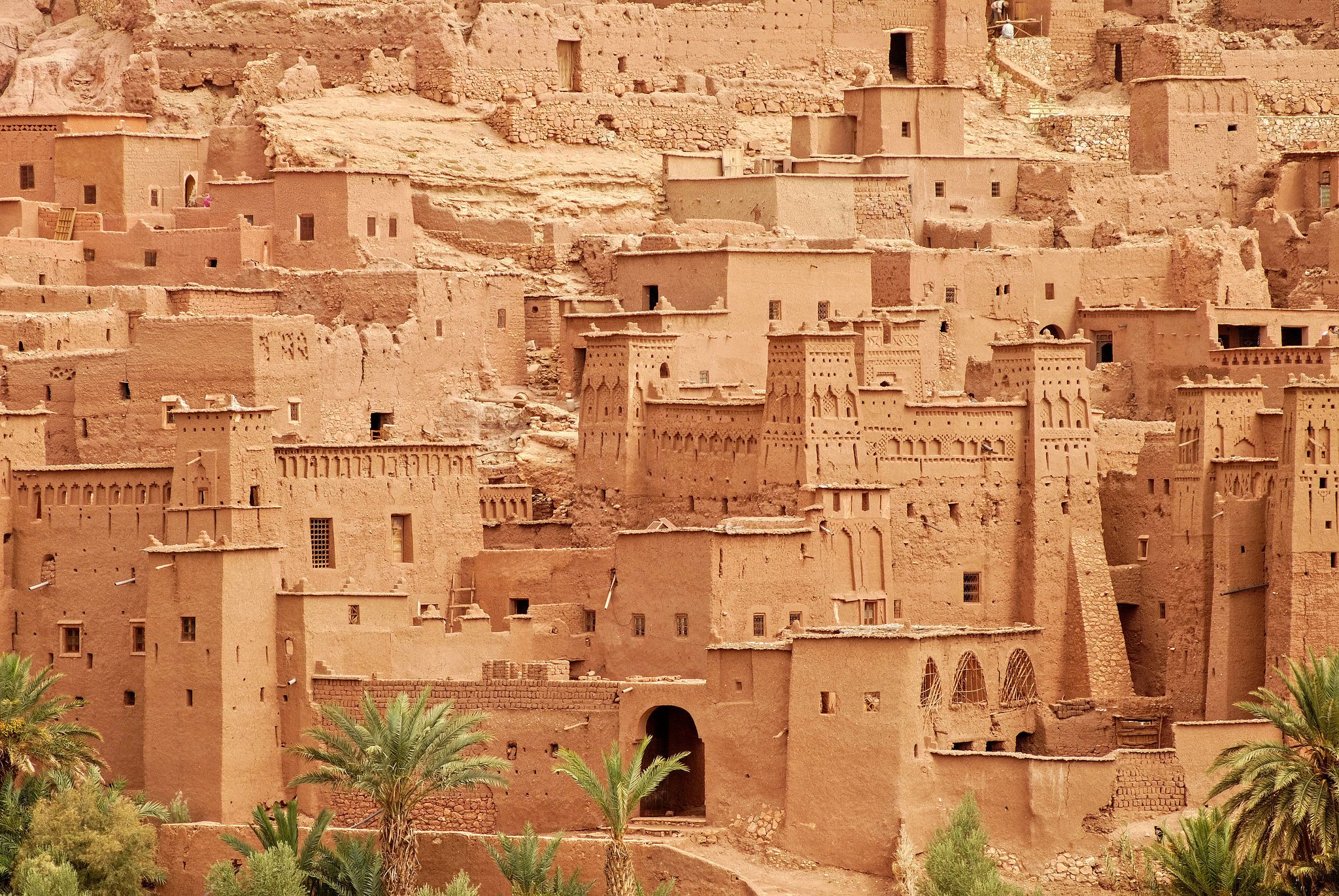
Here are some examples of some older structures from both cultures.
Southwest:
Morocco:
Here is an example of an old Moroccan structure.
Here are some modern examples
Maybe it's simply because both are dry climates, so they both end up building similar architecture naturally. But I feel there is more to it, because of Spanish influence here in New Mexico.
Puebloan and Moroccan architecture both make abundant use of adobe for outer walls. It's abundant in arid environments and is a spectacular insulating material before air conditioning. However, it has properties that make it problematic to use. Most importantly, clay is very heavy. Pure adobe walls would have to be many feet thick to stand, so it's almost always used to coat a much stronger core. The Hopi Mesas of Arizona and the city of Aït Benhaddou are both located in areas with abundant stone cover and used these local stones for the core. The American Southeast had less stone and commonly used woven nets of stick called wattle as the cores of their walls. However, the Moroccan and American styles were distinct until contact. Your example of a modern New Mexican house highlights a very important architectural feature brought by the Spanish: The arch. The arch was a very popular entrance shape in Spain and North Africa, but it was only rarely used in the Southwest before Spanish conquistadors brought it with them. The only places I can think of that make use of them are the Mindeleff Dwellings. At other sites, doorways were constructed with a supporting stone or log on top, disallowing the characteristic arches used in Morocco.
You noticed a very good point about the desert vegetation in modern American cities. Americans tend to import African plants, which are similar to native ones and more widely available to landscapers. Africans in turn have imported many American plants. The Honey Mesquite is a problematic invasive species in Africa despite originating in the Southwest.
The apparent similarities between Moroccan and Puebloan styles are largely due to convergent development in response to similar environments and material limitations. Another example of this is the generally small room size in both areas, which is a result of the size of local trees and to keep temperatures cool during the summer. Although some important architectural features were brought by the Spanish, generally the styles are distinct.