My own personal favorite axe to grind deals with the causes of the American Civil War, and the linked nonsensical "Lost Cause" myth perpetuated initially by some of Lee's subordinates in the immediate years following the war.
Proving the whole the war wasn't about slavery twaddle dead wrong takes no deeper a dive than to look at the ordinances of secession issued by the legislatures representing the states that would form the CSA. To steal from my own writing elsewhere...
(Note that links were posted rather than hard copies for ease of readers' research)
Mississippi says:
"Our position is thoroughly identified with the institution of slavery– the greatest material interest of the world. Its labor supplies the product which constitutes by far the largest and most important portions of commerce of the earth. These products are peculiar to the climate verging on the tropical regions, and by an imperious law of nature, none but the black race can bear exposure to the tropical sun. These products have become necessities of the world, and a blow at slavery is a blow at commerce and civilization. That blow has been long aimed at the institution, and was at the point of reaching its consummation. There was no choice left us but submission to the mandates of abolition, or a dissolution of the Union, whose principles had been subverted to work out our ruin."
Georgia states:
“For twenty years past the abolitionists and their allies in the Northern States have been engaged in constant efforts to subvert our institutions and to excite insurrection and servile war among us…
These are the same men who say the Union shall be preserved.
…but they know the value of parchment rights in treacherous hands, and therefore they refuse to commit their own to the rulers whom the North offers us. Why? Because by their declared principles and policy they have outlawed $3,000,000,000 of our property in the common territories of the Union; put it under the ban of the Republic in the States where it exists and out of the protection of Federal law everywhere; because they give sanctuary to thieves and incendiaries who assail it to the whole extent of their power, in spite of their most solemn obligations and covenants; because their avowed purpose is to subvert our society and subject us not only to the loss of our property but the destruction of ourselves, our wives, and our children, and the desolation of our homes, our altars, and our firesides. To avoid these evils we resume the powers which our fathers delegated to the Government of the United States, and henceforth will seek new safeguards for our liberty, equality, security, and tranquillity.”
South Carolina:
“A geographical line has been drawn across the Union, and all the States north of that line have united in the election of a man to the high office of President of the United States, whose opinions and purposes are hostile to slavery. He is to be entrusted with the administration of the common Government, because he has declared that that “Government cannot endure permanently half slave, half free,” and that the public mind must rest in the belief that slavery is in the course of ultimate extinction.
This sectional combination for the submersion of the Constitution, has been aided in some of the States by elevating to citizenship, persons who, by the supreme law of the land, are incapable of becoming citizens; and their votes have been used to inaugurate a new policy, hostile to the South, and destructive of its beliefs and safety.
On the 4th day of March next, this party will take possession of the Government. It has announced that the South shall be excluded from the common territory, that the judicial tribunals shall be made sectional, and that a war must be waged against slavery until it shall cease throughout the United States.
The guaranties of the Constitution will then no longer exist; the equal rights of the States will be lost. The slaveholding States will no longer have the power of self-government, or self-protection, and the Federal Government will have become their enemy.”
…and Texas wrote:
“Texas abandoned her separate national existence and consented to become one of the Confederated Union to promote her welfare, insure domestic tranquility and secure more substantially the blessings of peace and liberty to her people. She was received into the confederacy with her own constitution, under the guarantee of the federal constitution and the compact of annexation, that she should enjoy these blessings. She was received as a commonwealth holding, maintaining and protecting the institution known as negro slavery– the servitude of the African to the white race within her limits– a relation that had existed from the first settlement of her wilderness by the white race, and which her people intended should exist in all future time. Her institutions and geographical position established the strongest ties between her and other slave-holding States of the confederacy. Those ties have been strengthened by association. But what has been the course of the government of the United States, and of the people and authorities of the non-slave-holding States, since our connection with them?” (3)
Some of the states beat around the bush a little; others understandably spent time sharing why they felt they had the right to independence. The core underlying commonality was that they indicated that the root cause of session was, after all, slavery; and their unwillingness to surrender slavery as an institution. Their motive to want to keep slavery is as clear as it is potent– no matter how empirically wrong holding another human in bondage is.
And honestly. The war was surely about one “States’ Right” — the presumed right to hold slaves. Any attempt to paint it as anything else is pure, unadulterated hogwash. The common Confederate soldier may not have owned a single slave in his life; but he was most surely fighting the cause of a man who did, and no amount of wishful thinking or revisionism will truly change that fact.
—
(1) Source: http://www.measuringworth.com/slavery.php
(2) Source: http://www.learnnc.org/lp/editions/nchist-antebellum/5347
(3) Source: http://sunsite.utk.edu/civil-war/reasons.html
Edit: Stupid formatting. Trying to make it not suck.
Assuming you're coming at this from a US school perspective, African History is generally pretty horribly neglected. Pretty much any period could do with more coverage but I would recommend covering The Scramble for Africa (the fancy name for Europe carving up Africa into distinct national zones from c.1880-1910). This is partly because I just read Pakenham's very engaging book (cleverly titled The Scramble for Africa) and the fact that I never learned about it in school is really burning into my brain. There are a few reasons why I think it's worth covering in more depth:
The scramble is interesting and features some really big and exciting personalities. If you extend the period a bit (like Pakenham does in his book) you can include Livingstone's expeditions as well as the rise of the Zulu at the very start of the period. You then have Gordon's last stand at Khartoum, the horrors of the Boer Wars, King Leopold's basic evil nature (and, you kind of have to admit, his horrible political genius), and the eventual end of Otto Von Bismarck to name but a few.
It really sets the stage for future history. The Scramble and the politics around it are a great way to show students how Europe changed from the Napoleonic Wars to World War I. Many of the treaties and politics of the Scramble set the stage for World War (although by no means exclusively so). That said, you should avoid neglecting African politics to just talk about Europe, although given most US curriculum that might be hard.
One benefit I think is kind of huge (and noticed myself reading Pakenham) is that the borders set in the Scramble are very similar to the borders of the nations of modern Africa. This is a great way to combine history and geography, by learning about these events students can get a better grasp of where African nations are now (something I know my school didn't teach, and many others seem to neglect as well). They shouldn't get confused about why there are two different countries called the Congo anymore, either. Or why Gambia is entirely within Senegal except for a small bit of coast.
European nations dividing up Africa between themselves and the horrors of Colonialism that went with it (and preceded it...and followed it...) are still really relevant in making Africa the way it is today. While a lot has happened since, and it would be a mistake to discuss African history solely in the context of things White people did and thus deny them their own agency, these events are still really important and I think too often fall out of sight in many people's conceptions of history.
Also, if they're reading Heart of Darkness in English (or going to in a later year) having a good understanding of the race for the Congo and the horrors that Leopold oversaw there really helps.
That's just my 2 cents anyway. Totally outside my area of expertise, so hopefully I didn't make a fool of myself!
I highly recommend dedicating some time to the history of the Pre-Columbian Americas. Take a week, if you can. Take 3-4 days. Heck, take a day, that's more than I got in high school. It's 6000 years on two entire contents, and this is all that textbooks ever have on them. Between 6 textbooks, I could find one crappy paragraph that even acknowledges that people existed in South America before 1300. So do yourself a favor and expose your kids to some cool stuff. And let's be real teenagers dig this kind of stuff:
Chavin de Huantar was the center of the first pan-Andean religious/culture phenomenon starting around ~3000 years ago. The main temple at the site is an intricate labyrinth of secret passages around a monolithic oracle, straight out of Indiana Jones. We know that priests would use the highly psycho-active San Pedro cactus before entering these pitch-black chambers which were surrounded by the rushing water of a diverted river and even secret-er chambers for other folks to hide in and make all kind of unearthly noises with trumpets and the like- combining sounds, drugs, and psychadalic art (that's different pictures when upside down) to create an other-worldly experience.
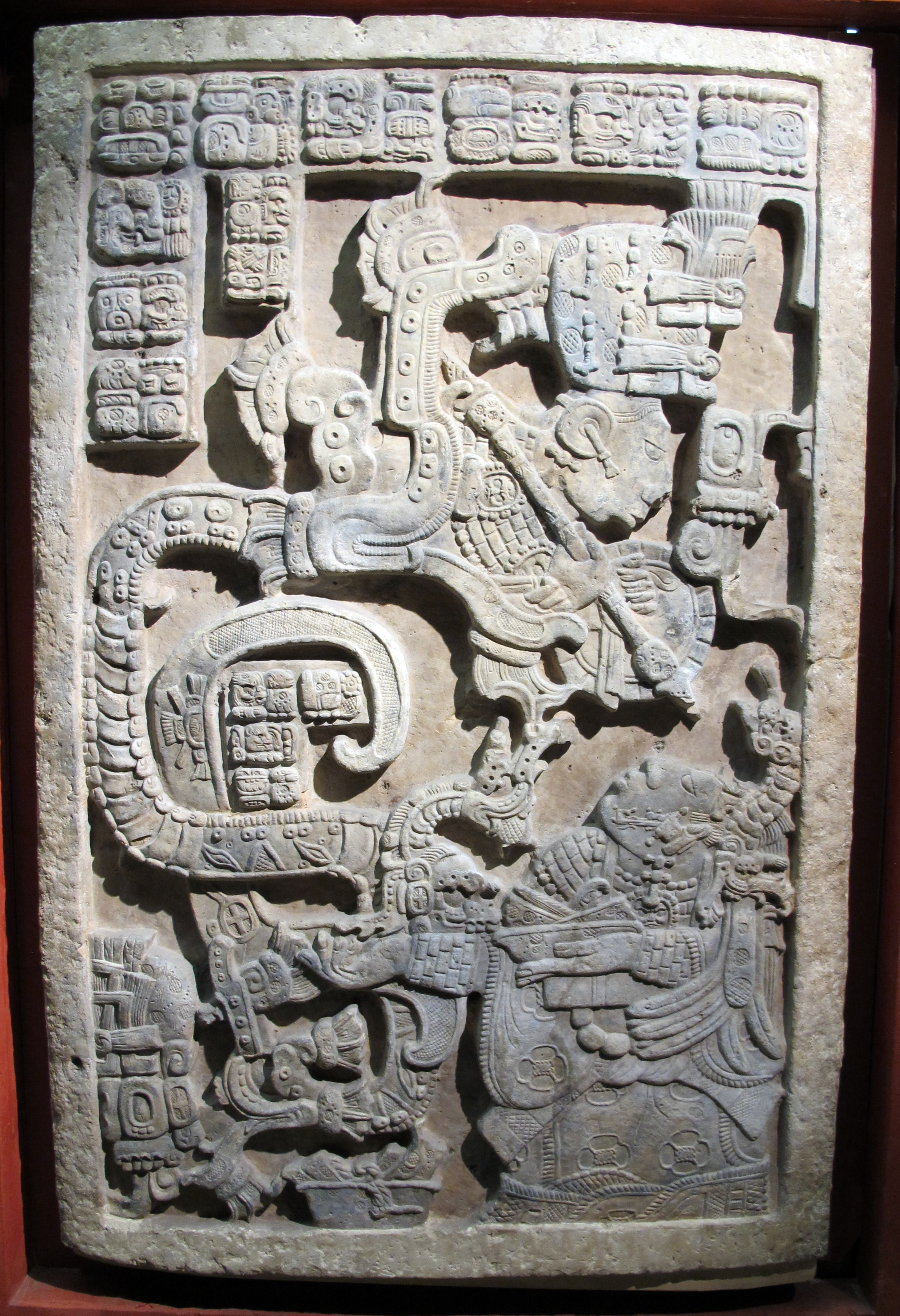
Everyone loves the Maya, so why don't you talk about summoning ancestors through blood ritual or everyone's favorite food chocolate. Of course, Mayan hieroglyphs and mathematics are also a viable starting point....
I could go on and on. In all seriousness, I recommend checking out some flaired user profiles to get an idea of interestings topics to cover: Qhapaqocha or mine for Andean stuff, Mictlantecuhtli or 400-Rabbits for Mesoamerica, and rioabajo or anthopology_nerd for North America. This can tell you what kinds of things people are asking about. As for resources, you can check out our book list. If you want something cheap, you can get Michael Coe/Stephen Houston's The Maya (8th ed.), their Mexico: From the Olmecs to the Aztecs, and Cities of the Ancient Andes used on Amazon for less than 10 bucks.
I like the sound of misconceptions, which are often things that interest people which is why the myths go "viral": perhaps a quiz to find who knows what, then go through them to show that there's stuff to know and we shouldn't just believe anything we hear: Just a few I like: Vast slave armies built the Pyramids; Columbus proved that the Earth was round; The Boston Tea Party was against new taxes. There are of course countless more. Others may have their favourites.
The Haitian Revolution doesn't get anywhere near the attention that it should (I've been guilty of this myself). It is the only revolution in the Age of Revolutions that substantially challenged the racial hierarchy of the period, and was the first distinctly black nation in the New World. White Southern reaction to the Haitian Revolution helped create the attitudes that led to the Civil War.
What time period?
As an American Student, I loved hearing about everything happening at the same time as the American Revolution outside of the USA.
The French Revolution being a bigger deal for the major powers at the time than the American Revolution. And being a huge deal in general. I can't recall the significance of the French Revolution ever being stressed while I was in (American) high school. It was mostly something along the lines of "And the scrappy American forces shocked the world by beating the dastardly redcoats. Oh, and the French had a revolution too, a couple years later, and they cut some heads off." Now, this is my experience and hopefully this was not typical. Just in case.
The more interesting the better, they are teenagers after all.
My APUSH teacher loved to mention Cher Ami once we reached WWI.
I thought it was a fun little thing to learn about, because we so often think it's humans that are the center of history when many times an animal can have just as big as an impact. Like when rabbits reached Australia, and so on.
She carried the message
We are along the road parallel to 276.4. Our own artillery is dropping a barrage directly on us. For heaven's sake, stop it.
then
As Cher Ami tried to fly back home, the Germans saw her rising out of the brush and opened fire. For several moments, Cher Ami flew with bullets zipping through the air all around her.[3] Cher Ami was eventually shot down but managed to take flight again. She arrived back at her loft at division headquarters 25 miles to the rear in just 25 minutes, helping to save the lives of the 194 survivors. In this last mission, Cher Ami delivered the message despite having been shot through the breast, blinded in one eye, covered in blood and with a leg hanging only by a tendon.
One of my college professors had a great lecture about Cortez that should work well for high schoolers.
Most of them might know the name but most narratives focus on him being a slash and burn conqueror. However, the professor focused on the Spanish background - young men raised to fight a holy war that had been won on the eve of their adulthood - and juxtaposed that upon the realities of the natives they discovered in the new world.
Also, Cortez was kinda crazy so that always makes for good story time.
One thing would be to take things ten years at a time and look at other continents. 1492 columbus was sailing to the americas. What was going on in South America? What was going on in Japan? What was going on in Africa?
Keep moving forward in this way to get a world view understanding.
Another option could be to link ISIS with past arms in how they used terror as a weapon of fear and control. How vlad the impaler impaled 50k ottoman soldiers. Or how the Mongolians used terror to control a vast lands like the pyramids of heads in india. Of Chinese warlords who had prisons commit suicide in front of their enemy. Etc.
The world glosses over the evils of man has done and think these leaders were strong people. Also they forget the rest of the world was just as cruel as europeans.
This happened to my brother, so please please PLEASE don't teach incorrect facts about WWII. He was taught that we dropped the bombs on Japan, AND THEN Japan attacked Pear Harbor. Terrible.
If you're in the states, try to cover The Province of Quebec's involvement in the American Revolution. I don't know if this is typically taught, but I don't even meet many Canadians who were taught that.
Something that gets overlooked all the time is history between the fall of the Roman Empire and Columbus outside of Europe. It's good to put into perspective how unimportant Europeans and the "ruling white man" were merely hundreds of years ago.
Do kids these days really know enough history to believe in discredited myths? Part of me suspects they're almost blank slates.
In terms of events, you can't understate the importance of the Columbian exchange; you could have them draw up a list of their favorite foods, and cross off the ones that would never exist without New World/Old World ingredients. Hew out some figures of its effect on population growth, and divide the class into people that would and wouldn't exist without it, or what percent of the class would die if they were Native Americans first exposed to Eurasian diseases.
I always thought the 60s counterculture was interesting when in highschool
I believe that we start at the rise of the empire. We go on the assumption that they learned earlier world history in middle school. When I taught it before we started with Mary Leakey discoveries and homo habilis, erectus, sapiens etc. The curriculum has changed, which is a huge mistake in my opinion. Most kids retain very little from middle school. Unfortunately, I have little leeway in what I cover.
I never learned this until later in life but partition of India and Pakistan it's one of the most interesting stories about the fall of colonial powers after ww2
This may be a bit too far back but everyone loves Vikings. I took a class in college that was from human beginnings to the end of the Middle Ages and I learned so much about Vikings that I had never known before, mostly that most Vikings didn't really rape and pillage as much as everyone thought they did and they were super respectable to women and children. Heck women fought alongside men half the time.
New Zealand sent 10% of their population in WW2. The most IIRC of any allied forces per capita
My personal pet peeve is "people didn't smile in early photos because photos took 3/5/10/20/60 minutes to develop". This post explained better than I could.
Don't forget the various Islamic Empires, such as the Abbasids, Ottomans, Mughals, and Safavids. There's a lot of fantastic art and architecture left behind by those groups, plus they had interesting political structures. Suleyman is a great contrast with European kings from the same time period. Of course, make sure you address how Greek and Roman science and philosophy was saved by Muslims, who reintroduced it to Europe during their occupation of Spain (Averroes is an important Islamic scientist in pre-Reconquista Spain)
Many young people seem to believe that American colonists 'invented' slavery, and do not understand that slavery was an institution that goes back to the earliest civilizations and was practiced by nearly every major state/empire that had existed up to that point. At the same time, it seems clear that when the first English colonies were established in North America, there was initially no intent to build up a slave economy. Once the tobacco craze began to take off and the colonists realized both the profitability of tobacco and the need for a cheap labor force to maintain that profitability, they quickly decided to draw upon the same source of labor as their illustrious forebears.
Sybil Ludington did the same thing as Paul Revere, at the same time, only difference is she was sixteen and she went forty miles as compared to Paul's twenty...
OP is a public school teacher and is limited probably by the standards of the state he/she teaches in. As an old history teacher I usually had small constructs of historical figures and/or events to help stimulate student interest and maybe develop some critical thinking. Unusual facts of people and/or events worked generally well For the Byzantium empire I found Theodora, wife of Justinan to be an excellent example. She was a child prostitute before becoming queen and is generally considered to be Justinian's 'better half'. During a particulalry nasty civil strife period (or war) she organized two factions (the Blues and Greens) into the local stadium unarmed where she then had the army march in and slaughter them to the man (http://www.smithsonianmag.com/history/blue-versus-green-rocking-the-byzantine-empire-113325928/) BTW - Justinian was just thinking of running away. For the Renaissance I would talk about how the painters would develop their colors of paint - I don't have the link handy but yellow was made from concentrated bovine urine force fed certain foods. The materials were extremely toxic - royal purple came from a snail. For Davinci I would essentially call him a ghoul who would dig up dead bodies he could later dissect and study (http://www.artcrimearchive.org/article?id=88001). Also Martin Luther presumably decided to become theologically active after being struck by lightning where he exclaimed to God he would serve if surviving (http://www.luther.de/en/blitz.html). Makes one wonder if this event had not happened. It is also presumed - don't have a link handy that the Gutenburg Press was developed at just the right time for the 95 thesis spreading from it's initial copy on the church door. For the Age of Exploration I would discuss how Magellan actually was dead long before he successfully circled the globe. He was presumably 'pickled' in a barrel or casket of rum so he could be properly buried back home - wonder if anyone had the nerve to drink the rum later? (http://www.history.com/news/ask-history/was-magellan-the-first-person-to-circumnavigate-the-globe). Obviously there are many other interesting tidbits to catch young students' attention. One of my favorites was WWI and the rise of large artillery. The Big Bertha was a howitzer developed by the Krups company (yes the same one) and named after a rather large and supposedly mean daughter of the founder. How is that for a legacy? The guns destroyed the supposedly impregnable fortresses around Leige with just a few rounds (https://en.wikipedia.org/wiki/Big_Bertha_(howitzer)). To help develop how big these cannons were I would draw the circumference using chalk and a string on the blackboard and have student stand near them - yes I am that old. Good luck OP - I miss my high school teaching days and genuinely loved when I hooked students. It is a noble profession despite the political winds today.
Edit - new to uploading and deleted my first post - please bear with me as I am more a lurker than submitter
Willing to get fired? I joke, but I remember The Nadir of Race Relations being cited as one of the least-taught topics in high-school American History classes. And I think it's an important topic; even if it had no contemporary resonance, it would be valuable to puncture the myth of "continuous progress" that's built into nearly all high school history textbooks.
But oh, boy, are you risking one heck of a backlash if you teach it.
Edit: Somehow I missed that you said world history. My bad. Does the course include anything on World War I? When I went back to re-study the issue, I found that I really wished I'd had at least a thumbnail history of the Ottoman Empire when I was in school; similarly, when I went back to re-study World War II, I was boggled by how little it turned out that I knew about the Spanish Civil War.
I would be sure to try to mention the importance World War One played in the role of how history turned out. It was really, in my opinion, that war which started the events that led up to world war two. WW1 was devastating and if you think about it, changed the geography as well as history. Another person or persons I would be sure to maybe go into detail about is the Khans and their conquests.
Edit: Spelling.
How about the fact that three of the five staple crops the world now depends on (maize, potatoes, and cassava) were developed in America between six and ten thousand years ago? There are interesting visuals available online showing the difference between teosinte and maize, which would also give you an opportunity to talk about selective breeding (and even to have students compare/contrast this breeding with creation of GMOs).
If you're going to mention medieval European History it's good to note that the image of a society in complete depression, living in filth, fearing god and focused on death was perpetrated by a Dutch historian named Huizinga, who wrote a very influential book on society back then. When he wrote that book, his wife had just died and he was depressed, which he channelled into his book. This is why we have such a dark view of the period. Think the book was called 'The Autumn of the Middle Ages'.
Talk about Africa and South America. Show them that clip from the West Wing about map projections and start a dialogue about why "world" history classes are so focused on Europe, the US, and (sometimes) China. I don't know about your textbook, but when I was teaching high school world history, there were two chapters devoted to to the French Revolution and only one page on the Latin American independence movements.
It changed the tone of the entire class when I started the class by talking about something other than Europe. I don't know how far back in time your curriculum goes, but mine was supposed to start at 1450, so the first few weeks were devoted to a World Fair project--I broke the class into seven groups (Southeast Asia, South Asia, Middle East/North Africa, Europe, Central America, West Africa, and South America) and each was in charge of presenting their region's accomplishments and recent history. It was a fun way to broaden their perspective while getting them some practice in historical thinking skills. By framing it as a research project, it allowed me to go way beyond the Euro-centric state standards by passing it off as a skills-based exercise.
I also recommend taking a few weeks at the end, if testing/standards allow, and let the kids choose from a few contemporary topics (I let them choose from technology, terrorism, economics, art & music, food and resources, environment, and something else I can't remember right now) to allow them to explore how global their lives are now.
I would personally talk about colonialism. Obviously the old vanguard, specifically US history portrays it in a bit of a white-washed manner and underplays systemic violence and ethnic cleansing. However, nowadays I often hear more loudly and loudly from more progressive/liberals a white apologetic version. Which essentially claims "the world is fucked up today because of white Europeans, and every problem in Africa, Asia, Latin America is because whites caused it by colonizing them". Beyond this being an utterly simplistic view, I find it exceedingly guilty of Euro-centrism (which it claims to correct) and of course so many errors. I think taking a look at colonialism is a great way to learn world history. I think it would extremely beneficial to look at the different methods and means to colonizing, when and how different regions were colonized. The differences in administering them, why they were successful or failed. Independence and nationalist movements. There's so much nuance and detail to the subject, and I think the current progressive paradigm "white Europeans fucked everything up now these countries have so many problems it's white peoples fault" is just completely insufficient in every manner to approaching the situation and learning about colonization and its effect on the world, which is most certainly felt today.