This coin was given to me as a birthday gift from my dad close to ten years ago, ever since its been knocking around the house, of late I've been wondering where it came from and how it got to a forest just outside of Kabul. Any thoughts are welcome.
The empires of Alexander and his general Seleucus extended to Afghanistan, so it would have been a regional currency. It seems less refined than other issues, so it may be a local reproduction - that doesn't mean it's not a genuine old coin, though - designs of established denominations were often re-used locally. Whatever its origin, it's from your dad, it came a long way and it's nice to have.
First, there are a couple subs that are better-suited to this question. /r/AncientCoins jumps most readily to mind.
As others have said, it's probably a replica, given that it has any edges at all. Ancient coins, when they do survive, tend to wear down in such a fashion that they resemble a flattened m&m, and don't retain square edges. Not to mention that even in great condition, they are rarely round; the way they were made means that they are irregularly shaped in the best of circumstances.
That being said, Alexander and his army's romp through Asia left Greek culture and rulers just about everywhere they went, and a number of those kingdoms survived for a good while after he left. In the area we now call Afghanistan, there were the Greco-Bactrian kingdom and the Indo-Greek kingdom.
Okay, I did a bunch of digging and am 95% sure that it is a Baktrian coin. Now the hard part is to figure out who the ruler is. One clue that I noticed in Baktrian coinage is that they initially have no text on the obverse (heads) side of the coin but this changes later on as the Baktrians move into India and the obverse side starts to get text because the reverse side will often have aramaic(I think) texts. Being that this coin doesn't have any text, it narrows the number of rulers down (probably before Eukaritides I). Paging /u/XenophontheAthenian : can you read and translate the bottom title on the reverse side of the coin? I think it translates to "PALLTOU." That title will probably be the thing I need to figure out who the ruler is.
OP: Do you know the size of the coin? It looks like it may be a copy of a drachma, and that can help narrow it down.
what's important to note is the edges of the coin. If there looks to be a seam around the circumference of the coin or if it looks like there were any filing marks it's the easiest tell-sign that these are duplicates made from a mold rather than the real thing.
The most reliable way to find out its history and value is to take it to a pawn shop or find somewhere in your area that specializes in coins/jewelry and the like
I am not going to comment on the authenticity but I have decided it is if not a genuine Bactrian coin, then at least based on one. I do not believe it was minted by Bactrain Greeks in which case there are two options, modernish counterfeit or ancient imitation. Do not confuse an ancient imitation with a counterfeit, the coins were used as legal tender and were closely of the same intrinsic value as 'originals' the imitations are just produced by local mints without the quality of larger mints.
I have come to this conclusion based on two things, like /u/tobymoby616 pointed out Bactria and other places ruled by ancient Greeks (Syria, Turkey, Egypt) are notable for the lack of words on the obverse of coins.
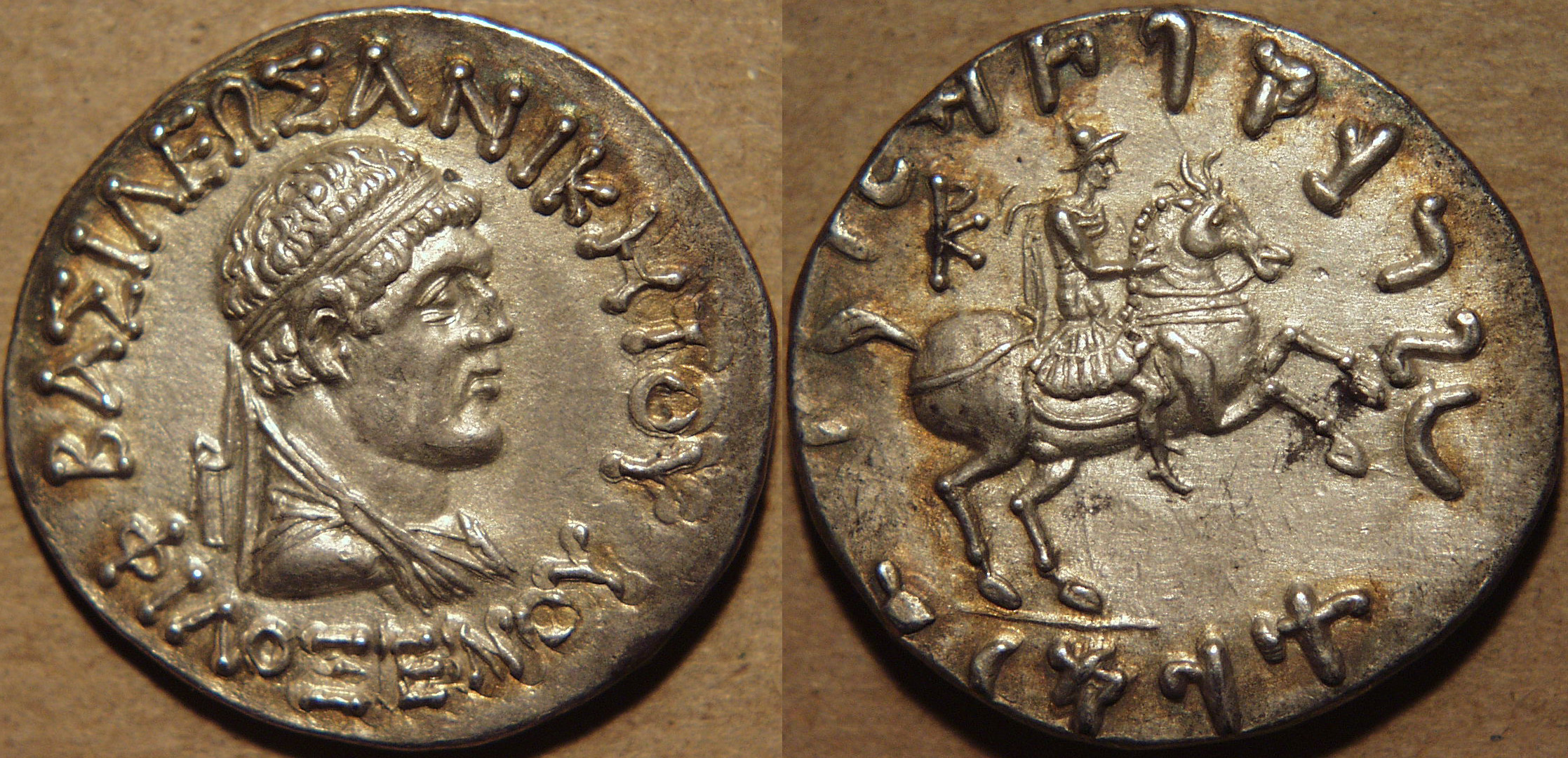
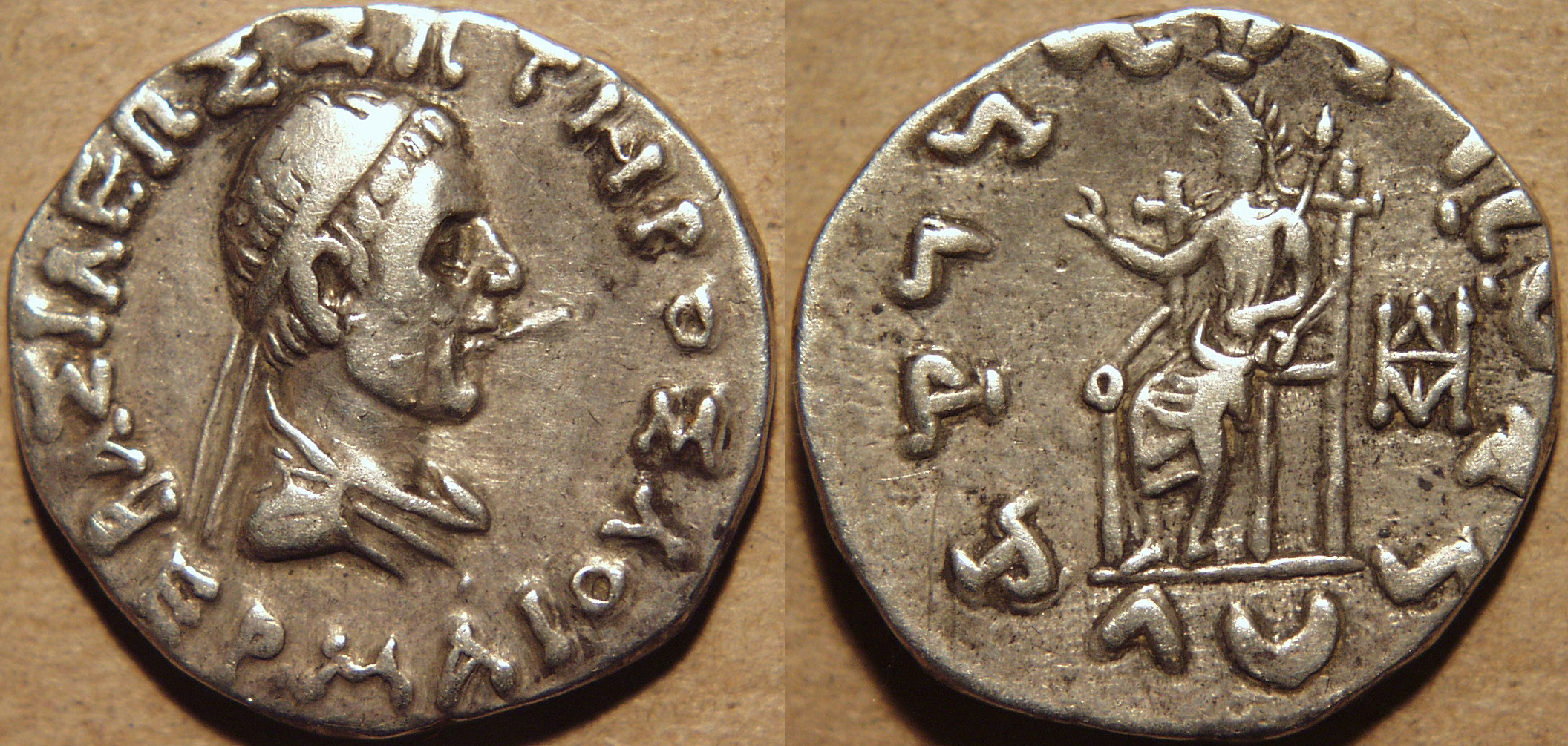
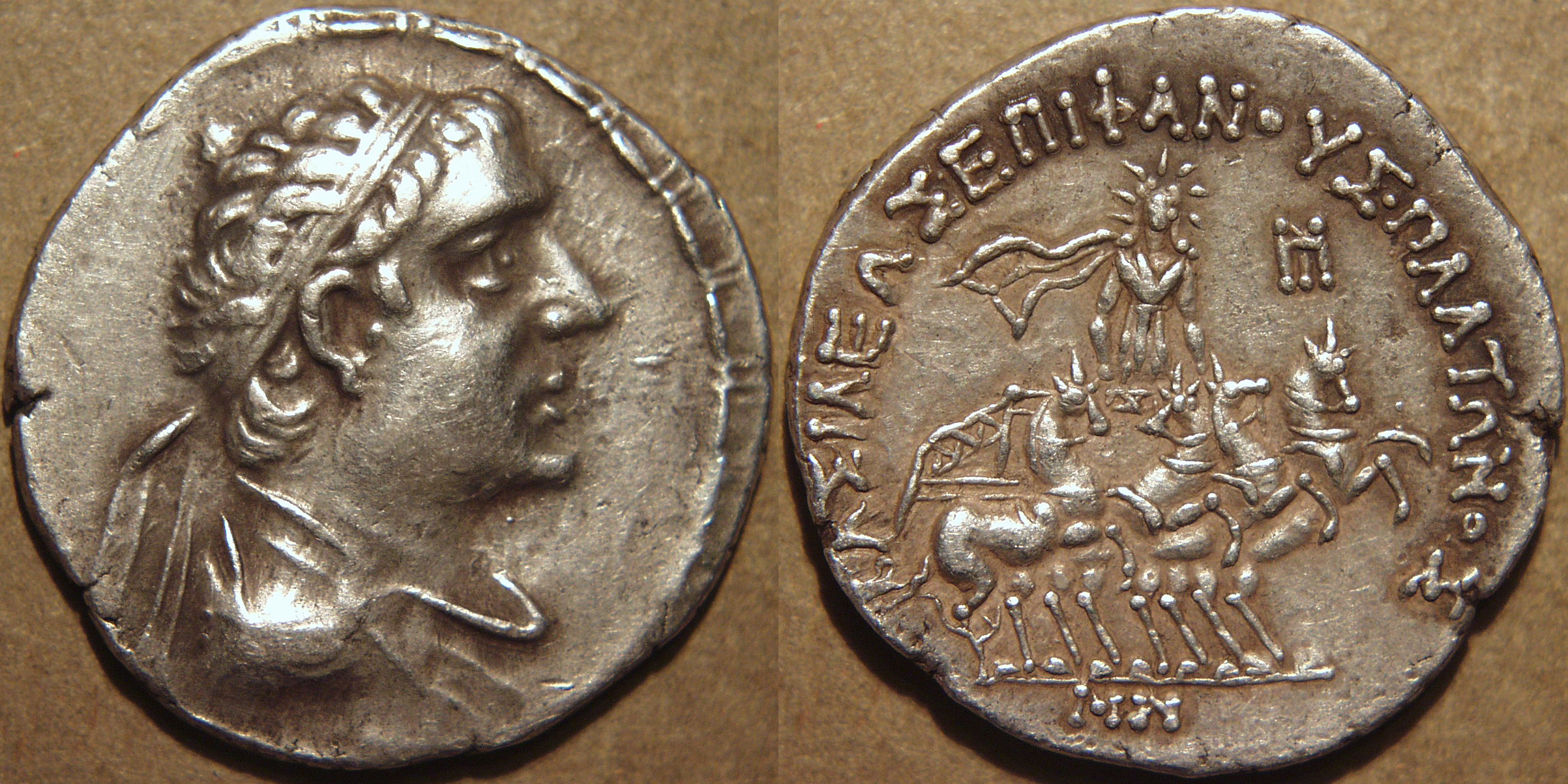
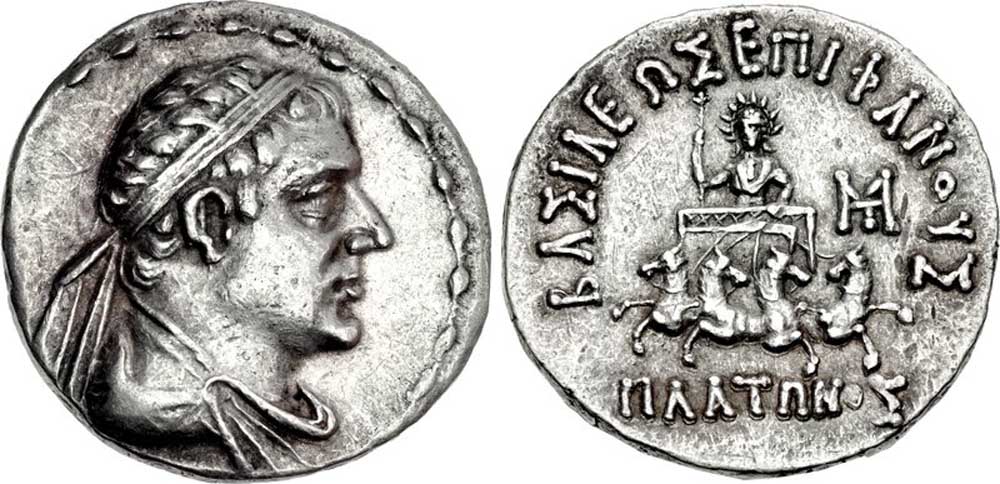
There are three main aspects that as a numismatist I am looking at the hair style/head ornaments, the text on the back and the quadriga. The text on the back on the bottom is a straight horizontal line and not curved around the edge like the lettering at the top. Here are three Bactrian coins with that head ornament [Philoxenus (about 125 BC),] (http://coinindia.com/MIG0338a-136.40.jpg) Hippostratos (about 70 BC) and Hermaios (about 20 BC) but none have the horizontal text, text like that is usually associated with the Romans but two Bactrian rulers did mint coins like that Eucratides I (about 150BC) and Plato (his son) but notice on both of them the W/M/other looking mintmark not present on OP's coin.
this one and this one are the closest I could find both minted under Plato around 145-40 BC. It matches up with a lot of important aspects head/hair ✔, text line ✔, quadriga ✔, but yet it is not same coin.
TL;DR I'm going to say was minted as an imitation under one of the nomadic invaders later based of an earlier Bactrian coinage designs. Of course pending a translation which would tell more definitively what exactly this coin is.