I answered this question Here about a year ago, and I feel much the same now as I did then.
But to give a brief summary, Ulysses Grant and Robert E. Lee were radically different in temperament, background, and supporting officers. Lee was firmly a general of the "Old School," he was the best practitioner of Napoleonic Warfare since the Corsican himself. Lee's major battles, and especially Chancellorsville, were essays on Napoleonic warfare. He was good at doing what he did, and I would argue (contrary to boneyabba's analysis) that he did it throughout the entire war.
Grant was equally talented, but was his own man. Unlike Lee, Grant never practiced an especially Napoleonic style of warfare (although Grant was trained the same way as Lee, based off the writings of the Baron de Jomini as interpreted by Scott and Halleck). Grant was tenacious, aggressive, and unrelenting. Once he set his sights on a target, Grant relentlessly pursued his objectives to the very end, often much further than his opponents were willing (or able) to go. But, contrary to what many neo-Confederates would say, I would argue that Grant was not a butcher, or one dimensional. Rather, Grant was dedicated, and would not turn back as did McClellan, Hooker, and Burnside. Further, Grant's battles outside Vicksburg prove that he was able to use maneuver to destroy his enemies.
The Overland Campaign is the famous matchup of the two greatest Civil War generals. Grant and Lee both played to their own skills, and their unique approach to warfare. Lee tried repeatedly to smash Grant's army as he had to every other enemy he faced. In the Wilderness, Lee attacked the Army of the Potomac in nearly the same place, in nearly the same way, and to nearly the same effect as he had attacked Hooker the year before. And many in the Army of the Potomac thought they should withdraw as Hooker had done. But Grant was made of sterner stuff, and never liked to go backward. Instead of falling back on Washington, Grant tried several times to turn Lee's flank and force him into an open and conventional battle. Lee was able to counter these moves, but just barely. In the process, he took heavy casualties and was often forced to fight defensively rather than in his customary offensive manner.
In that process, Lee and Grant were pretty evenly matched. Had he better managed his other peripheral offensives (like at Bermuda Hundred, Mobile, and Shenandoah), Grant would have probably destroyed Lee through sheer attrition. But Lee was able to reinforce his army and maintain his original strength. But, rather than keep plugging away with little flanking maneuvers, which Lee would surely parry again, Grant opted for a larger maneuver against Richmond and its supply lines through the city of Petersburg. By threatening that critical point, Grant forced Lee to stand and fight. There, Grant repeated the Siege of Vicksburg, and destroyed Lee's Army. By 1865, Lee was short of food, supplies, and men. He barely had enough to hold his lines outside of Petersburg, and once he abandoned the city, Lee barely even held his army together. Ultimately, Grant's persistence, aggression, and simple tenacity succeeded in beating Lee, in conquering the unconquerable.
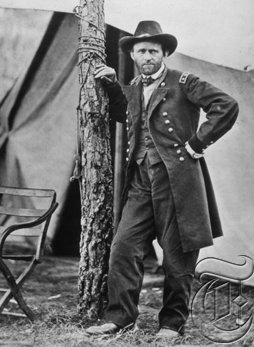
So who is better? I couldn't really answer that. It's like comparing apples to oranges. Grant ultimately beat Lee, but often times Lee gave as good as he got. And some historians argue that Illness and incompetent supporting officers squandered a few opportunities which must have finally beaten Grant (I disagree). I have a lot of respect for Ulysses Grant, for what he stood for, and for him as a man. He is perhaps my favorite general, and one of the greatest Americans. I have a framed photo of Grant I see every day. Perhaps that makes me biased. But the honest truth is that both men were the best of the peers, and some of the sharpest military minds every produced by the United States.
Sources:
Russell Weigley, A Great Civil War
JFC Fuller, Grant and Lee
Gordon Rhea's four volume history of the Overland Campaign
To add a bit they may not be so easy to compare. Grant for instance was an early practitioner of amphibious warfare (often ignored although McClellan did too) and promoted extension collaboration with the navy while in the West. He was somehow reluctant to come east once made General of the US Armies, I always had the feeling that he liked the open space and maneuvering and his campaigns in the west may be good examples. Grant had a plan to put out the Confederacy, a strategic one, the only up to that point to apply pressure to the Confederacy in the East and make that theater collapse. It did not work out well due to poor coordination and I think bad generalship by his subordinates to execute it, but it was a good plan and only the Anaconda Plan predates this. As mentioned by /u/BeondTheGrave he would not let it go and was relentless. I do admit that the frontal assaults in Cold Harbor were probably unnecessary but it's quite difficult to put ourselves in his mind frame at that particular moment.
Lee was no doubt a brilliant tactician and quite intelligent reading the enemy intentions, he knew very well how much pressure apply to the Army of the Potomac and was in most cases a couple of steps ahead of his counterpart. By contrary Lee never seem to have had an strategic approach to the whole war beyond his area of operation in and around Virginia. True that Jefferson Davies did ask Lee for this, he would put Lee in command of the Confederacy armies late in the war but too late to have any effect. So we always see Lee planning for the Army of Northern Virginia, that was his responsibility, and somehow it was expected that Southern victories and exhaustion of the North on both its politicians and public opinion would let the South prevail. Remember that the South need not to win, just not to loose. This does not mean Lee may have not had a strategic plan if it was required but it never was made his duty as I see it.
Both seems to have been comfortable in the geography they knew best, Lee in Virginia and Grant along the Mississippi river. Lee was not keen to go to the West and Grant just came to East because he had no chance I think.
Finally consider that they would only face each other in the last phase of the war, yet people tend to keep comparing them like they fought each other always. See what each did prior to that encounter and the sort of campaigns they had to fight, consider weather, geography, supplies, manpower and a key piece of data what sort of adversaries they faced. McClellan, Burnside or Pope were no match for Lee, Hooker may had stood a chance to knock out Lee but failed. Grant, I think had superior generalship over his adversaries in the West too in my humble opinion. It was when Grant found Lee and Lee found Grant that the whole thing got to a new level, although at that moment I think the Confederacy was mortally wounded already. I agree with /u/BeondTheGrave that the peripheral offensives should have been better managed. What if Sherman was in command of the Southern attack towards Petersburg? PT Beauregard would have probably gave way not unlike the famous what if Jackson was there at Gettysburg on day 1? What if is all pure speculation and it happened what it happened.
From my perspective I tend to have Grant slightly over Lee for his ideas in joint warfare and strategy, that is the ultimate goal of a general in my opinion, I know there are politicians, civil power etc that shape decisions, but in ideal world. Lee never got to experience that for a number of reasons. Again in my humble opinion.
Edit: typos.