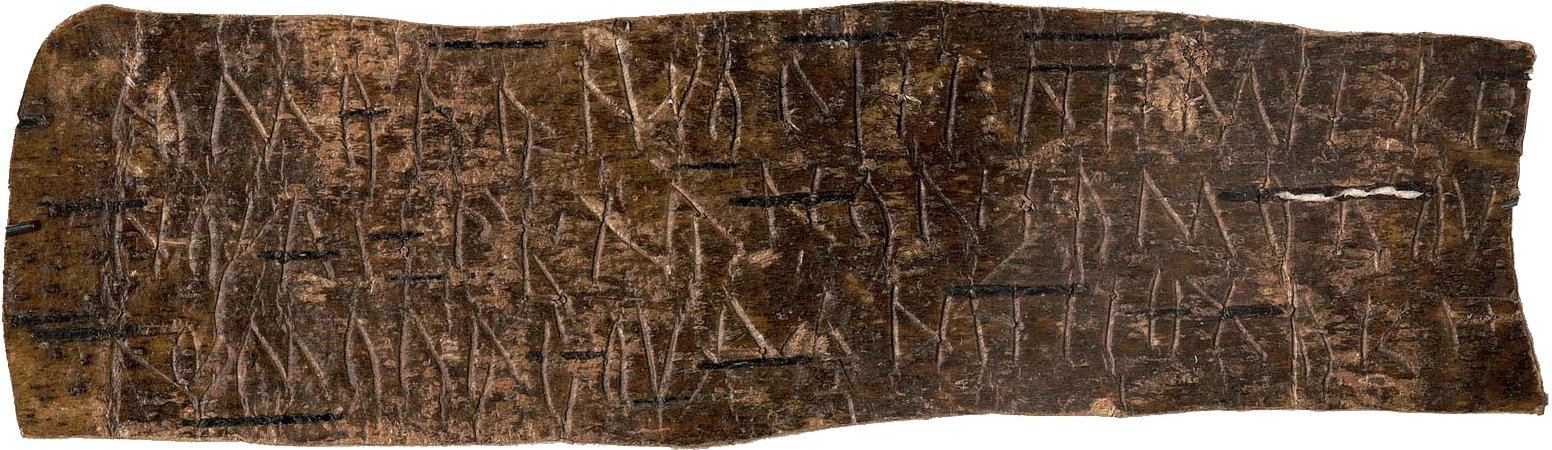
How far back can we go? Which came first the chicken or the scratch?
Edit: so I started this thread before a 8 hr drive, definitely came back to a wealth of information. I'm glad I wasn't the only one interested in this question. Thanks everyone!
Although early Russian history is at the periphery of my studies at best, the birch bark documents found near Novgorod come to mind. They aren't really "ancient" but they are some of the oldest documents we have from that area (13th century). The people there wrote letters, poems, all sorts of things, on birch bark that ended up being discarded or otherwise ended up in the ground. The soil ended up being a great environment for their preservation. I was there in 2009 and got to see some of them in person.
https://en.wikipedia.org/wiki/Birch_bark_letter_no._292 for some information on it. Using wikipedia here because it happens to have copies of many of birch bark documents from Novgorod.
There's an example of this in the Assyrian State Archives, which is a collection of cuneiform documents from the Neo-Assyrian Empire. The text of the tablet (SAA 15 017) is actually quite short:
To the king, my lord: your servant Sîn-na'di. Good health to the king, my lord!
I have no scribe where the king sent me to.
Let the king direct either the governor [o]f Arrapha or Aššur-belu-taqqin to send me a scribe.
/u/Daeres covered this on the AskHistorians Podcast Episode 19 (relevant bit starts around 34:23), but the gist is that message itself was rather crudely formed and contained spelling errors, to the point that decipherment was difficult. The importance of the crudeness of message is that it both showed that literacy was, to a certain extent, present among the upper class, but that they were not so literate as to dispense with professional scribes.
As a hobby genealogist, I see MANY poorly written documents. This one is maybe only 7/10 in terms of legibility. I've seen worse.
https://dl.dropboxusercontent.com/u/91759524/Peter%20Gellert%201735.jpg
I know this isn't exactly what you're looking for, but the handwritten manuscripts of Beethoven are almost comically illegible. Here's the first page of the Waldstein Sonata. A page from the 9th Symphony. And apparently this is from the String Quartet Op. 131, though how anyone figured that out is beyond me. His copyists had their work cut out for them and Beethoven was notoriously harsh on them for printing mistakes. He wasn't a very reasonable fellow.
Compare this to the even hand of Antonio Vivaldi and the artistic curves of Bach.
By and large ancient texts are very much unlike what you think of. They're sloppy, with misformed letters, confused spellings, and because of the price of paper they generally contain an ungodly amount of text crammed into as small a space as possible. We don't have anywhere near as much genuinely ancient material as we'd like (most of our ancient texts are medieval copies of course, which have similar, usually far worse, problems), but between surviving papyri and inscriptions we have a fair sample size. Inscriptions, not surprisingly, tend to be much better than papyri. Even then, however, you find all kinds of problems. Greek inscriptions in particular are confused and often quite messy, particularly those of the Archaic and Classical Periods, when orthography and scripts were not yet standardized--in an inscription from c.400 in Athens, around the time of the introduction of the Ionic script, you might find several scripts being used inconsistently, spelling errors, sloppy carvings, and misshapen letters. Latin inscriptions are usually somewhat better, but even then you find inconsistency in the abbreviations, orthographical errors, mistakes sloppily remedied, etc. This isn't even considering the existence of Greek and Latin cursive, which is pretty much completely illegible to anyone not trained to read it (and even then!). Here is one of the Oxyrhynchus Papyri, and it's one of the neater examples of a genuine ancient papyrus. I can barely read any of it at all. Without any training in papyrology the most I can do is identify the odd letter, maybe a word here and there. Here's a somewhat sloppier example, also from the Oxyrhynchus Papyri--that's almost completely illegible to me. And here's a Latin papyrus. Now, those are all written in the sort of cursive that's characteristic of most papyri, but even with training it's hard. Even paleographers struggle with this stuff--there are all sorts of contested readings within single manuscripts (as opposed to different manuscripts disagreeing with each other), whether medieval or ancient copies, because paleographers can't figure out what the hell is written there. Then you get issues like the lack of punctuation or neat structure within texts--with several of Propertius' and Catullus' poems, for example, we're not sure whether the poem is a single poem or two separate ones, because the copy doesn't make it clear. Scribes could be careless and switch words--sometimes entire lines--around, or insert notes in the margins that would then be incorporated into the body of the text by the next scribe who didn't understand what he was looking at. These last couple errors are more indicative of medieval copies, but you get the drift
From within my area of expertise (English textual philology to 1200CE), I would point to the Ormulum as the chief culprit. Though clearly this does not qualify as "ancient".
Just about everything which might be said against the Ormulum, with respect to its quality as a medieval manuscript, can be justifiably said against it. If it were completely devoid of other defects, the scribal hand would be cluttered and unartful. But it is so very far from devoid of other faults.
Corrections, deletions, and additions to the text abound, as you can see. The text is written in phonetic spellings of its own invention which cause it to read like the half-literate scribblings of a disobedient schoolboy.
Finally, if that were not enough, from a literary standpoint, it's drab homiletic pap of no particular interest to anyone, really. Not even church historians.
So why am I discussing it? Because it is written in an era (the 12th century) when vernacular texts written for vernacular audiences are a great rarity, guaranteeing it a footnote in the history of English literature despite itself. And precisely because it uses invented phonetic spellings, it functions as a window into the phonology of the 12th century, guaranteeing it an imposing presence in English historical linguistics. And so does this monstrosity become a classic of English literature.
Edit: Apologies for the dearth of references, incidentally, but I'm at work, and have none of my library with me.
Ancient Graffiti is the first thing that comes to my mind. Obviously someone scribbling a message onto stone impromptly will do so with less finesse than writing a actual document.
Pompeii is full of old Roman scribblings, some of them actually look really impressive, but many are crude writtings as you would suspect; and many of them are very naughty in nature.
Transcriptions of Pompeii Writings from Prof. Prof. Brian Harvey
I think your assumption is a bit off. I've always considered Palaeography to be the art of deciphering the mess made by people who didn't know how to properly write. Still one of the most frustrating parts of researching to me, no matter what day and age. Printed documents are Gods gift to historians.
I work on 16th and 17th century texts, which are not exactly "ancient," but I think I can answer your question all the same. There are two factors that would contribute to your only having seen "perfect and well written" manuscripts. The first has to do with which manuscripts have survived to the present day and the second, related issue has to do with how manuscripts were produced.
To begin with the first point: the manuscripts most likely to survive to the present day are those that have been carefully preserved over the years, i.e. ones that contain content perceived as worth preserving, that are made of high-quality materials produced by skilled craftsmen, and that have been in the possession of wealthy individuals or institutions capable of storing them. While things like shopping lists, memoranda, and recipes are of great interest to historians today, it's less likely that they were perceived as valuable in the past. When we do find them, it's often because they're scrawled in the margins or blank pages of books that people did find valuable, that is, if they weren't bleached or cut off the page by nineteenth century collectors who preferred their historical texts to be pristine.
On to the second point: many manuscripts display the "skills of an artist" because they were in fact produced by professional scribes. In the years before the advent of the printing press (and even, in fact, well after it), professional scribes produced presentation copies of all sorts of books. We often think first of medieval monks illuminating copies of the Bible, but there were plenty of other texts and plenty of other types of scribal publication. Sometimes, people would copy down poems or letters for their own collection ("user publication"). Other times, authors would hire scribes to produce fancy copies of their work, which they would often present to a potential patron ("authorial publication"). And at other times, publishing houses would produce elaborate copies of a work for sale ("entrepreneurial publication").
Depending on a text's producers and intended audience, there's a big range in terms of manuscript quality. There are some really good examples online. There's a collection of different manuscript versions of John Donne's poems at the Donne Variorum. There's an example of authorial publication: Donne's "Letter to Lady Carew," a poem addressed to a potential patron in Donne's own hand. There's the O'Flahertie MS, an example of entrepreneurial publication that shows less regard for saving paper, and is written in newfangled italic script, rather than secretary hand. The Westmoreland MS is an example of user publication: it was produced by Donne's friend, Rowland Woodward, apparently for his private use. Notice the relatively cramped hand and the occasional insertions and deletions that indicate this probably wasn't a presentation copy.
You can also check out the Digital Scriptorium
And you can read up on manuscript publication: Beal, Peter. In Praise of Scribes: Manuscripts and their Makers in Seventeenth Century England. New York: Oxford University Press, 1998.
McKenzie, D.F. Bibliography and the Sociology of Texts. London: British Library, 1986.
McKitterick, David. Print, Manuscript, and the Search for Order 1450-1840. Cambridge: University Press, 2000.
Love, Harold. "’Publication’ in the Scribal Medium” in The Culture and Commerce of Texts. Amherst: University of Massachusetts Press, 1998.
I think in terms of this, the Oxyryhncus Papyri, aka the City of the Sharp Nosed Fish Papyri are up there.
It's primarily domestic texts from Roman Egypt, which I think would class as things that would not have great hand writing, but there are also fragments of Menander and Sophocles which are perhaps more up in genre of 'great writings'. There's a book about it http://www.amazon.co.uk/City-Sharp-Nosed-Fish-Lives-Greeks/dp/0753822334 as well as the Oxford database of the papyri, http://www.papyrology.ox.ac.uk/POxy/.
Another good place to look may also be curse tablets. As these were commonly thrown into wells/springs by normal people, they were frequently almost form letters, thrown together by mass producing curse writers, or if they were written by the curser, pretty illegible. Heres some from just down the road from me https://en.wikipedia.org/wiki/Bath_curse_tablets (Sorry for wikipedia) and here's an article from Oxford Uni http://www.csad.ox.ac.uk/rib/ribiv/jp4.htm.
While this is not as old as some of the others mentioned here, the Vindolanda tablets from the Roman fort at Vindolanda in Brittania offer examples of both good and bad handwriting. In addition, the collection has examples of both good and bad grammar. The tablets date mostly to around 100 AD. Examples from the collection can be found here: http://vindolanda.csad.ox.ac.uk/
Edited for content.
Last week I had the opportunity to see the new H.P. Lovecraft exhibit at the Hay library and was actually surprised how hard I found it to read some of the letters. Spoke with the curator of the exhibit who told me that no, this wasn't the normal way letters from this time looked and apparently HPL would even write sometimes 12-page letters of barely legible scrawl to friends, then add a note warning them not to try to read it in one sitting.
Couldn't quickly find much online to definitively corroborate, this forum posting appearing the most substantive, which cites S.T. Joshi and David E. Schultz. Joshi is a prominent Lovecraft scholar and Schultz apparently edited a number of editions of Lovecraft's work.
There's also this claim that HPL described his scribbling as "cacography" which is pretty funny.
I recommend doing a Google search for Roman graffiti. There's a lot of it, and most of it is damn near illegible. Lots of pictures of dicks, too.
Edit: some examples.
https://s-media-cache-ak0.pinimg.com/236x/9d/96/98/9d9698ddf1a2935e634d05fb797257f1.jpg
http://2.bp.blogspot.com/-LRbxG7pWJgQ/UDVlHdA0gyI/AAAAAAAAAUE/oDRmKw8pBoQ/s1600/Graffiti.jpg
Ostracons from Egypt have been found which were originally "practice tablets". They contain rough draft hieroglyphs by students in scribal schools. Hieroglyphs were a sacred writing system used for liturgical and administrative purposes, so one who was not learning "the skills of an artist" would instead write in demotic, which is something like a heavily abstracted cursive form.
Follow up question (kinda?), is/was there some sort of "inside joke" when discovering new documents from certain historical figures people are less eager to decipher because of their poor penmanship?
I think it's important to point out that through much of history only the elites knew how to read and write. It's a class distinction (one that still exists ). Societal elites would need clear writing, communication being invaluable skills for them.
Also, we may not necessarily be able to read old writings with chicken scratch, which would mean that most writings people take a look at would be the ones that we can actually read.
That's not to say poor writing didn't exist of course. But it would probably explain why you haven't really seen examples of poor penmanship.
Roman graffiti has already been mentioned, so I won't touch on how illegible Latin cursive is. What I haven't seen, however, is a reference to proto-Sinaitic. Proto-Sinaitic is likely the ancestor of all alphabets, abjads, and abugidas, but it originated in the Sinai peninsula written on sherds of pottery, including ostracons, which are ceramic sherds upon which people would practice writing or reproducing their script.
I don't know if you're talking about only looking for historical writings that are ancient, based on the question, but one thing of interest is a letter by Israel's first Prime Minister, David Ben-Gurion, which is debated to this day. He had notoriously poor chickenscratch handwriting, and what people argue about is a letter he wrote before Israel was founded. The letter, to his son in 1937, described plans for how to create a state and what would happen after: who would settle where, how Arab and Jewish inhabitants would be treated, etc..
One group of scholars have typically claimed that Ben-Gurion wrote that the plan was to dispossess the Arab population. But another claims that his shoddy penmanship led to him crossing out a bit more than he intended, which changed the translation away from "we do not wish to dispossess...". In context, the discussion seems to lean towards the latter, but the shoddy penmanship has led to a lot of debate and many arguments between historians trying to discern his actual historical intentions. And because the historical record is still so fought-over, what he wrote is incredibly important to many trying to study Israel's history, what its founders thought/wanted, etc..
So it doesn't have to be ancient to have bad handwriting change our perceptions ;).
Ancient graffiti - for example, the Alaxamenos graffito, or the Viking runes carved into Maeshowe on Orkney. Since there were written by common folk, not literary types, they tend to be less artistic - in both style and form. For instance, one piece of Maeshowe graffiti reads: "Thorni fucked, Helgi carved".
I don't have my textbooks handy right at this moment, but the ruins of Pompeii have provided a massive source of epigraphic evidence in the form of common graffiti.
There is a huge abundance of statements and declarations which provide great insight into the daily life of a Pompeian. Some of them are really funny and often sexual; highlighting the skill of a prostitute, and many are often political; supporting one candidate over another.
I haven't used this page before, but this link provides dozens of translations of these graffiti (although I can already see some of the translations differ from the ones I have read before).
My favourite one is this
"VIII.7.6 (Inn of the Muledrivers; left of the door); 4957: We have wet the bed, host. I confess we have done wrong. If you want to know why, there was no chamber pot"