I've taken a few general history courses (basically world history from ancient times to world war 2 over three courses) which was overly Western/Mesopotamia/Chinese focused so I got the bare minimum about the peoples in the Americas (and Africa) and I'm trying to fill in the gaps starting with mesoamerica.
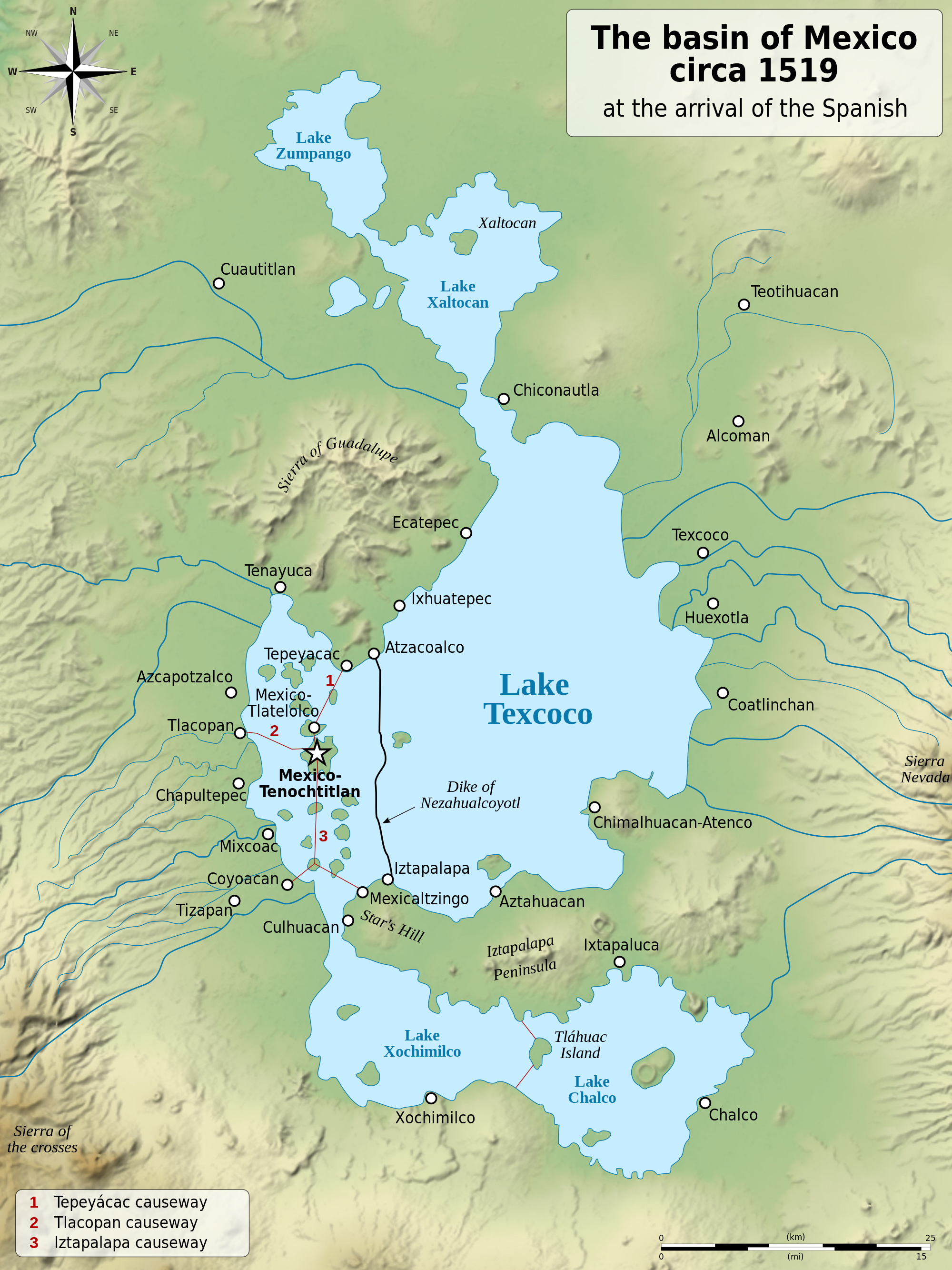
The first thing to keep in mind is that the Aztecs themselves were not a singular polity but a political alliance. The Aztec Triple Alliance was composed of 3 different Nahua altepemeh (city-states/polities/etc.): Tenochtitlan-Tlatelolco, Texcoco, and Tlacopan. Each altepetl (singular) was itself the chief city among a particular Nahua group. Let's take a moment to break down the Triple Alliance ca. 1517. First though, a map.
Tenochtitlan-Tlatelolco
The pre-eminent altepetl of the Triple Alliance and what most people are talking about when they say "Aztec." Both Tenochtitlan and Tlatelolco were Mexica (a Nahua group), which had begun as independent cities in the early 14th Century, until Tlatelolco was conquered by the Tenochca in 1473 CE. At the time Cortés et al. entered the city, Tlatelolco was still ruled by a quauhtlatoani, essentially a military governor. While a sort of sibling rivalry still existed between the two groups at this time, the Tlatelolco were firmly on the side of the Tenochca when war with Spanish came. The final battles of the Siege of Tenochtitlan were, in fact, fought in Tlatelolco.
Texcoco
An earlier city with a longer lineage that the Mexica cities, Texcoco was the heart of the Acolhua, a Nahua group which nonetheless traced their roots back to earlier migrations into Valley of Mexico. As such, the Acolhua held a certain reputation of being the more refined and cultured group when compared to the Mexica. At the time of the Spanish arrival, however, the Acolhua were split. A succession crisis had occurred in 1515, which lead to a Mexica backed tlatoani (lit. speaker, but usually translated as something like king) in Texcoco, but an autonomous group in the northern Acolhua areas under a different tlatoani. This becomes important later, when this northern tlatoani, Ixtlilxochitl, sides with the Spanish-Tlaxcalans, breaking the Triple Alliance and flipping the whole of the eastern shores of Lake Texcoco against the Mexica.
Tlacopan (often called Tacuba in Spanish sources)
Tlacopan was the "junior" partner in the Triple Alliance. The canonical division of tribute was 2/5 each to Tenochtitlan and Texoco, and 1/5 to Tlacopan. The altepetl was a Tepanec (again, still Nahua) group which sided with Tenochtitlan in their civil war against the Tepanec Empire in the 1420s, which lead to Mexica independence and the establishment of the Triple Alliance. The most important thing to remember about Tlacopan is that no one cares about Tlacopan. We know they sided with the Mexica in the war against the Spanish, but are basically ignored in all sources.
So that is the Triple Alliance itself, but what about external groups?
Tarascans/Purepecha
A non-Nahua polity in roughly what is now the state of Michoacan, the Tarascans had been engaged in basically a cold war with the Aztecs since about 1478, when a Aztec invasion under the Tenochtitlan tlatoani Axayacatl was soundly defeated. The border area between the Aztec holdings and the Tarascans was an area of border forts and signal towers. The Tarascan area was a chief center of bronze metallurgy, and this sometimes gets brought up with some nodding and winking to bronze weaponry, but the evidence for the arsenical bronzes being used as weapons (as opposed to tools and luxury goods) is scant to non-existent. /u/Ucumu studies this group and can probably shed some light. You might also want to check out the AskHistorians podcast episodes 13 and 14, which are (no joke) some of the most comprehensive public resources on Tarascan history.
Tlaxcala
The traditional rivals of the Triple Alliance. Tlaxcala was, like the Aztecs, an alliance of Nahua groups. Situated in the neighboring Puebla Valley, most of the fighting between the Aztecs and the Tlaxcalans was carried out through political/military squabbles at the border atlepemeh of Atlixco, Huexotzinco, and Cholula, as well as through regular xochiyaototl (flower wars). Hassig, in Aztec Warfare, notes that these xochiyaoyotl were growing increasingly more like full-on warfare at the time of the Spanish arrival as the Aztecs tightened the noose on the Tlaxcalans, whom they had spent decades surrounding in a sort of slow siege. The Tlaxcalans famously sided with Cortés early on, complaining bitterly of the deprivations they were suffering under Aztec encroachment, and Tlaxacalan troops made up the bulk of the forces arrayed against Tenochtitlan and provided basically all the logistical support.
Various Mixtec/Zapotec polities
Motecuhzoma Xocoyotl (i.e. Montezuma) had spent the bulk of his reign engaged in campaigns in what is now Oaxaca and Guerrero. These disconnected and dis-unified groups, however, could not really be seen as a real enemy to the Aztecs. The rough terrain and lack of unity did, however, stymie Spanish incursions later.
Metztitlan/Huaxtecs
Two groups on the northeastern edge of the Aztecs. Again, not really enemies per se. The Huaxtecs area had been mostly conquered, though it was a a frequent sources of revolt (in the form of ceasing to pay tribute) when the opportunity arose. Metztitlan was an Otomi polity which had been an occasional target of Aztec aggression (notably a mediocre campaign under Tizoc), but was basically just a hold-out in the are thanks to a defensible position.
Various Nahua/Maya groups in Tabasco and beyond
Aztec expansion into this area ended roughly around what is now central Veracruz state. Like the other groups, these were not so much enemies as disparate groups that the Aztecs had not yet organized against and focused on subjugating. Aztec presence was strong in the southern Veracruz/Tabasco area and they had a presence on the western Yucatán as well, notably at Xicalango. The infamous Malinche actually came from Tabasco, as a side note.
This is a very broad and not particularly deep overview. Let me know if you have any follow-up questions.