First of all, I am obliged to share that this has been asked in the past, so you should read through this thread and the excellent answers therein.
Second, I am obligated to tell you I know nothing about the Macedonians, so I shall ping my colleague /u/XenophontheAthenian to fill in that part of history, and together we shall combine our powers, Voltron-like!
(Edit: see Xenophon's answer here, and I highlight several differences)
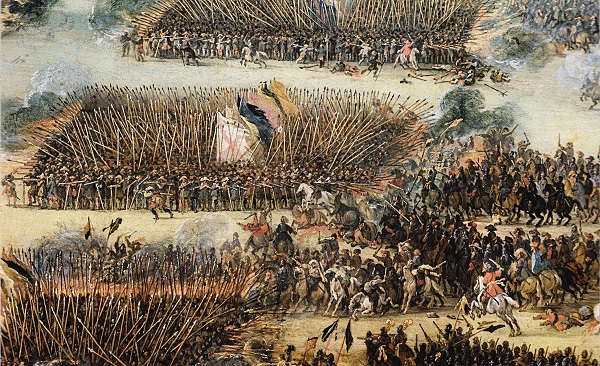
I would like to start with the things that made the Swiss pikes truly all-powerful for a period of time in late medieval era. First is their training level and cohesion. Men from the same canton, even the same village, work as mercenaries in summer between plating and harvest. So within each unit, which is typically 100 men arranged 10x10, they knew each other very, very well, and moreover trusted each other very well. Because they normally lived in the same canton, they could train and maintain their teamwork. In battle they have these pike blocks support each other.
All this made them very agile, they could maneuver, face adversaries in any direction, and they were supremely confident. On the defensive and when moving normally, they could and did have pikes facing in all directions. Unlike levy pike formation, they could actually go on a rapid offensive, where the pikes are facing one direction and all pikemen did a rapid march against the target.
Second is that they were later on combined with heavy French mounted gendarme units. The French realized that their weak levy infantry could use hardened Swiss veterans, and this made a great combination. The French invested their money in the Swiss, and the Swiss invested their security in France.
The combination of French gendarmes and Swiss pikes dominated battles until the Spanish, fresh off their experience in the Iberian Reconquesta, developed further combined-arms tactics to overcome the Franco-Swiss alliance when they came into conflict in the southern part of Italy, which holds a special place in the heart of /u/jasfss/. After initial losses, the Spanish commander de Cordoba discovered that if the Swiss pikes could be impeded, they could be destroyed by a combined group of pikes, swords, and shot. This gave birth to the tercio system, which literally means "third". The shot troops could harass the Swiss pikes as they approached, and when they are close, friendly pikes will block them as swordsmen harass enemy cohesion and shot troops continue firing from the flanks.
This is why the "picture perfect" image of the tercio is a large block of pike/sword/halberd in the center (although the latter became less and less common as a battlefield weapon as time progresses), with a thin outer layer of shot, and with shot troops in the sleeves, often combined with smaller contingents of pikes in case they are threatened suddenly. You can see here and here. In the Spanish style, 2-3 squadrons of pikes form each pike block, and each pike block and its supporting elements have a degree of independence and could support each other. As such, they could attempt tactical flanking maneuvers such as in Breitenfeld shown here.
As they approach the enemy, the shot troops fire their guns, and when contact is nearly made they pull back behind or on the flanks of the center pike block. Later Spanish tercios typically had 300-400 men per pike block, arranged 30 wide and 10 deep, supported by twice as many shot troops. This all adjusted according to battle needs, so it was said that the sergeant-major's most important skill was to memorize the table of squares!
Reference: Fighting Techniques of the Early Modern World: Equipment, Combat Skills, and Tactics by Matthew Bennett and Christer Jorgensen