I apologize if this is too broad of a question, but I am interested in any and all comparisons, even if they are from unrelated parts of the globe and historical periods.
An example to clarify my question a bit: I have heard that the English Army favored massed longbow fire, while Mongol armies tended to shoot from horseback. Would training for an English archer be more focused on having the strength to keep up a sustained rate of fire, and less on accuracy? And would archers like those of the Mongols do the opposite? Also, where and how would most training be done, in a day-to-day way like hunting, or in a more "professional" environment strictly for the purpose of training?
Again, any and all examples would be appreciated, this is more of a general question I was wondering about.
I can give you a bit of an idea on the English longbow, at least until someone with more knowledge comes along.
So starting with the basics, an English longbow, typically about 6ft long depending on the height of the archer (usual the same height or longer than they were) and made of straight grained yew. These bows were what is known as a 'self bow' meaning they were made of a single piece of wood, although additional horn knocks on the ends do not seem to be unusual in the later medieval period. The draw weight, measured in pounds, is how hard the string is to pull back. This is closely, but not directly, correlated with how far and fast the arrow flies.
The exact draw weight of medieval bows is something of a mystery. Obviously being made of wood they don't last like swords or armour does, and to my knowledge the only surviving examples come from the wreck of the Mary Rose. These are not a representative sample as they come from the very end of the longbows service life, and from a vessel that would have been equipped with the very finest of everything. However with these caveats aside, analysis of the surviving bows gives draw weights of between 80lb to 180lb with the bulk being approximately 140lb. These weights are probably a little too heavy when compared to the Crecy or Agincourt period as they reflect the end of the medieval Armour vs weapon arms race. These draw weights also take into account the bow being drawn to the ear, as contemporary illustrations suggest, rather than to the mouth as modern archers do.
The amount of training and strength required to draw such bows all day is enormous, and for these reasons archery practice began when boys were still young. The evidence of the toll this took on there bodies can be seen in their skeletons. It also requires a totally different way of drawing the bow as can be seen here. This is necessary to engage the much stronger back muscles, rather than using the weaker ones in the shoulder. It does seem that the emphasis was on speed and weight of fire rather than pure accuracy, however it is worth remembering that a skilled bowman could still hit a knight on a horse out to a considerable distance, especially compared to contemporary firearms.
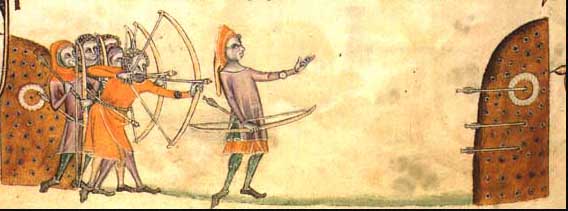
As for where and how training was conducted, most was done in the community. There are excellent illustrations of archers practicing at the 'Butts', as well as some showing the villages apparent indifference. The importance placed on this archery practice is reflected in the law of the period. The ‘Assize of Arms’ in 1252 ordered that all Englishmen between the age of 15 to 60 years old should equip themselves with a bow and arrows. In 1363 'the archery law' commanded the obligatory practice of archery on Sundays and holidays, indeed in some medieval church doorways you can still see the groves where generations of men have sharpened the points of their arrows. Finally this Archery Law "forbade, on pain of death, all sport that took up time better spent on war training especially archery practice". This included a popular new sport called 'foot-ball'. But that would never have caught on anyway...
Sources and further reading
Secrets of the English War Bow Hugh D. H. Soar
English Longbowman 1330-1515 Clive Bartlett
The fair at Hoboken by Pieter Bruegel the elder
The Butts The Luttrell Psalter
Hope this helps.
Edit: Format
hi! totally forgot we have a whole FAQ section on English longbows - here you go