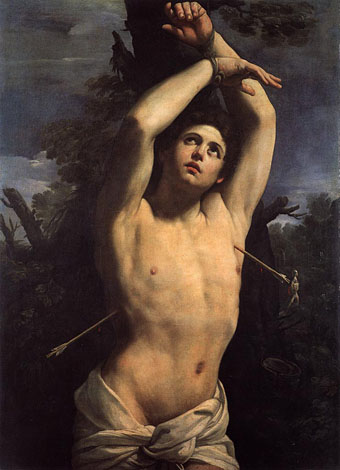
I'm especially interested in how this developed in the early modern period, a markedly anti-gay time period as far as I'm aware (at least so far as one could say that "gay" was a concept at all).
EDIT'd for accuracy
I don't know about the Early Modern St. Sebastian iconography or sexuality (are you using that term to mean... first part of the 20th century, "early Modernism," or to mean late medieval/High Renaissance Early Modern?) but the earliest explicit use of St. Sebastian as a gay icon that I've encountered is in Yukio Mishima's Confessions of a Mask.
Published in 1949, so on the late end of Modernism... and Mishima's (or his main character's) erotic fixation on St. Sebastian is portrayed as really idiosyncratic, I think - he's Japanese, and discovers this Reni painting (or perhaps this one or one of five other Reni Sebastians) in one of his father's books when he's still a schoolboy. It's his first sexual experience, more or less.
Reni's paintings seem really sensual from our perspective today, but at the time they were painted? I think the painter was aiming at religious ecstasy and the transience of all flesh – at transcending the body, not celebrating it. But perspectives change.
Something was going on with St. Sebastian and homoeroticism in the 19th century: Oscar Wilde, after his release from prison, went by the name "Sebastian Melmoth" as a tribute to "the famously penetrated St. Sebastian" he said. Mishima definitely read Wilde as young man, which may have affected his semi-autobiographical account.
Confessions of a Mask made Mishima an international celebrity, so his St. Sebastian obsession there definitely affected the way the saint was seen around the globe following that.
If you're curious, there's a photograph of Mishima (who was a bodybuilder and model as well as a novelist) as St. Sebastian about halfway down this Steve Cox page, which is also a really fairly comprehensive collection of St. Sebastian lore from an art historical perspective. Some imagery NSFW, copiously footnoted.
Edit to add: There's a 1905 Rainer Maria Rilke poem cited in Cox's page that might also be a milestone in St. Sebastian-as-queer-icon.
 As one recumbent so he stands totally held up by his great will
 withdrawn as mothers are when suckling still, and wrapt within himself as by a wreath.
 The arrows fly: up, up they come as if they sprang from out his tender loins, each iron quivering along its end.
 Yet he smiles darkly and remains unhurt. Once only, oh, so great his sorrow grows, his eyes reveal the pain as he looks on,
 but they change to denial, judging those inferiors as they scornfully let go the vile destroyers of a lovely thing.