Hello, thank you for taking the time to look at my question :)
I wanted to know more about the city of Troy (not the war itself), especially the wall, since it was known to be invincible at the time. The problem is that I only managed to find sources about the war and the others didn't seem to be trustworthy or were just very poor.
Do you know anything about the cities walls, or do you have any sources I could look up ?
Part of the problem that XenophonTheAthenian identified, I think, is that this phrase
especially the wall, since it was known to be invincible at the time.
makes it sound like you're primarily interested in the mythical Troy. We have no ancient reports at all about the walls of the historical city, so whatever you've been reading about what "was known at the time" must be from a mythical source (and I can't tell what source that might be).
There's also a question over which Troy you're talking about. The site was inhabited for over 4000 years, from ca. 3000 BC up until the late Byzantine period. There are two likely candidates for the walls you're thinking of.
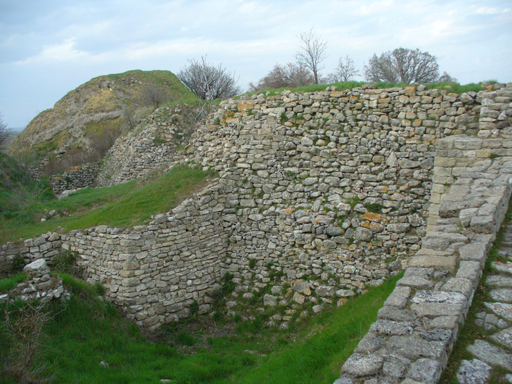
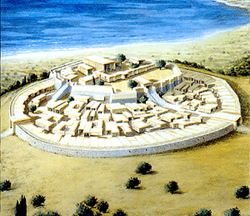
First are the walls of Troy II. This is the archaeological layer that Schliemann identified as "Homeric Troy", though it later turned out that that layer is over a thousand years earlier than any popular dating for a supposed "Trojan War" (Troy II is roughly contemporary with the building of the Great Pyramid at Giza). Schliemann happened to like those walls because they were nice, thick, and impressive, and that suited his idea of what "Homer's Troy" ought to look like. Here are some images: the ramp up to the walls; the wall to the side of the ramp; where the ramp meets the wall; another section of wall; and an artist's conception of what that phase might have looked like (apologies for potato quality).
The other main candidate is the walls of Troy VI. This layer is right for the period usually preferred by people who believe in a historical Trojan War, covering much of the second millennium BC and ending ca. 1290 or 1180 (depending on whether you regard the last phase as Troy VIh or Troy VIi [=formerly Troy VIIa]). These walls cover more area, but are less impressive than the Troy II walls. Here's the best-preserved bit (the wall on the left); here's what it looks like if you pull back a bit; and [a different angle](https://upload.wikimedia.org/wikipedia/commons/e/e2/Walls_of_Troy_(2).jpg). The masonry in these walls suffered damage from what was almost certainly an earthquake in the early 13th century BC; they would still have been mostly standing at the time of the fire in Troy VIi (or VIIa). They may possibly have stayed standing just long enough to inspire a certain poet, after Greeks started colonizing the area in the 8th century BC, but the colonists were more interested in building a new city than in excavating the old one.
This page has a pretty decent overview of the city's development in its first 2000 years, with some images that I recognize from reputable sources. For more specifics, and more careful coverage, I'd recommend Bryce's book The Trojans and their neighbors; for more images, see if you can get hold of Troia: Traum und Wirklichkeit (in German); I haven't seen Rose's 2013 book The Archaeology of Greek and Roman Troy, but it may do instead.
I'm not really sure what you're asking. Are you asking about the historical, archaeological site identified as Troy? Or are you asking about the walls of Troy as described in the literary corpus? Because the two are very, very different--the historical Troy doesn't really have all that much to do with Homeric Troy. Since you say that the walls were reputed to be invincible would indicate to me the latter, since Troy's walls are only called that as a formulaic piece within the textual, and specifically Homeric, corpus. The actual walls of Troy VIIA are quite different from what Homer describes, and we shouldn't consider the poet to be describing anything real, especially since the Homeric Poems are a product of oral heroic epic and were written and compiled centuries after Troy had ceased to exist--I mean, for Christ's sake, Homer describes Thebes as being hundred-gated, which is obviously absurd and is not archaeologically supported. If you're talking about the archaeological site of Troy VIIA, the obvious place would be the Companion to Homer, although I'm not sure what the newer editions have to say about the archaeology of the site--the work changes quite a lot from edition to edition, and a great deal of archaeological work has been done in the last few decades





.jpg)