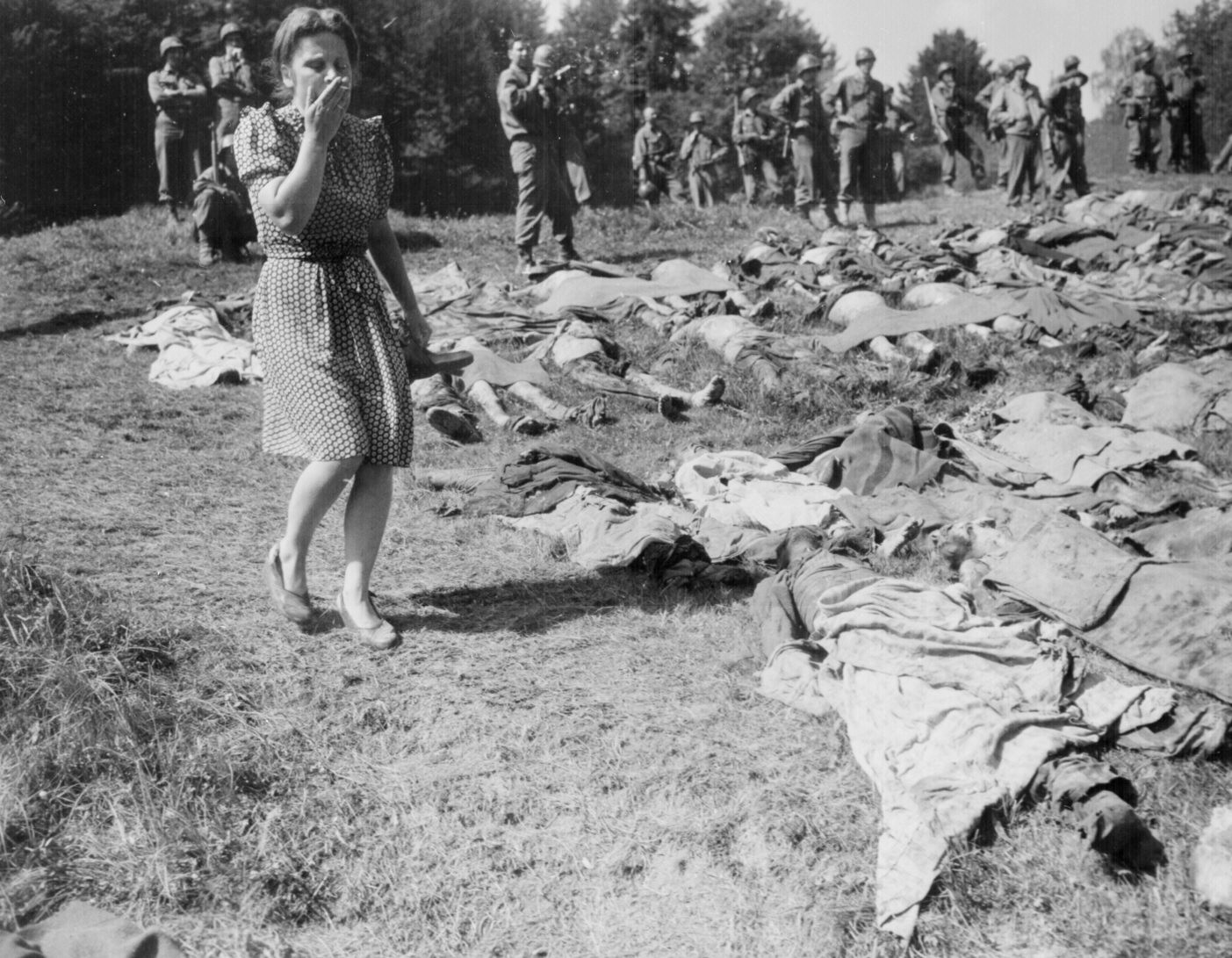
And did they force civilians to do a lot of work (during and post-war) to make up for their guilt, even if many of them had never explicitly supported the Nazis?
Were German civilians treated extremely poorly by American/British troops after occupation by Allied forces on the West Front?
Not a historian, but this post has 154 votes and three comments, so here's what I do know.
Stephen Ambrose, as has been noted, is not respected in the historical community. However, one of the soldiers, Don Malarkey, notes in his biography that he didn't remember the concentration camp being that bad. Dick Winters, though, said that the camp was a shock to him, and that it fully cemented his belief in the war. I can't remember if he says whether they made the German (Polish?) civilians clean up, but he DOES say that his men frequently would quarter themselves in houses owned by German people, forcibly evicting the current residents for a night or two, as it shows in the series. Winters says that he had no problem with this policy and felt no misgivings about it.
There are also pictures of civilians being forced to walk through concentration camps at Wobbelin, Buchenwald, and [Landsberg] (http://www.scrapbookpages.com/Buchenwald/Exhibits.html), so definitely some Nazi-shaming went on.
Source: Easy Company Soldier by Don Malarkey.
Beyond Band of Brothers by Dick Winters
Just looked at the book behind the series (by S. E. Ambrose) and the scene is only a short paragraph by the end of chapter 16, which does not say anything one way other, so no help there.
Looking at pictures from the time we can see genuine shock from people because they did not know the full scope of what was happening in these places. Lee Miller was a photographer and war correspondent who traveled with US soldiers as they found the camps. She suffered from PTSD and became an alcoholic after photographing the war. (Source: her son who runs her foundation and gives tours) http://www.leemiller.co.uk
This image is of German soldiers watching a film reel of the camps. You can see that many of them are shocked at what was happening.
German citizens were forced to tour the camps as part of the denatzification effort. They are also shocked by what they see.
This page has a US Army film that was made during the liberation of the Landsberg camp depicted in that episode. The caption on the page states (via google translate):
250 citizens 16-70 years are together fetched from Landsberg and the surrounding area. Under the supervision of US troops they start with their bare hands to collect the dead and to bury.
Not quite answering the question in full but Mark Bando is a 101st Historian. Here's his critique of each episode of BoB. http://www.101airborneww2.com/bandofbrothers.html
There was a documentary recently on Hitchcock's film on the concentration camp entitled "night will fall". That was a different camp, but the broad strokes are pretty much the same as the account that the 101st airborne soldiers gave.
A great read is here: http://www.thedailybeast.com/articles/2015/01/17/inside-alfred-hitchcock-s-lost-holocaust-documentary.html
For the record, Eisenhower himself was staggered discovering the camps, and the size of it.
"The same day, I saw my first horror camp. It was near the town of Gotha. I have never felt able to describe my emotional reactions when I first came face to face with indisputable evidence of Nazi brutality and ruthless disregard of every shred of decency. Up to that time I had known about it only generally or through secondary sources. I am certain, however that I have never at any other time experienced an equal sense of shock. I visited every nook and cranny of the camp because I felt it my duty to be in a position from then on to testify at first hand about these things in case there ever grew up at home the belief or assumption that “the stories of Nazi brutality were just propaganda.” Some members of the visiting party were unable to go through with the ordeal. I not only did so but as soon as I returned to Patton’s headquarters that evening I sent communications to both Washington and London, urging the two governments to send instantly to Germany a random group of newspaper editors and representative groups from the national legislatures. I felt that the evidence should be immediately placed before the American and British publics in a fashion that would leave no room for cynical doubt."
I did some research on a similar topic during a Holocaust class I took last year. My paper doesn't quite answer your question, but some of the sources I used will. The first source is an interview from a man in a reconnaissance unit which found several camps. It will be particularly useful to answer your first question, however it's been a year since I looked at it and can't remember enough to do it justice. Here they are:
Phillip Solomon, interview by Ellen Rothman, May 28, 1987, transcript, Holocaust Oral History Archive, Gratz College, Melrose Park, PA
Robert H. Abzug, Inside the Vicious Heart (New York, NY: Oxford University Press, 1985)
William I. Hitchcock, The Bitter Road to Freedom (New York, NY: Free Press, 2008)
Major Dick Winters' memoirs, Beyond Band of Brothers addresses Easy Company's discovery of Landsberg concentration camp, p. 214:
By now the men and I were seasoned combat veterans, but the sights we witnessed when we arrived at the camp defied description. The horror of what we observed remains with each paratrooper to this day. You could not explain it; you could not describe it; and you could not exaggerate it. It did not take long to realize that the Nazis were intent on eliminating all the Jews, gypsies, and anyone who disagreed with Hitler's regime. The memory of starved, dazed men who dropped their eyes and heads when we looked at them through the chain-link fence, in the same manner that a beaten, mistreated dog would cringe, left a mark on all of us forever. Nor could you underestimate the barbarity of the Nazi regime, even during the latter stages of the war.
Each of the televised episodes follows the narrative of one of the soldiers in Easy Company. Winters was not the POV of "Why We Fight", the episode where Easy finds Landsberg. It follows David Kenyon Webster's, the Harvard guy who steadfastly remained a private throughout the war by his own demand. He's the one yelling at German troops marching home on the Autobahn from the back of the troop transport in that episode. Webster kept extensive writings about his experiences during WWII, and possibly planned to make a book out of them, but he died in 1961. His papers were given to Stephen Ambrose, who based much of his accounts in Band of Brothers on them. They were also published as Parachute Infantry: An American Paratrooper's Memoir of D-Day and the Fall of the Third Reich. I don't have this book, but I understand Webster was disgusted with the war and with Germany itself for dragging everyone into the war. I'd check his account in his book for more info.