I figure one would have to have a pretty strong sense of character to be able to stand up against Hitler for so long.
Hindenburg was not so much a resistor to the rise of Hitler and the NSDAP, but rather an impediment to their consolidation of power. The distinction between impeding and resistance is a subtle one, but in this case an important one. When Hindenburg was elected as President in 1925, he was arguably the most popular political figure in Germany with a wide following among the centrist and moderate right wing Germans. He had been a figure of public veneration during the First World War even though he was quite old, the great hope was that he would be a unifying figure in the contentious politics of the Weimar Republic.
To an extent, he did act as a source of stability and unity for the German democracy. Although he came from a German military milieu that was quite hostile to the democracy and perpetuated the myth that Republic's civilian leaders had stabbed Germany in the back in 1918, he did little to actively undermine democracy. Gustav Stresemann astutely observed that Hindenburg had more of Wilhelm I than Wilhelm II in him and that he would abide by his oath to the constitution and not engage in any foolish political adventurism. Stresemann also noted that in light of Hindenburg's advanced age (he was a veteran of the Austro-Prussian War), "the main thing is [to ensure] that uncontrollable people do not gain influence upon him."
Herein was part of the problem with Hindenburg: although Hindenburg considered himself above politics, he increasingly surrounded himself with an entourage of right-wing German political figures that were anything but apolitical. This camarilla saw both the Depression and the advent of the NSDAP as an opportunity to restructure or undo Weimar democracy and pushed Hindenburg to sign emergency decrees and other legislation designed to attack left-wing German political parties and unmuzzle the NSDAP's political shock troops.
Here though is where Hindenburg's character came into play. As a scion of the conservative Prussian Junkers aristocracy, Hindenburg prided itself on perpetuating the Junkers's strict ethos of duty. This sense of duty became stronger as he became increasingly senile and his camarilla could never quite prod him to act against the constitution. He never liked Hitler and the NSDAP's political methods were uncouth to his sensibilities, but he felt that he could tame Hitler by outlasting him. Despite Hitler's gains as a national figure, Hindenburg arguably enjoyed greater popularity and he handily beat the NSDAP upstart in the 1932 presidential election.
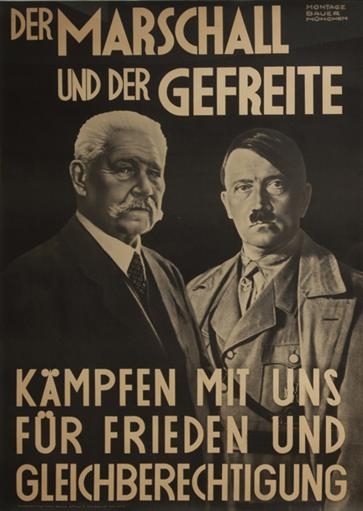
Hitler for his part did not have a high opinion of Hindenburg, but recognized that Hindenburg's popularity was such that any attack upon the Field Marshal would backfire. As such, he played a waiting game as well, dealing with the camarilla and co-opting Hindenburg's image in electoral materials such as this famous poster and this one. As Chancellor, Hitler had to gingerly avoid drawing Hindenburg's ire lest any public break with this popular figure sabotage the delicate workings of the NSDAP's consolidation of power. Hindenburg's entourage shielded him from the news of the excesses of the NSDAP's terror.
So while Paul von Hindenburg had a strong sense of duty and character to carry out his duties, he was never able to translate this into any meaningful actions that prevented Hitler's ascent to power. The main obstacle he posed to Hitler was in passive resistance; Hindenburg was simply too prominent of a national figure for Hitler to ignore or bypass.