Assuming it was the Rosenbergs that did it.
I'm uncertain if I should ask this here or /r/askscience. I imagine the physics of 1949 wasn't a state secret, and the Soviet Union had its own talented scientists. What specific information did the Soviets need to acquire through espionage in order to get the bomb? Was it a "how to build a bomb" instruction manual, or some secret physics equation that wasn't known to the public? How long would it have taken for them to build their own if they hadn't gotten it the way they did?
Edit: thought of a better way to frame it: did they need espionage to solve the engineering problem, or the underlying science.
David Greenglass (Julius' brother-in-law and his primary source) told the Atomic Energy Commission that he gave the Soviets information on:
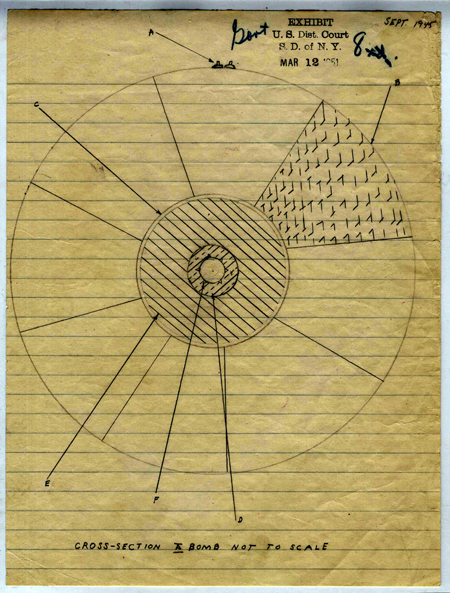
The implosion design for the atomic bomb (here is what he claimed to have drawn them)
Information on explosive lens experimental setups
Information on other experimental designs being considered (notably that of "levitation," which involves suspending the plutonium core with an air gap between it and the tamper, so that more velocity can build up before compression).
Much of this information was crude and deduced from Greenglass' limited experience. You can tell from his diagram that it is not exactly a blueprint — and he had many of the facts wrong, and none of the dimensions.
The Atomic Energy Commission agreed to declassify the concept of implosion for the trial and allowed Greenglass to testify on it. They hoped he would not talk about the initiator or levitation and were afraid of a cross-examination that might reveal them. Fortunately for them the Rosenberg defense attorney basically got scared of the "secrets" and had them all sealed by the court anyway (they were only released in 1966), and did not inquire into any of the details.
Greenglass' primary value to the Soviets was confirming the basic value of other espionage information (e.g. that of Klaus Fuchs and Ted Hall) on similar subjects. Fuchs gave much more detailed information about all of these things to the Soviets.
On Greenglass' knowledge and testimony, see Roger M. Anders, "The Rosenberg Case Revisited: The Greenglass Testimony and the Protection of Atomic Secrets," American Historical Review 83, no. 2 (April 1978), 388-400.
As for your general question about all of their evidence, not just the Rosenberg ring (there were other sources not directly connected with the Rosenbergs, like Fuchs, Hall, and George Koval), they had a lot of information about the design of the nuclear weapon tested at Trinity in July 1945 and dropped on Nagasaki in August (Fuchs was very key to this endeavor and knew a lot and passed on a lot). They knew a bit about designs of the first experimental reactors (but not the industrial-sized ones needed to breed plutonium). They knew a lot of the top-level choices the Manhattan Project had made (which technologies to invest in). They knew a bit about the enrichment methods for uranium (Fuchs had helped developed the theory of gaseous diffusion). They knew about some long-term plans for things like the hydrogen bomb (which nobody knew the correct way to build at the time).
So in some areas they had very good information from espionage. In others, like enriching uranium and producing plutonium, the really tough parts, they had relatively superficial knowledge. The Russians have released some of this information, including on the H-bomb work.
Did it help them much? It is not clear that it did. The head of the Soviet bomb project, Lavrenty Beria, did not trust espionage information blindly. (And with good reason: flipping spies and giving bad info is part of the intelligence game. The British were excellent at this re: the Germans during the war.) He did not even trust his own scientists very much. So he had the intelligence information "sanitized" so it looked like it came from other, unknown Soviet scientists, and added it to his complex and redundant system of duplicating knowledge to ferret out spies or wreckers.
In other words, the Soviets did not attempt to use the information efficiently. They did not even use it to avoid "dead ends" or "blind alleys" — they followed those up, too, because even if the spy data was right from the perspective of the spies, it was not necessarily ultimately correct (and, indeed, the US abandoned gas centrifuges as an enrichment method during World War II because their team could not get them working, but a German-Austrian group working for the Soviets figured out how to make it work).
Generally speaking, information was not the limiting factor in the Soviet's progress for the bomb. Acquisition of raw uranium ores was the major factor (you need thousands of tons of uranium ore for a bomb project and there were very limited uranium reserves known in the Soviet Union at the end of WWII), as was developing the plants for enrichment and plutonium production. The timeline of their program was pegged to these issues, not issues of bomb design; the espionage information was almost exclusively about bomb design. Which is important, to be sure, but not what determines whether a state gets a nuclear weapon or not — no proliferating state has ever been held back in this area, because this is the kind of thing that a team of engineers and physicists and etc. can work out, once they know it is possible and are given resources.
The classic book on the Soviet weapons program is David Holloway, Stalin and the Bomb, but I also very much enjoy Michael Gordin's Red Cloud at Dawn, which is all about the question of information flows, espionage, and what it takes to actually build a working nuclear weapon (i.e. not just stuff that can be written down). Alexei Kojevnikov's Stalin's Great Science has an excellent chapter on the Soviet use of espionage sources.
This is a difficult question because no one really knows. Various accounts exist over to what they gave to the USSR and on whether any of it was even useful for the USSR. But then these accounts are difficult to verify, not just because of their contradictory nature, but because of the highly ideological, rather than academic, approach that the USSR and the US took throughout the Cold War.
The court accused them of letting the Russians achieve a nuclear bomb years before they would have otherwise, and in doing so caused the "Communisy agression" in Korea. The judge said that all the deaths in the Korean War wer ethe Rosenburg's responsibiliy. Now days this appears to be a mix of Cold War hysteria and propaganda.
The Rosenbergs claimed that the whole trial and death sentence was a political sham to give the US government an excuse to make an example to the American Left and to leftimised the agressive US foriegn policy of the Cold War.
Part of the main case was based off testimony by Ethel Rosenberg's brother, David Greenglass, who had been identified as a Soviet source by a arrested handler/courier claled Harry Gold. Greenglasshas since claimed that he lied under pressure from the prosecution, who advised him that providing evidence against the Rosenberg's would protect him and his family. At the time Greenglass claimed he conffessed out of guilt for betraying his country and didn't considered the consequences for others. The sketches of the working of nuclear weapons that Greenglass gave to the Rosenbergs to give to the Soviet Union were the main crux of the prosecutors case.
Krushchev's memoirs claim that he doesn't know the details of the Rosenberg's help but that Stalin and Molotov told him that the help was significant and accelerated the nuclear problem greatly.
But other sources give the Roseneberg's aid much less weight. Alexander Feklisov who was a former Soveit agent, claimed the Rosenebergs knew nothing about the bomb and didn't help at all. However they did pass on infomation about computer and electronic systems that was helpful. If this was the truth then many people think the Rosenbergs should have only been imprisoned instead of executed, as many legitimised the execution by the potential threat to human lives caused by helping the USSR get the bomb. If they didn't help them explicity with a bomb, did they really deserve to die?
Another source, that I can't find or remember the name of, claimed that the Rosenberg's did pass nuclear infomation but that it only confirmed what soviet scientists already knew. I remember when I read this I thought "that might just be exagerating the achievments of the USSR out of pride" but it is another perspective and definitely a possibility.
Boris Brokhovich, who was involved in Russia's nuclear reactor programs, claimed that the Rosenberg's didn't provide any help at all to the USSR and that they died for nothing.
So we don't know exactly what they gave or how helpful it was really!
I would have gone into more depth but I'm on my phone and getting thumbache lol.