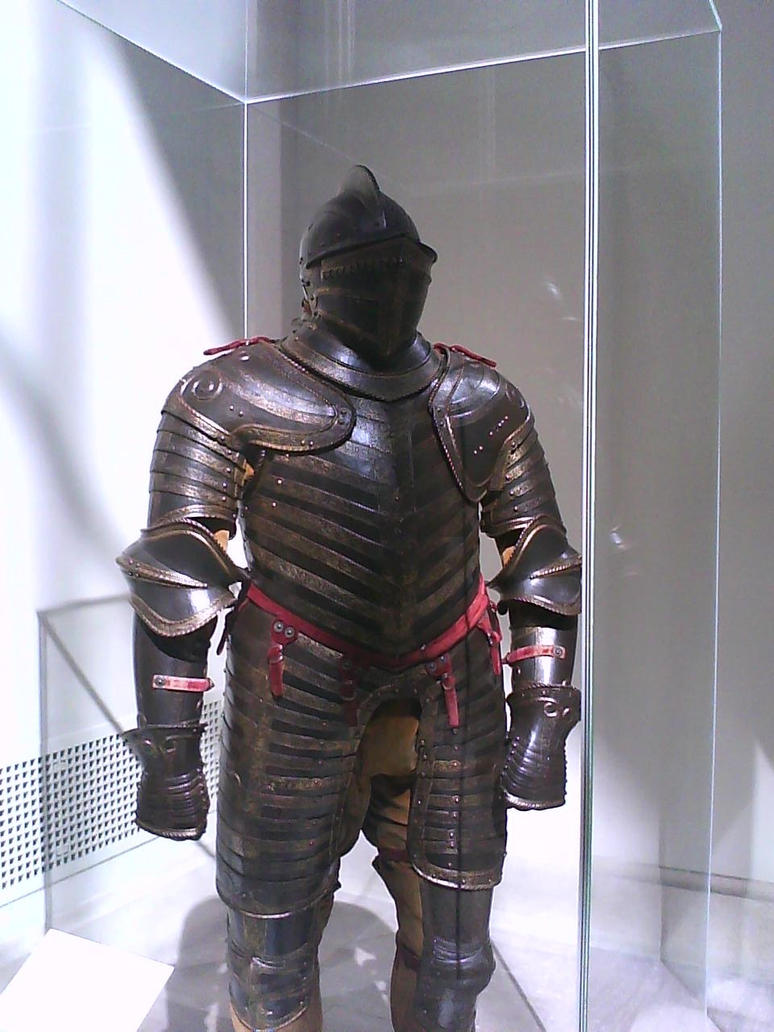
I have read different things about darkened darkened plate armor in warfare. I've heard that darkened armor was for knights who couldn't afford a squire or someone to help them polish their armor, so the darkened color helped prevent rust. I've also seen darkened armor for kings and high military figures (e.g. King Henry VIII's field armor). What is the truth to black/darkened plate armor? Is it a fashion, or is it for practicality? Both?
Probably a bit of both, and these kinds of surface finished were likely much more common in the past than a visit to a modern museum suggests.
Brian Gilmour wrote a good article a few years ago about surface color on armor, and he argues - I suspect correctly - that most medieval armor we have today was cleaned up (often in the 19th century) by curators who thought that all armor was supposed to be shining and metal-colored, and assumed that any color on the armor had resulted from poor care and corrosion. Hence, many polished off whatever surface finish armor originally had to get it shiny. But if you flip through medieval paintings, you'll see that armor is frequently depicted in a variety of colors like black and russet. Sadly, much of the 'white' armor you see today was probably originally colored (you see, incidentally, the same thing happen in many cathedrals - after the medieval paint started to get shabby, it was frequently stripped, leaving bare stone where the walls used to be colorful).
Surface treatments like russetting do make maintenance easier (reducing the likelihood your armor will rust), but they also offer an aesthetic attraction. A lot of armor is trimmed with brass, and that decoration looks much more impressive when the steel is darkened to heighten the color contrast. You see this contrast on Henry VIII's field armor, like you said,; if the dull, dark metal were polished, it would actually make the armor less visually imposing.
I personaly haven't read any evidence suggesing this kind of visual (and also practical) effect was associted with low status. Rather, I think our fixation on the ideal that armor had to be shining and white says most about how about our modern one-track imaginations fail to grasp the full color potential of steel, to the point of actually polishing it off in some cases to try to preserve a polished version of the middle ages that's less colorful than the actual middle ages were.
Some economic background.
The majority of labour in armour is the polishing - something like 80% of the man hours to make a full harness is spent polishing it. Armour is in general very labor intensive, and unlike many other medieval goods (clothes) the cost of armour is largely the cost of labor, not the cost of materials (materials make up less than 10% of armour's cost by the 16th century). So much of the savings that a finish can provide is not the maintenance benefit, but the front-end benefit of avoiding polishing or allowing less intensive polishing. Russetting and blueing are both generally done on polished armour, so there isn't much savings associated with them. They are also somewhat tricky processes that require re-heating armour. Most of the surviving blued or russted armour that I aware of is 'high end' armour from the 16th century. Of course, this may reflect survival bias.
However, paint is a method of finish and decoration that can be applied to unpolished armour. It protects the metal, provides decoration and negates the need for polishing. Alternately, some armours appear to have been completed with the scale from forging still on, forming a black finish.
There are two surviving groups of armour that show painting and unfinished surfaces. Both are associated with lower-status soldiers, so there may have been an economic motivation for their finish - at least it was cheap decoration.
Some sallets and proto-close helms of the late 15th and early 16th centuries are decorated with paint. The 15th century sallets are commonly called 'black sallets' because they are unpolished. A number of the early 16th century ones are painted with grotesque monsters on the face. These helmets seem to have mostly been worn by medium cavalry that rode mostly unarmoured horses and wore armour without sabbatons or greaves - a famous portrait of this kind of horseman is Durer's The Knight the Devil and Death. At the very least, painted helmets provided decoration that was affordable to men who were at the bottom of the aristocratic economic ladder. In some cases the decoration appears to have identified units of cavalrymen - a certain unit of Nurnbergers might wear monster faces on their helmets, for instance.
In the later 16th century you also see 'black and white armour' which has black surfaces, often painted, though in some cases they might be left with hammer scale only. It is also possible that these surfaces are actually a rough variety of blueing. These black surfaces are surrounded by raised areas that have been polished 'white'. These armours are associated with infantry and light cavalry - less aristocratic troops than gentlemen at arms, at least initially. Again, the unpolished surfaces would save a lot of time and money in polishing, but they also produce a distinctive and striking aesthetic effect.
In both of these cases paint and hammer-scale is a cheaper alternative to other means of decoration like gilding, and also saves on polishing. However both the paint of the 'black sallets' and the black and white patterns of black and white armour are still decorative. This is a very long way of saying that it can be hard to tease the practical and the aesthetic in armour. Today we think of things as being either 'decorative' or functional but the distinction is not so clear cut in the middle ages and early modern period. Russeting and bluing of polished armours seem to have mostly been done for aesthetic effect only - but keep in mind that properly representing one's social position is very important to a noblemen in the Middle Ages or Early Modern period. Even this 'decoration' isn't purely decorative in the way we might think of it.
Sources:
Tobias Capwell - Masterpieces of Armour at the Wallace Collection (notes on painted sallets)
Claude Blair - European Armour 1066-1700
Alan Williams - The Knight and the Blast Furnace - Notes on the relative labor involved in armour-making and the sources of armour's cost