I'm curious about when supplies were becoming more and more scarce, how common would it be for troops to make use of equipment picked up from enemy soldiers? Anything from firepower to med kits, or even things like socks and boots.
For example, would it be rare to see an American soldier smoking a German cigarette or wearing gloves taken from a fallen German soldier?
Or even using a German rifle, if say, they had no more ammunition for their own, would they pick up a German gun and use it as a replacement?
This might be a little early for your question, but the "jerry can" fuel container is a famous example. German welded steel cans were superior to the British four gallon containers, which were made from flimsy pressed tin plate and were often treated as disposable items for a single trip (the British two gallon cans were said to be good, but expensive and comparatively rare). Large numbers of jerry cans were captured at Benghazi in 1941 and were used to equip the Long Range Desert Group. Later in the war the German design was copied by both the UK and the USA and was said to be a contributory factor to the success of the invasion of the Continent.
The jerry can design is still in use today. The cross indentation in the sides adds strength; the stopper can be opened without tools and can often be used to pour without a funnel; the triple handle allows the can to be passed down a line of people hand to hand; and the can is lined with a corrosion-resistant plastic (this bit has probably been updated since WW II, but they did have some form of lining).
EDIT - article on the design here and a bit on the history here. I've been trying to track down a decent historical reference for the LRDG use, but don't have it in my own books. The Desert War by Alan Moorhead is supposed to have detail on it.
Again answering only for Finland, where captured Soviet equipment was used extensively. (Last DP light machine guns from Winter War loot were removed from war reserve stocks in the 1990s.)
The official Finnish history of the Winter War (quoted in Wikipedia) counts the following captures:
-Rifles: 25 248
-Light machine guns: 1 574
-Machine guns: 954
Anti-tank guns
-37 mm: 2
-45 mm: 123
Mortars
-50 mm: 31
-82 mm: 63
-Field guns: 89, mostly 76.2 mm
-Howitzers: 35 (mostly 122 mm)
-Heavy howitzers: 14 (mostly 152 mm)
In addition plenty of other equipment, tanks, vehicles, horses, etc. Besides, these were only what was counted at depots and headquarters: quite a bit of the captured material was used up immediately or destroyed before it was even sent back from the lines.
Contrast these with e.g. the fact that at the beginning of the war, Finland had in total 32 guns of 150 or 152 mm calibre and no anti-tank guns heavier than 37 mm.
Most of the heavier equipment did not get into use during the Winter War but was refurbished and used in the Continuation War (1941-44). These included e.g. BT-5 BT-7 tanks, which were later rebuilt into 112 mm 114 mm self-propelled BT-42 "assault" guns. (And fared very badly against T-34s in 1944, though mostly because of completely unhinged tactical use.)
It was by all accounts standard practice to scavenge ammunition for example - this was of course quite simple since Finnish rifles and machine guns used similar enough ammunition to the Russians. (Not identical, BTW.)
Use of captured equipment during WWII was fairly common. It was most commonplace in the North African and Eastern theaters and the German army was the most prolific user of captured equipment in my opinion.
The first use of captured equipment was fairly common across the North African theater. There are pretty extensive photos of enemy equipment in use by both sides. Oddly pith helmets seem to have changed hands fairly frequently and it is not uncommon to see a group of soldiers wearing Italian, German, and British pith helmets. Here's a series of photos showing some American vehicles in German hands. If you browse this site you will see literally hundreds of pictures of captured equipment in German use. In fact, German unit organization and the supply system identified these items. "Beute" or captured equipment, or equipment of foreign manufacture can usually be identified by parenthesis after the designation containing a letter. the MG-26(t) for instance, was a Czech machine gun manufactured by the Brno plant.
Many German units were organized around captured equipment. For example, Barry Rosch's "Luftwaffe Codes, Markings, and Units 1939-1945" lists KG 200, a specialized unit of the Luftwaffe as having at least one B-24 Liberator (Code A3+KB) Liberators and ten B-17s (P.16) and "Versuchsverband Ob.dL" (Experimental Group) maintained P-51, P-38s, Spitfires and P-47s on hand between 1943-45 (P.53). He also makes note of training units utilizing French Dewoitine D.520 fighters and transportation units utilizing Italian transport aircraft specifically the Fiat G. 12 and the Savia-Marchetti SM.82 in Transport Groups 1 and Tranposrt Group 3 (P.360-361).
For an example of officially sanctioned use of captured equipment by German ground forces I will use the example of the 352nd Infantry Division which faced the Americans at Normandy. According to George Nafziger's "German Order of Battle: Infantry in World War II" the divisions artillery unit contained mostly 76.5mm Russian Howitzers (P. 309).
If you want to get seriously in the weeds, here are examples of the KsTN organizational charts showing allocations of men and equipment allocations for units. I've picked artillery, as a good number of them are based on captured guns. Cards 462b, 491, and 492 are based around Russian, Czech, and French guns respectively. This is proof positive that the use of captured equipment was authorized by the Army High Command.
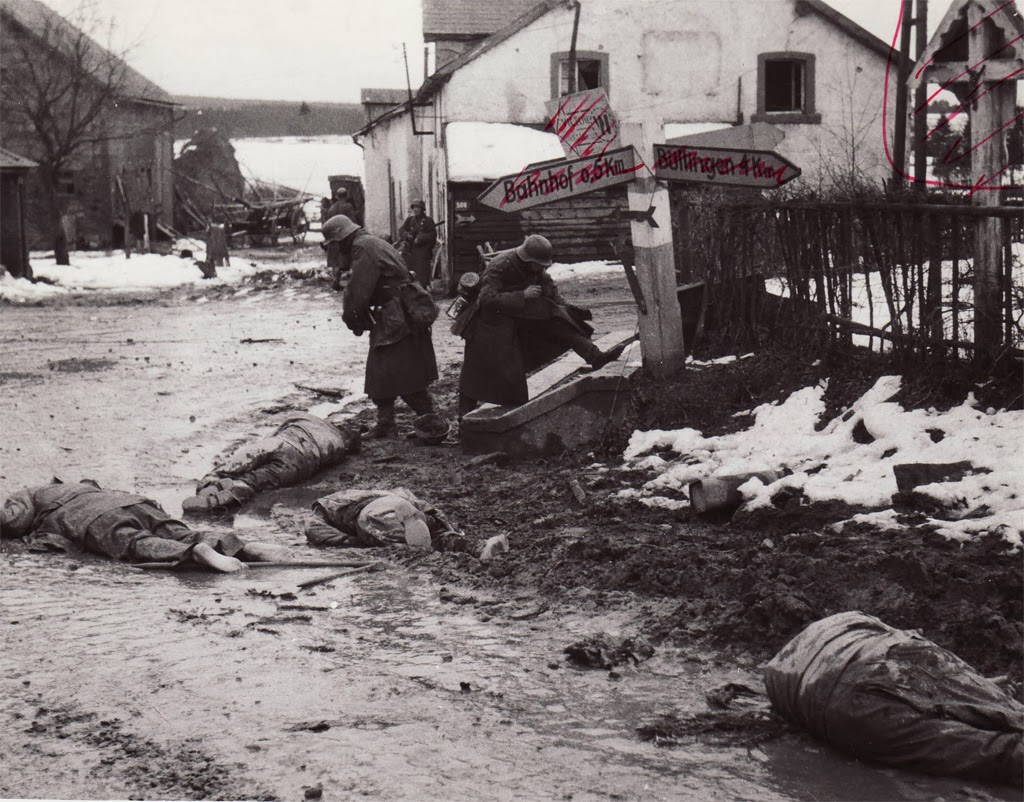
Of course at the tactical level Soldiers will make due with what they can. This grisly photo of American dead during the Battle of the Bulge is notable because of the clean bare feet of the leftmost American. It is likely that his boots were taken by a German soldier. Cigarettes of American or British origin also appear to have been highly prized based on veteran accounts.
Western allied use of German equipment seems to be organized at a lower level and more short term. Smoking German cigarettes I assume would have been a last resort, as German tobacco late in the war would generally have been of low quality.
Use of a rifle is plausible, but it would likely be short term. Armies tend to frown upon throwing your own weapon aside and picking up something else. I would guess that the use of enemy weapons happened, but that it was probably just for a short time in emergency or as trophies/novelties.
The allies did utilized German vehicles and artillery in a limited fashion. There are a number of photos of "Cuckoo" a Panther adopted by the Coldstream Guards in NW Europe in 1944-45. In addition, Osprey Publishing's booklet "US Field Artillery Druing WWII" has several examples of American troops utilizing German artillery, including a PaK 43, in an indirect fore roll shortly after the Battle of the Bulge. (No Page number, kindle won't cooperate) The stockpiles of ammunition on hand combined with the sets of firing tables they captured allowed their use to reinforce artillery units at the end of the war.
Edit: Added some pg. numbers, corrected statistics on KG 200, and added specific Italian types utilized. Added KsTN link. Edit 2: Corrected D.520 designation.
I remember reading that the Soviets designed their mortar to be 82mm instead of the 81mm that was standard elsewhere. They could still use any mortar rounds they captured from enemy forces, but if any of their rounds were seized, they were too big to fit in the smaller mortars.
I can't find any sources for that though, so maybe it was just a happy accident.
During the North Africa campaign the British made good use of 5 gallon fuel/water Wehrmacht-Einheitskanister they captured. You can read a bit more about it here: https://books.google.com/books?id=IA20xVTl-nEC&pg=PA107. The current US and British fuel cans at the time were prone to leak, difficult to carry and awkward to pour and refill. Rather than merely supplementing the British fuel cans the German version became the de facto standard for the allies for the rest of the war. President Roosevelt was reported to have said "Without these cans it would have been impossible for our armies to cut their way across France at a lightning pace which exceeded the German Blitzkrieg of 1940."
Both the Marine Corps' and the US Army's history of the battle of Guadalcanal offers additional examples of circumstances where one side made due with captured equipment.
On 9 August, the transports withdrew to Noumea. The unloading of supplies ended abruptly, and ships still half-full steamed away. The forces ashore had 17 days' rations — after counting captured Japanese food — and only four days' supply of ammunition for all weapons.
Ashore in the Marine beachheads, General Vandegrift ordered rations reduced to two meals a day. The reduced food intake would last for six weeks, and the Marines would become very familiar with Japanese canned fish and rice. Most of the Marines smoked and they were soon disgustedly smoking Japanese-issue brands. They found that the separate paper filters that came with the cigarettes were necessary to keep the fast-burning tobacco from scorching their lips. The retreating ships had also hauled away empty sand bags and valuable engineer tools. So the Marines used Japanese shovels to fill Japanese rice bags with sand to strengthen their defensive positions.
From http://www.history.army.mil/books/wwii/guadc/GC-03.htm
Besides the runway and the weapons in Kukum, the Japanese had abandoned a store of .25-caliber rifles, .25- and .303-caliber machine guns, two 70-mm. and two 75-mm. guns, ammunition, gasoline, oil, individual equipment, machinery, Ford and Chevrolet-type trucks, and two radars. They left stocks of rice, tea, hardtack, dried kelp, noodles, canned goods, and large quantities of beer and sake behind. The marines took over the abandoned weapons and used them to bolster their defenses. The 100-pound bags of rice and other food in the commissary dumps were added -to the marines' limited stores.
The use of captured weapons, as above, is an example of the exigencies of warfare. I have read accounts of soldiers who would use a captured infantry weapon in the heat of battle if their own jammed or ran out of ammunition, however I have not found any accounts of a World War II-era soldier who replaced their primary weapon with one captured from the enemy for an extended period of time.
The Nazis used equipment and vehicles captured at Dunkirk extensively. The British tried to burn as many vehicles as they could before evacuating the city, but the Nazis still found trucks and tanks by the parking lot full.
Often, they were were quickly repainted and got proper unit markings slapped on, and used all over France.
This results in pictures many pictures of things like a Wehrmacht Criuser Mk IV and Wehrmacht Self Propelled Guns on MK IV chassis.
You can look at "Captured American & British Tanks Under the German Flag" by Werner Regenberg for more info.
According to Anthony Beevor's Ardennes 1944, during the Battle of the Bulge this became a common occurrence on both sides as both the battle and the weather became worse. German soldiers would take winter clothing from dead or captured American soldiers (which often led to them later being killed on captivity on suspicion of being commandos trying to pass for Americans), while at least on some occasions British troopers would try to get German jackboots to replace their own. Both sides also took bedsheets from civilians to make ersatz snowsuits.
While this isn't at the end its a good example... in the east the Germans captured vast stocks of soviet equipment and ammunition... this would be repurposed and turned around to be used either to equip new units (such as anti-communist Ukrainians and other collaborative soldiers) or pressed into service in the absence of the necessary specialist equipment(specifically the 76.2mm(r) anti tank gun which was just a soviet f-22 divisional artillery piece with minor retooling.
Another common example on both sides was the regard they gave for each other's machine pistols... early in the war pieces captured by Soviets would be used to equip their scouts in prefenece to the heavier ppsh and it's lack of a folding stock (leading to the eventual adaptation of the pps-43). On the other side German units praised the soviet ppsh-41 for its ruggedness in the face of appalling weather conditions...
In regards to tanks the Germans employed Buetepanzers extensively with several SS tank units first going into combat with captured t-34s that at the time were considered better then their contemporaries (albeit with radios crammed into the tank)
German use of captured firearms was basically endorsed, at least in so much that the firearms were given official designation and provided with logistical support (ammo). I only know about the Soviet examples:
The SVT-40 semi-automatic self-loading rifles were used by German forces, and were given the designation Gewehr 259(r) and were even supplied with a German version of the operations manual. The rifle was also sent back and studied, which lead to the development of the G-41.
The TT (Tokarev) pistol was designated Pistole 615(r). It was even easier for this one because the 7.62x25 Tokarev cartridge was virtually identical in dimensions to the 7.63x25 Mauser, so the German forces could use the pistol with their own ammunition.
PPSh-41s submachine guns were captured and used in large numbers. They were either converted to 9x19mm and called the Maschinenpistole 41(r), or left unaltered and called the Maschinenpistole 717(r) and supplied with 7.63x25 Mauser. The PPS were called Maschinenpistole 719(r) and supplied the same way.
The Sten, a British 9x19mm SMG, was used by in small quantities by the Germans, though it wasn't given an official designation. It was chambered in the same round as the German MP-38 and MP-40 so it would've been easy to supply. Towards the end of the war the Germans basically copied the design to produce the MP 3008 which was nearly identical to the Sten except it had a vertical magazine well instead of the Sten's iconic horizontal well. Mauser also produced the Gerät Potsdam, which was an identical copy of the Sten right down to manufacturing marks. They made about 28,000 of them and they were maybe intended for clandestine operations. Which actually kind of makes no sense because the Germans had captured many actual Sten guns.
edit to add: Note on the 7.62x25 Tok vs. 7.63x25 Mauser.
Germans could use their 7.63mm Mauser in the captured Soviet pistols because size-wise they were the same, albeit underpowered. Soviets could not use the 7.62mm Tok in captured German firearms because the cartridge is much more powerful than the weapons were designed to handle, which would lead to overpressure and possible/likely destruction of the firearm and injury to the user. IE It's a really bad idea.