Which nation had the most and made best use of self propelled artillery?
In the American army, self propelled artillery was very prevalent. Each armored division had 3 battalions of M7 Priest self-propelled howitzers, each with 18 pieces, for a total of 54. For additional support to crack tough obstacles, one or more of the six independent battalions (only 100 vehicles were constructed) of M12 155 mm Gun Motor Carriages could be called on. It was used for direct fire against buildings and pillboxes, and the Germans feared it greatly. The more common 150 mm "Hummel" was the German equivalent. Toward the end of the war, the Americans began to develop heavier and heavier self propelled guns (the 203 mm T89 and monstrous 240 mm T92 being an example)
Surprisingly, the variants of 105 mm-armed M4 Shermans, with 4,680 being built, were actually America's most common self-propelled "artillery" piece. Thinking more conventionally, (little or no armor, open top) the 105 mm Howitzer Motor Carriage M7 was the second most common American self-propelled artillery piece, with 3,490 being produced, and the M8 75 mm Howitzer Motor Carriage was a distant second, with 1,778 built.
Even reconnaissance elements had their own self propelled artillery, unlike the Germans, who didn't get it until late in the war. Each Cavalry Reconnaissance Squadron had six M8 self propelled 75 mm howitzers in 3 platoons. If the squadron was part of an armored division, it had an extra platoon for a total of 8 pieces, as well as an extra troop of armored cars.
Tanks and tank destroyers were often used as ad-hoc self propelled artillery pieces, especially in urgent situations and when there was a lack of other vehicles that could be used. The M10 tank destroyer was even equipped with an artillery sight for this very purpose.
Here's an M4 Sherman keeping busy on fire support duty near Vicht, Germany, in November 1944
Sources:
ETO Order of Battle- DIVISIONS
http://www.history.army.mil/documents/eto-ob/etoob-toc.htm
US Armored Division organization 1944-45
US Cavalry Reconnaissance Squadron organization 1944-1945
German Reconnaissance Units organization
M7 105 mm Howitzer Motor Carriage
http://afvdb.50megs.com/usa/m7priest.html
M8 75 mm Howitzer Motor Carriage
http://afvdb.50megs.com/usa/75mmhmcm8.html
M12 155 mm Gun Motor Carriage
http://www.historyofwar.org/articles/weapons_M12_155mm_GMC.html
http://afvdb.50megs.com/usa/155mmgmcm12.html
T89 8 inch Howitzer Motor Carriage
http://www.history.army.mil/books/wwii/Beachhd_Btlefrnt/ChapterXVII.html
Shermans
http://the.shadock.free.fr/sherman_minutia/data/sherman_production.html
"Combined Arms" is the principle that is key to tactical success in WWII, especially offensively. Combined Arms means Artillery, Infantry, and sometimes Armor and Air acting together to defeat the enemy. If a commander can't use artillery, he's playing rock, paper, scissors without the scissors, and thus terribly vulnerable to an aware opponent. For example, a group of dug in Anti-tank guns and machine guns will be able to halt any advance if artillery can't suppress them for a tank or infantry assault, if artillery can suppress them the attackers have a much better chance.
An armored division needs artillery to use combined arms principles effectively. But the tanks and motorized/mechanized infantry have much more mobility than conventional towed artillery and will leave their artillery behind when on offense, or be forced to retreat without it on defense. This is why self-propelled howitzers are important elements of armored formations. For the most part, self-propelled artillery was found in mobile units only, Soviet Tank Corps, Panzer and Panzergrenadier Divisions, Armored divisions and brigades, etc.
While German Panzer units had some heavier 150mm mobile pieces and good artillery doctrine, American and British units had many more 105mm (or 25pdr) gun tubes, and had the motorized logistics to really let their artillery fly. Artillery is the sector where logistics translates into firepower, and the ability to rapidly resupply spearheads with ammunition means that American and British units could employ much more artillery during mobile operations than their German and Soviet counterparts. The other important element of Artillery fire is it's accuracy, which is dependent on how well it communicates with spotters and forward observers, and /u/vonadler made [an earlier comment in this arena that compares various nations and I don't think I can improve on that] (https://www.reddit.com/r/AskHistorians/comments/3ixrvq/did_the_semiautomatic_m1_garand_give_the/cukognb)
Yay, finally a question I can contribute to!
Artillery was the heart of the Soviet doctrine in WW2. With that comes a large variety of SPGs that the Soviets used. The most common sights on the battlefield would probably be the BM-13 'Katysha', named after the popular Russian song of the same name.
You may know it as 'Stalin's Organ'
These artillery pieces were first fielded by specialized and top secret artillery batallions and later on distributed amongst more common regiments. Due to the incredible simplicity of the artillery piece(series of rails that can be quickly mounted and unmounted on any truck), the exact number of these launchers is hard to pinpoint(they could be frequently dismounted for transport or to use the truck for something else). Wikipedia says ~550, my books say ~20-770 during different points of the war.
The very first attack on the Germans with these was done with only 10 trucks!
Next to the Katysha and some oddity improvised artillery pieces(see the ZIS-30), the Soviet Union fielded a variety of SU artillery units/tank destroyers.
From prototypes to modernized versions of old guns, the self propelled artillery of the Soviets rapidly expanded its ranks in WW2
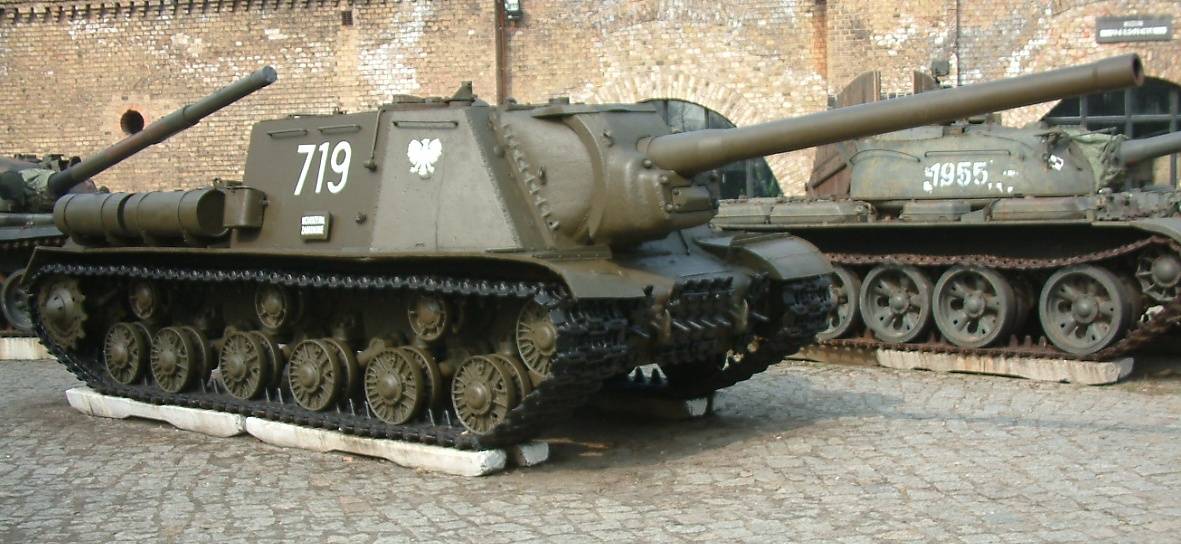
The SU-76, SU-85, SU-100, SU-122 and SU-152, sometimes known as 'ISU'(122, 152), were examples of the most common such guns. Note that none of these started as dedicated artillery pieces. Most were designed as anti tank or anti-bunker(assault) guns and moved onto to be (improvised and later dedicated) self propelled artillery capable of both effective direct fire(their original purpose) and fairly effective indirect support. Dedicated indirect artillery support was usually provided by towed artillery. The numbers of these SPGs vary wildly, so I'll take the numbers from my main source(Book for future admirals, see below):
SU-76 variants: 16000+
SU-85 variants: 2100+
SU-100 variants: 1200+
SU-122 variants: 2850+
Su-152 variants: 572
ISU-122: 2300+
ISU-152: 4700+
(some of these are overlapping figures, as some SU-122/152s were at some point dubbed 'ISU' or rebuilt to match the ISU specifications and vice versa).
The units were divided among either specialized artillery battalions/divisions, usually with 20-40 SPGs of varying calibers per artillery division. There are some personal stories by commanders who at one point during the war led over 100 SPGs into battle due to officer shortages or deaths, and reports of understaffed battalions that only had 5 SPGs at any given time.
You would often see a 'lopsided' distribution of guns in some divisions, depending on their role. If the division was about to assault a heavily fortified area, they would be issued more and heavier SPGs and less lighter SPGs(such as the SU-76). There was an artillery division on the Eastern Front, defending Leningrad, that consisted only of SU-76s.
While not the largest amounts of vehicles produced by a single country, I believe the Soviet Union had the largest variety of self propelled artillery and the largest numbers of such units used(meaning either improvised or dual purpose vehicles).
Sources(s):
'Book for Future Admirals', 1976/86(Russian)
'Compiled Russian Armory 1900-1979', 1989(Russian)
'Notes of a wartime loader', 1965(Russian)
Various compiled personal accounts and reports from old Russian books to verify some numbers.