If you need to make this more specific, I'm specifically interested in gold's treatment in native North American societies.
Thanks!
For people living in eastern North America prior to the arrival of Europeans, gold wasn't one of the metals they utilized. There just isn't much of it in the area, and what gold does exist is hard to extract. There are some gold artifacts made by the Calusa and their tributary communities in southern Florida, but none have been reliably dated to the pre-Columbian. The most likely, these items were made from gold salvaged from Spanish wrecks - something that the people of southern Florida are known to have done regularly according to the historical record (they'd also rescue the survivors of the shipwrecks and bring them to St. Augustine for reward / ransom, depending on how optimistic you're being about the relationship). That said, the Caribbean islands would provide a potential pre-Columbian source of gold and we know the Taino were making copper-gold alloys (one of the southern Florida artifacts is only 60% gold, the rest being copper and a bit of silver; though the silver would indicate a salvaged source again) and there was contact between Florida and the Caribbean islands. While the potential exists, there's nothing yet to confirm it.
Elsewhere in eastern North America, when Europeans showed up asking for gold, Native Americans generally lumped it in with copper. When Cartier asked the people of Hochelaga (now Montreal) if there was gold in the area, they pointed him westward, presumably in the direction of great copper deposits of Lake Superior.
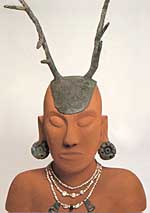
Copper was the most important metal used by people in the Eastern Woodlands. In ancient times (between 6000 and 3000 years ago to be more precise), the Old Copper Complex fashioned copper into all manner of tools, weapons, and ornaments, including knives, spearpoints, and awls, fishhooks. Here are some examples. The Old Copper Complex didn't smelt copper however. Since they were situation near those large native copper deposits around Lake Superior, they could easily mine raw copper directly and process it as needed. In this post I discuss how they went about mining that copper. Around 3000 years ago, there's a major shift in the copper industry in the area away from utilitarian purposes intended for local use and toward export (generally as raw materials that would be fashioned into ornamental or ceremonial items elsewhere). The Scioto Hopewell in Ohio (about 2100 - 1600 years ago) wore copper earspools and in at least one case a antlered copper headdress. This copper bird is another notable Scioto Hopewell artifact, because it has stylistic elements that would continue to be prevalent for centuries. Copper with these Mississippian copper "plates" and note, in particular, the >-shaped markings around the eyes. Here's a good look at what those markings are referencing. Both the Hopewell and the Mississippians had copper axes, but in both cases, they seem to have been ceremonial since there's wear patterns don't indicate that they were actually used for typical ax-related activities. The Hopewell also used copper to sheath their panpipes, as well as a few other miscellaneous uses. They also made silver earspools and iron beads and chisels; the silver came from Ontario and the iron came from meteorites.
Copper would continue to be an important trade resource into the colonial era. But while it was valuable, it wasn't valued in the same sense that gold was by Europeans. The most important difference is that it was never monetized. When, due to European influences, the Native societies of New England adopted an indigenous currency, it wasn't based on copper. Instead, they used standardized lengths of color-coded wampum beads, which for a time were popular with the colonists too during the early 1600s; the colonial governments established set exchange rates and allowed colonists to pay their taxes, up to certain amounts, in wampum.