Well, the big thing causing the huge changes to Pueblo (and Southwestern generally) religion in the 14th and early 15th centuries was the massive migration of people through the Southwest beginning in AD1275.
Between Ad1275 and about 1300 you see the almost entire depopulation of the Four Corners/Colorado Plateau area with ancestral Puebloan people moving south into the Rio Grande area, the Mogollon Rim (including the Cibola area [i.e. Zuni] and the upper Colorado [i.e. Hopi]), as well as into Southern Arizona and possibly northern Chihuahua.
With this population movement you get new communities that are large, dense, and multi-ethnic and multi-lingual. Because of this you see the development of a lot of new religious traditions, largely as a way of integrating these different migrant groups together into new communities or among established communities. Previous Puebloan religious practices really focused on smaller group activities within kivas (subterranean ritual chambers like this one - which would have had a wooden roof - from Pueblo Bonito in Chaco Canyon, NM). These religious activities were both more private - being in kivas rather than public plazas - and involved a restricted set of participants, primarily drawn from different religious societies such as a medicine society or war society. Bringing religious activities into the community as a whole is really what characterizes this period of Pueblo history.
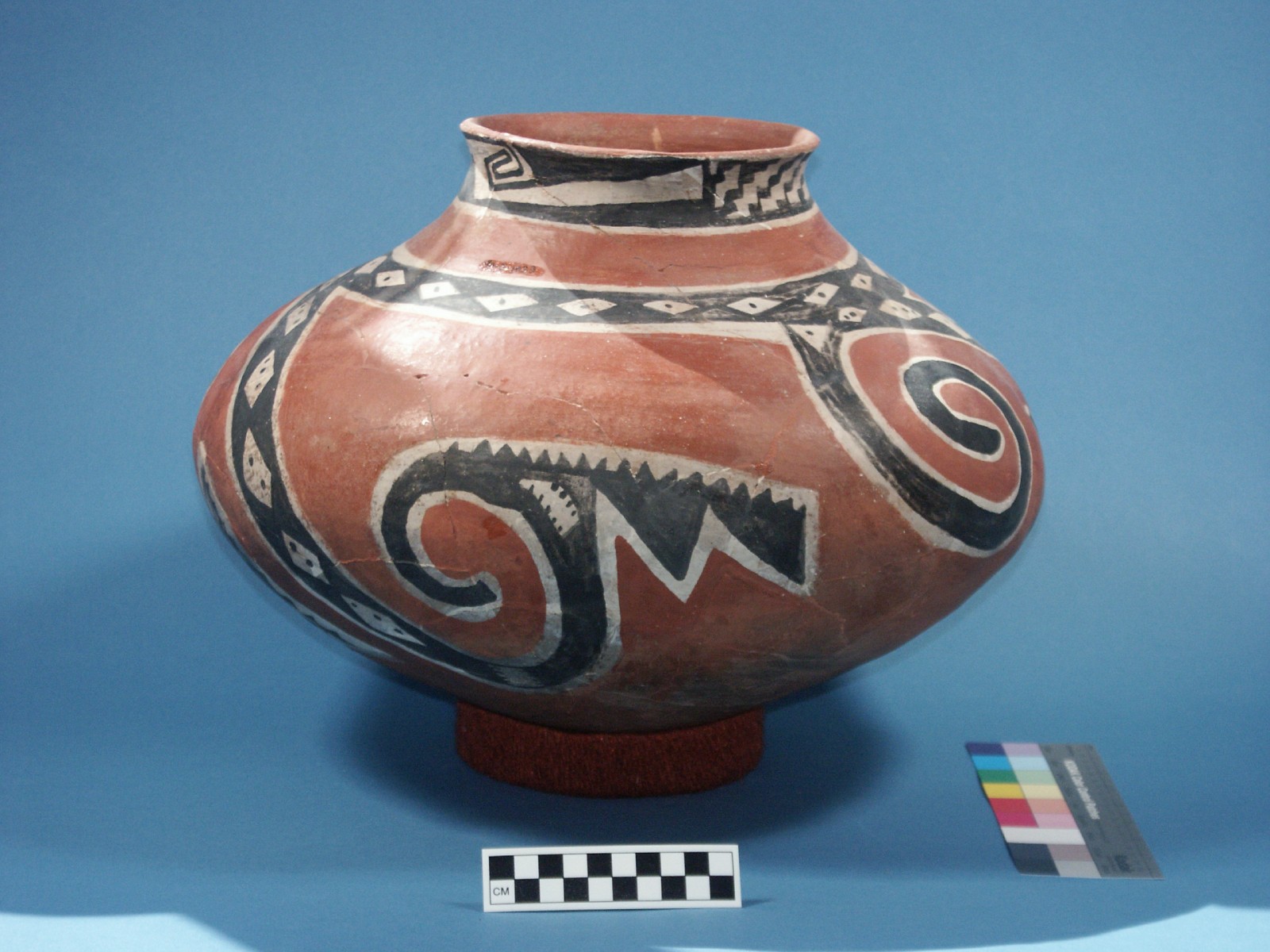
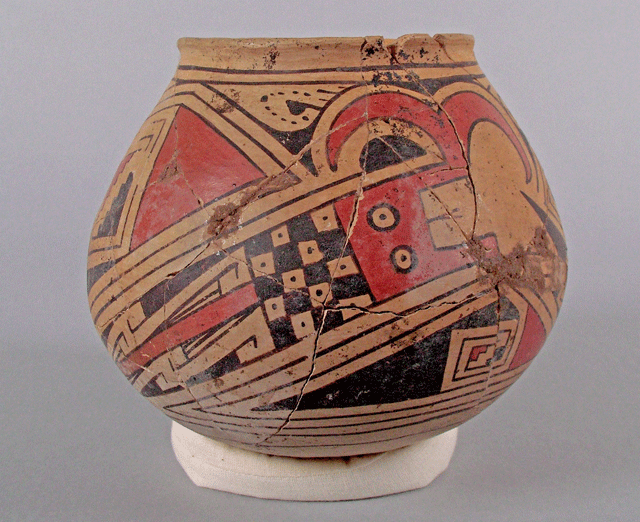
The big traditions developed in this time period are the Kachina cult (still practiced by Puebloan groups today), as well as the Salado cult or phenomena and the (likely) related Casas Grandes phenomena. All three are characterized by use of polychromatic pottery (in red, white, and black) with a huge increase in zoomorphic and anthropomorphic designs. Previous pottery traditions, mainly black-on-white and red-on-buff, focus on strictly geometric designs.
The kachina cult involves kachina spirits which represent different aspects of the natural world, especially specific land forms like mountains, as well as ancestors and mythic heroes. The primary focus of kachina religion is community rituals involving kachina dancers who dress up as and embody different kachina spirits. These kachina dances are very public spectacles (helping create community cohesion) usually intended to bring certain blessings (like rain or healing) to the entire community. In this time period you start seeing kachina masks (representations of kachina spirits as ritual dance masks) in murals, rock art, and in several types of pottery. Kachina religion is at present most prominent (and likely historically originated among) the Western Pueblos (Hopi and Zuni), as well as among the Rio Grande Pueblos.
Further south you have the development of the Salado and Casas Grandes phenomena, both of which have a lot of similarities suggesting a common origin or some other relationship between them. In general, both are characterized by the incorporation of a lot of Mesoamerican religious symbolism, especially in decorated pottery. Evidence for macaw breading at Casas Grandes, like these breeding pens with macaw eggshell found archaeologically, as well as the abundance of copper bells, further underscores the importance of Mesoamerican religious symbolism to both traditions.
The Salado phenomena is most closely associated with southeastern Arizona and New Mexico in highly multi-ethnic communities. The use of outside - i.e. Mesoamerican - symbolism may have been helpful in uniting these disparate groups. Likewise in northern Chihuahua where the important center of Casas Grandes dominated much of the region, though with probably significantly less mixed communities.
Both traditions are characterized by a combination of local southern Arizona (Hohokam) architectural traditions in the use of Platform Mounds alongside distinctly ancestral Puebloan ceramic traditions (red-white-black polychromes), both incorporating Mesoamerican symbolism. Among this symbolism, snakes, and particularly "horned serpents", are very prominent, such as on these Tonto Polychrome bowls (part of the Salado tradition) and on this Ramos Polychrome (from Chihuahua and the Casas Grandes tradition).
Interestingly, while the Casas Grandes phenomena is strongly associated with the site of Casas Grandes, the Salado cult is incredibly homogeneous and spread very quickly (in less than 25 years) without any clear center of innovation or central political/religious control. In other words, it looks like Salado was a very popular religious movement meant to help ease tensions in highly multi-ethnic communities while the Casas Grandes phenomena is very focused on expanding the sphere of influence based on the site of Casas Grandes itself.
While both the Salado cult and Casas Grandes (both the site and phenomena) didn't last into the 16th century, or even much beyond AD1425-1450, Mesoamerican influence did penetrate northward and influence 16th century (and later) Puebloan religious imagery. In particular, imagery relating to the "flower world" becomes quite abundant in murals and on pottery. Imagery of hummingbirds (and birds in general), as well as insects (especially dragonflies), alongside corn stalks, flowers, rainbows, and clouds all point towards a complex of images derived from Mesoamerican ideas about the upper world and strongly associated with fertility rituals and rainmaking ceremonies. While Salado and Casas Grandes don't have the temporal longevity of the kachina cult (which exists in the present among modern Pueblos), the influx of Mesoamerican imagery was likely translated northward by their success in these two 15th century Puebloan and Chihuahuan religious phenomena.