What an interesting question! i look forward to an answer by a classicist or archaeologist, but in the meantime I do enjoy taking a stab at empirical answers to 'yes or no' empirical questions through a little googling.
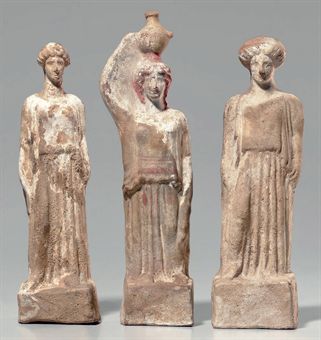
The most famous instance of female load-bearing on the head in "Europe" is the Greek Caryatid which shows up in western art and archetecture all over the place. However, a little image searching also turned up some more quotidian images of women balancing stuff on their heads across the Mediterranean world. I guess it's a handy way to carry heavy vases.
That said, I'd also be interested to know how the African women with a basket on her head become such a staple of the colonial and post-colonial imaginary.
Not just a stereotype. Head-load portage by African women is well documented and studied, according to research cited in Nature says that Kikuyu and Luo women who practice head loading from an early age can carry up to 20 percent of body weight with no additional energy use than unloaded walking.The abstract says that head carrying seems to be particularly suited to rougher terrain, but that when women move to cities they tend to give it up. I wonder if the same thing happened as rural Europeans moved to better paved cities and towns.
Sort of. The saccol was still commonly used in France at least as late as 1890. This was a sack that dangled from the head, typically with straw padding where it contacted the head and soldiers. It was used to carry loads over long distances.
Eugene Weber discusses this in [Peasants into Frenchmen: The Modernization of Rural France, 1870-1914] (https://www.goodreads.com/book/show/750401.Peasants_Into_Frenchmen?from_search=true&search_version=service) in a chapter called Roads, Roads, and More Roads. It is not on my shelf at the moment, but it discusses a wide array of different strategies which were used by the peasantry to carry heavy loads over long distances. The whole point of the book is that most of France was not actually modernized, much of it was not even French speaking, until World War I, so a lot of these practices actually went on after industrialization was suppose to have happened.
There is a famous statue of kumica at Zagreb's main vegetable market. Kumica is a name for a peasant women from Zagreb surroundings who came to sell their produce at the market in Zagreb.
The statue has a woman carrying a basket on her head, which is how they carried goods into town.
Also the image of the statue and folklore "reenactment". http://i50.tinypic.com/2zylvo7.jpg