While dynasties spread thousands of miles to the West, South and North, the Korean peninsula remained largely untouched by the Chinese powers, despite its wealth and proximity. Why was this the case? Geographical reasons? Military strength?
Okay, this question comes up again and again: I'll actually try to answer it, using Chinese periodization. It's probably a bit incoherent, sorry in advance. Do feel free to ask follow-ups.
I begin with Eastern Zhou because that's when Korea properly enters the historical record; the first "Korean" (which was not a concept that yet existed) state we know of - Joseon, generally called Gojoseon to distinguish between a later and more famous Joseon - is for the first time mentioned in various Chinese texts. Throughout most of this period Korea was in the Bronze Age, which had begun in Korea around the late 2nd millennium BC (the Iron Age in Korea began around 300 BC). Meanwhile for China this was a period of disunity, and the various warring Chinese states had no real reason to overextend their strength by invading the distant Korean peninsula.
Another point that should be made was that the the Yan, centered in northern Hebei, did make efforts to attack to the east. However, what was east to the Yan was not Korea but the Liaoning region. According to a text called the Weilüe, for example, the Yan general Qin Kai invaded Gojoseon around 300 BC and conquered "two thousand [li](https://en.wikipedia.org/wiki/Li_(unit))" - but archaeology does not back up the idea that the Yan exerted influence in Korea around this time. What seems more likely is that Yan took power in southern Liaoning (which was likely the previous center of Gojoseon) and forced Gojoseon to move into northern Korea, though this theory is still on the speculative side of things and still disputed (it is the consensus in South Korean academia).
Anyways, there is little doubt that "Korea proper" remained largely outside Yan hegemony.
##Qin and Han: The Early Empires (221 BC~220 AD)
As the Han state was founded in China - itself a successor to the Qin dynasty - Gojoseon (by this point probably centered in modern Pyongyang) also underwent a regime change (in 194 BC) with a Chinese immigrant named Weiman seizing power and usurping the king. Weiman's kingdom prospered until 109 BC, when Emperor Wu of Han invaded it with almost 60000 soldiers. The invasion had multiple causes, including its ties to the Xiongnu confederation (think the Mongols), a bitter enemy of China, but especially Gojoseon's attempts to take/preserve a middleman position which disrupted trade. After all, Gojoseon's "power likely derived partially from his ability to deny his rivals access to the Han court." In 108 BC Gojoseon surrendered, and the Chinese installed four commanderies in northern Korea. So Han China did in fact conquer significant swathes of Korea.
This state of affairs did not last long. In 82 BC the four commanderies were merged into two. In 75 BC the Xuantu Commandery had to be moved. The only commandery left in its original location was Lelang, probably around Weiman's old capital in the Pyongyang region, which continued to cast great influence in the region. Lelang would actually persist until 313 AD, a century after the end of the Han, so it wasn't too connected to central control (Chinese lacquerware from Lelang). Nevertheless, it's worth remembering that China has conquered much of Korea.
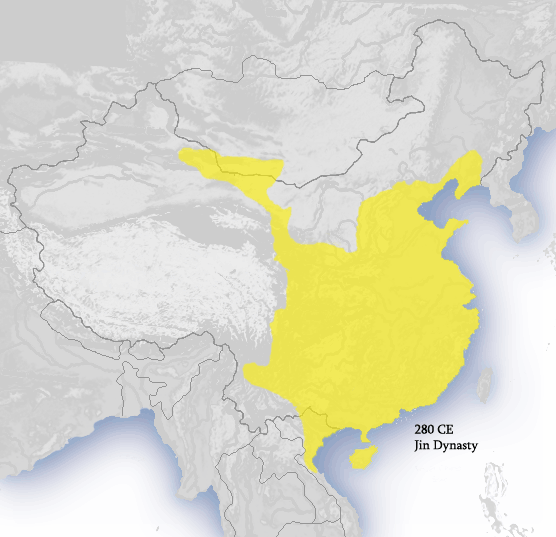
China was divided for most of this period, although Jin briefly reunited it. Meanwhile in Korea states were forming, and by the time China reunited under the Sui the peninsula would be organized into three states; Goguryeo in the north, Baekje in the southwest and Silla in the southwest and center. As during Eastern Zhou times, the Chinese states were generally not strong enough nor motivated enough to seek to enforce direct control over a distant region like Korea, although as with Yan there were Chinese invasions into Korea. In 245, for example, the capital of Goguryeo was sacked by a Wei army, but the Wei did not hold it and Goguryeo recovered.
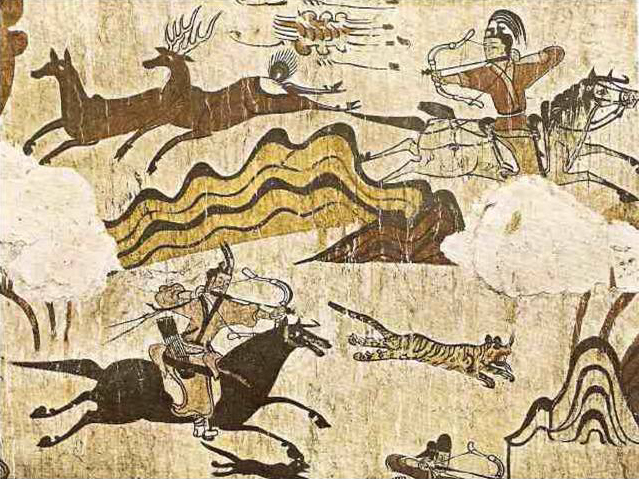
China was reunited in 589 by the Sui dynasty, which took to invading Goguryeo (Goguryeo archers), the aforementioned northernmost "Korean" state. One Sui edict in 597 accuses the Goguryeo ruler of oppressing the Mohe and the Khitans (other peoples in the region), bribing Chinese crossbow craftsmen to come to Goguryeo, making it impossible for Chinese envoys to see or hear anything, raiding China with cavalrymen, that kind of thing; next year 10000 Goguryeo soldiers invaded China. The Sui emperor was understandably pissed and invaded, but bad weather destroyed the Sui fleet and the Turks took the chance to raid China. Eventually the Sui emperor recalled his forces and the Goguryeo king apologized (Baekje, one of the other two "Korean" states, offered to help China conquer Goguryeo but China declined, nevertheless the proposal caused Goguryeo to attack Baekje in retalitation).
There was soon another Sui invasion of Goguryeo, after the same Goguryeo king refused to concede to Sui demands of the king personally coming to pay tribute to the emperor in Beijing (who was a different emperor by this year). This invasion is said to have involved 300,000 soldiers. The Goguryeo forces engaged in large-scale siege warfare and ensnared the Chinese into a trap; the invasion was an immense Chinese failure to the point that allegedly only 2700 soldiers returned (probably an exaggeration). But hardly discouraged by this failure, the Sui emperor continued to launch campaigns, over and over again, and the Chinese continued to be repulsed, over and over again. Eventually, the Sui collapsed; the failed campaigns against Goguryeo was a major factor.
The Sui were followed by the Tang, who in 622 accepted the independence of all three Korean states as nominal vassals. In 640 princes from Goguryeo, Silla, and Baekje all studied at the imperial academy in Chang'an, and a peace with the east seemed to have been established (not everywhere - Tang China was fighting massive campaigns against the Turks in this period). But in 642 a Goguryeo general slew his more peace-oriented king (who had studied at Chang'an) and assumed power while putting a puppet on the throne. The Tang were not pleased, to say the least, and invaded three times in the 640s. All of them got bogged down in siege warfare and mostly achieved nothing. So the famous Emperor Taizong died with Goguryeo still unconquered.
This state of affairs changed under the reign of his son, when China allied itself with the kingdom of Silla (which was encountering a large-scale Baekje invasion). So in 660 a joint Sino-Silla campaign conquered Baekje; with this base in Korea, and with Goguryeo weakened by civil conflict after the death of Goguryeo's de facto ruler in 666, Pyongyang fell in 668 to the Sino-Silla army.
Tang then tried to directly govern Korea under the Protectorate General to Pacify the East located in Pyongyang, with the Xiongjin Commandery for former Baekje territory and the Jilin Commandery for Silla territory, which meant essentially conquering its formaer ally Silla. Silla did not like this, and there was war in the 670s. Tang China was, however, preoccupied with a rising problem (the Tibetan Empire which was rather close to Chang'an) and lost the war. Afterwards, China had no interest in pursuing the costly conquest of Korea, as Silla was a loyal tributary that made no trouble for Chang'an and China had much bigger fish to fry.
The Tang collapsed into six decades of varying degrees of chaos in China, the result of which was the innovative but militarily weak Song Dynasty. At the same time, the Khitans, a nomadic people related to the Mongols, began gathering massive power, and eventually the Khitan khan declared himself Emperor. The Khitan were conquered by the semi-nomadic Jurchens of Manchuria in the 12th century, and the Jurchens conquered a third of Song China as well. Eventually the Mongols arrived and conquered both the Jurchens and the Song. Meanwhile in Korea, the Silla also devolved into chaos; a new regime, the Goryeo, emerged as the victors and created a centralized and more sinicized monarchy.
The Song and Goryeo had an amicable relationship throughout the era and the Song never invaded Goryeo (nor was there any particular reason they would want to). By contrast, the Khitans did invade Korea several times in the 11th century, with the Korean capital sacked; eventually the hostilities ended with a settlement generally better for the Korean side, and there were no hostilities afterwards. Unlike the Tang, the Khitans had no interest in conquering and governing Korea; their interest in it was more strategic and it would be a waste to invade Korea for no good reason when Song China is still seeking to reunite China (parts of northeastern China had been conquered by the Khitans).
Oops, got too long, will continue in a comment.