...and why did no great kingdom ever develop there?
I've never been there but from google images it doesn't look like a bad place to live. It looks similar to Alaska and Canada.
There are trees, grassland, lakes, and I'm sure a ton of wild game. I just don't understand why it was so depopulated.
Why did the Mongols choose to make the desert their home (Mongolia) when they could've went further north and had much nicer lands?
I'll let someone else (hopefully) discuss Siberia and the Khanate of Sibir, after which Siberia was named. Instead, I wanted to address a point you brought up:
I've never been there but from google images it doesn't look like a bad place to live. It looks similar to Alaska and Canada.
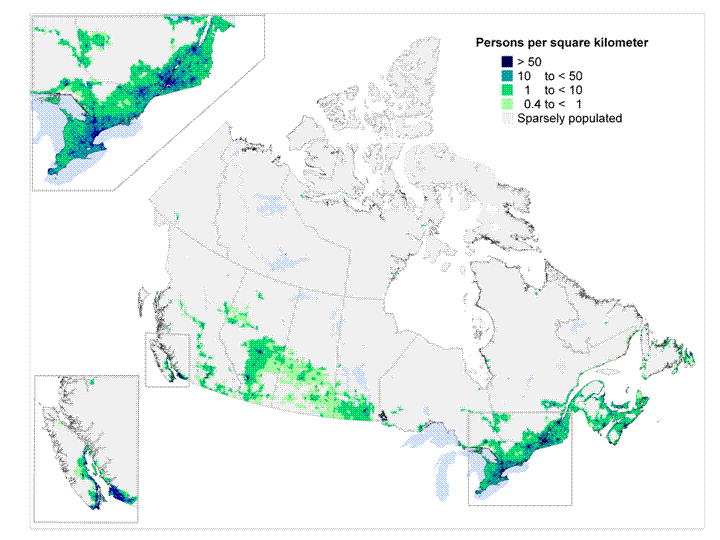
Prior to the development of mass transport most of what's now Alaska and Canada was sparsely populated. Even today the population of Canada is highly concentrated in the south (map). Like Siberia, most of Canada and Alaska is taiga and tundra - environments with long, cold winters and short growing seasons in the summer. Such environments are poorly suited to agriculture; it also means that less plant matter being grown each year for animals to eat, and in the taiga that's largely tied up in form of inedible / unpalatable trees. Without agriculture, you need some exceptional circumstances to support a large, concentrated population. Or, as is more common today, you ship in food grown further south or harvested from a large area (especially the ocean), both of which require modern transportation methods to sustain. Even then, its usually better to move people to where the food is than to move the food to the people, at least on that scale. This is why Siberia and Canada continue to be very thinly populated.
This isn't to say there isn't interesting history or concentrated populations to be found in these regions, both before and after the colonialism of the British and Russian empires. But, by and large, these regions don't have the ecological infrastructure to sustain high population densities over large areas without significant investment of resources from the outside.
Why did the Mongols choose to make the desert their home (Mongolia) when they could've went further north and had much nicer lands?
The Gobi Desert lies along the border between Mongolia and China. The northern part of Mongolia is grasslands, which provides fodder for large herds of animals and allows for an economy based on pastoralism. The taiga to the north would be as poorly suited for pastoralism as it is for agriculture, since domesticated animals are mostly grazers rather than browsers. Ironically the tundra, being more a more open environment is actually better for pastoralism, but with reindeer rather than the more familiar domesticated animals of the south. During the expansion of the Mongol empire, they pushed their Yakut neighbors northward into the Siberia, and the Yakuts did successfully breed cattle and horses that can survive in southern Siberia at least. Elsewhere they rely heavily on hunting, fishing, and reindeer-based pastoralism - which they would have adopted from their other Siberian neighbors.
It often gets to -50°C in winter. There is little food for most of the year and constant permafrost prevents crop growth. In other words, it's a horrendous environment that is unable to sustain any large population and definitely unable to sustain a sedentary population.
Re the Mongols, they were nomadic and civilization is putting it a bit strongly. Definitely culture. Civilised, not so much. One of the reasons they were such formidable warriors was due to the harshness of the environment they came from. In later years they often sent youths back to the steppe to toughen them up.
And re Canada / Alaska. Did any great civilizations spring up there? I was involved with an excavation on a sedentary population of South Dakota, but that was a hard life and suffered from over exploitation of the environment meaning they were more semi-nomadic. I can't imagine there were many great cultural flourishings further north. I suppose the costal cultures of the BC coast, but they were a maritime society and small groupings, so don't really count.
Just so you know, most of the land in Canada as is most of the land in Siberia is really, really not densely populated. My very quick, totally unscientific search for popl. density maps shows that a goody chunk of Canada, Alaska, and Siberia have popl. densities less than 8 people per square miles. Most of the densely populated chunks are in the southern boundaries of those geographic spaces.
I'm not sure what you mean by "much nicer land." The various lands occupied historically by the Mongols included both steppe grasslands and deserts. Grasslands were fine and dandy to feed the flocks and herds of a pastoral people and even deserts had concentrations of agriculture and commerce in the form of intense oasis farming and long and short distance trade. There doesn't seem to be any particular impetus to move northwards where the deciduous forests and tundra wouldn't have exactly fit their economic or military mode of life.
As for your grander question of why no great kingdom, I can't really say. Except maybe point to the fact that frozen tundra can't grow as much as a more temperate, fertile clime to support larger population?
As a Canadian, I'm going to point out the the regions of Canada that look like Siberia are EXTREMELY SPARSELY populated. They just cannot support large populations. Most peoples living in these areas survived in a hunter/gatherer capacity and now pay exorbitant amounts of money to have food shipped in my airplane. The parts of Canada that are populated are much more similar to the American mid-west, east coast, and north west coast (Washington = British Columbia), than Siberia