Well, I was wondering, bread has been a very common food for a long time, and it is quite easy to make, which makes me think it is one of the first 'elaborated' meals ever. But when was it invented?
In another - but related - topic, the first records we have of food with multiple ingredients date to when (and where)?
Nobody really knows.
Or at least, not specifically when and where. Bread in one form or another has existed for thousands of years, some evidence exists dating early bread to as far back as 30,000 years ago. The starch grains found in that study were found in Italy, Russia, and the Czech Republic, each dating to around the same time period, showing just how widespread the use of wild grains to make bread was even in prehistory.
Agriculture was not a single event in world history.
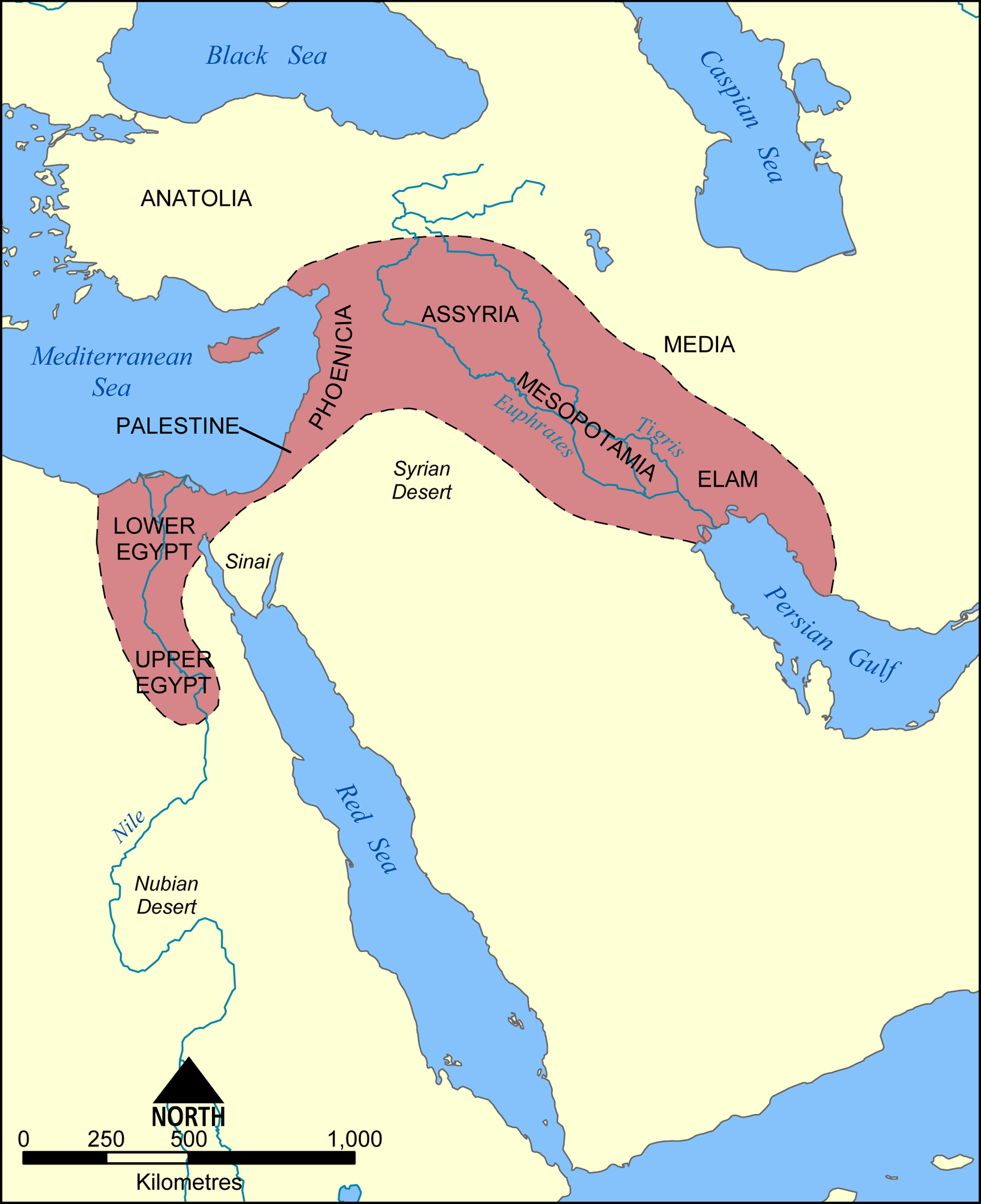
Agriculture began independently in several parts of the world at about the same time, including Mesoamerica, where maize, the domesticated version of the wild grass teosinte, first appears, the Yangtze region of southeast Asia, where rice was first cultivated, and lowland and highland regions of South America, which are the sources of potato, peanut and manioc. The fourth major centre of domestication was the ‘Fertile Crescent,’ a region of southwest Asia comprising the valleys of the Tigris, Euphrates and Jordan rivers and their adjacent hilly flanks.[1]
The cereal grains grown in the Fertile Crescent (map) include wheat, barley, flax, and the chickpea. Wheat and barley are particularly suited to making bread, and evidence has shown the harvesting of wheat in the Fertile Crescent as early as 7500 BCE - 7000 BCE[2]. While agriculture may have began in several parts of the world at the same time, the Fertile Crescent is a good place to look for the first food item that you or I would easily recognize as bread because of the presence of wheat and barley, and also because of the production of beer.
Bread has been closely tied to the production of beer for several reasons. If kept dry cereal grains can last months or even years, and then ground into flour to make gruel, which then can be made into bread. To keep the grain dry they would often be stored in underground pits. It would be difficult to keep these pits completely watertight, and water would seep in. The grain would begin to sprout, releasing starch, which is then turned into maltose sugar by enzymes produced by the moistened grain. The maltose sugar causes the water to taste sweet when drunk, something early agricultural humans would likely notice and try to recreate.
Grain gruel, a staple food, becomes slightly fizzy and alcoholic when left out for a few days, essentially a crude beer. The earliest evidence of beer comes from a set of pottery shards found in the Zagros Mountains of Iran circa 3400 BCE - 3000 BCE, right in the center of the Fertile Crescent[3]. That these people were storing grain and using it for beer shows that they had likely been making a form of bread for a long time, and that it would somewhat similar to bread eaten today.
While baked cereal grains have existed throughout the world for around the last 30,000 years, the existence of wheat, barley, and beer in the Fertile Crescent suggest that a food most similar to what you and I would call "bread" was likely first made somewhere in the Fertile Crescent sometime between 7500 BCE and 3000 BCE.
Sources:
[1] Brown, T. A.; Jones, M. K.; Powell, W.; Allaby, R. G. (2009). "The complex origins of domesticated crops in the Fertile Crescent". Trends in Ecology & Evolution 24 (2): 103. link
[2]Gepts, P. (2004). "Crop Domestication as a Long-term Selection Experiment" Plant Breed 24: p. 15. link
[3] R. H. Michel, P. E. McGovern, and V. R. Badler (1993). "The First Wine and Beer: Chemical Detection of Ancient Fermented Beverages" Analytical Chemistry 65: 408A-413A. link
To answer your second question I found a piece from the Yale library. Sorry if it's not my own original research.
hese two clay tablets from the Babylonian Collection, inscribed in Akkadian contain the oldest known cooking recipes. They date to ca. 1750 BC, the time of Hammurabi, known for his famous law code. The cuneiform writing system was complex and generally only scribes who had studied for years could read and write, so it is unlikely that the cookbooks were meant for the ordinary cook or chef. Instead, they were written to document the current practices of culinary art. The recipes are elaborate and often call for rare ingredients. We may assume that they represent Mesopotamian haute cuisine meant for the royal palace or the temple.
From the thousands of tablets recording deliveries and shipments of foodstuff, from vocabulary lists of various kinds of food and from records of payments to workers and soldiers we can get a fairly accurate picture of the standard Mesopotamian diet.
The meats included beef, lamb, goat, pork, deer and fowl - the birds provided both meat and eggs. Fish were eaten along with turtles and shellfish. Various grains, vegetables and fruits such as dates, apples, figs, pomegranates and grapes were integral to the ancient Near Eastern diet. Roots, bulbs, truffles and mushrooms were harvested for the table. Salt added flavor to the food as did a variety of herbs. Honey as well as dates, grape-juice and raisins were used as sweeteners. Milk, clarified butter and fats both animal fats and vegetable oils, such as sesame, linseed and olive oils were used in cooking.
Many kinds of bread are mentioned in the texts from the lowliest barley bread used for workers' rations to elaborate sweetened and spiced cakes baked in fancy, decorated moulds in palace kitchens.
Beer (usually made of fermented barley mush) was the national beverage already in the third millennium BC, while wine grown in northern Mesopotamia was expensive and only enjoyed by the royal household or the very rich.