Obviously I don't expect these civilizations to have Kayak.com or hotel rentals but I was curious if such advertising to the noble classes or site-seeing was common? And were there specific companies or groups of people that would facilitate this for them?
In late antiquity and the Middle Ages, long-distance religious pilgrimage very much took on trappings that we would recognize as tourism today. The underlying spiritual motive and meaning of those voyages remained paramount, but some version of "tour groups", "sightseeing", "publicity back home," and yes, "souvenirs" make an appearance.
The Itinerarium Egeriae is one of our earliest European texts by a female author, likely a noblewoman, possibly a nun, from Spain. She describes her trip throughout the Near East in the last years of the Roman Empire, very much on an organized trip with a tour guide of sorts:
We were also shown the place where Lot's wife had her memorial, as you read in the Bible. But what we saw, reverend ladies, was not the actual pillar, but only the place where it had once been. The pillar itself, they say, has been submerged in the Dead Sea --- at any rate we did not see it, and I cannot pretend we did.
But Egeria is not only interested in the holy sites:
I want you to be quite clear about these mountains, reverend ladies my sisters, which surrounded us as we stood beside the church looking down from the summit in the middle. They had been almost too much for us to climb, and I really do not think I had seen any that were higher (apart from the central one which is higher still) even though they only looked like little hillocks to us as we stood on the central mountain. From there we were able to see Egypt and Palestine, the Red Sea and the Parthenian Sea, as well as the vast lands of the Saracens---all unbelievably far below us.
Egeria signs off her text with her intention to pursue a pilgrimage further east, to Ephesus and into Asia. We do not hear from her again.
The Muslim conquest and post-Crusade reconquest of the Near East did not abolish European pilgrimage. Fifteenth-century laywoman Margery Kempe likewise visited Jerusalem with a tour group. In her Book, she describes having visions of the Passion actually taking place in the holy sites she visits. She is also concerned to establish her authority and knowledge of Christianity with the other (male?) pilgrims in her “tour group.”
The Church, of course, greatly promoted both local and long-distance pilgrimage throughout the Middle Ages. The pilgrim route to Santiago de Compostela in Spain is the most famous. Songs and entire liturgies (church service hymns and readings) formed around the “Camino de Santiago”. Handbooks or “travel guides” discussing the best way to go about it were popular texts.
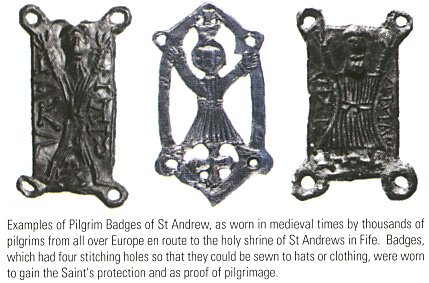
And, of course, if you went on pilgrimage, you needed a token to remember it by, right? Thus pilgrimage badges became a popular commodity. These were little metal trinkets, often with holes so you could sew them to clothes or (frequently) felt hats. Their ubiquity took them to the point of being parodied. That’s right. The Middle Ages not only had tour groups, travel guides, and postcards back home, it had “My brother went to Jerusalem and all I got was this little sculpture that looks like genetalia.”
During the Roman period Sparta basically became a tourist destination with many of the people dressing in a stereo typically Spartan fashion and showing off the past glories of their city to the delight of Roman tourists. The site of Troy was also a major destination. It has been theorized that the reason why there was so little metal found at Troy was that it was all picked up by tourists looking for souvenirs.