What do you mean by "turn around"? Do you mean in terms of economics or military or political stability or all of those? For the military of Nazi Germany, I can answer very sufficiently.
The short answer is that Hitler had little to do with the turn-around of the German military in the 1930s in regards to the operational, tactical and technological improvements made in that period. He, however, engendered the policies that allowed the German military leadership to accomplish these improvements faster and to also drastically increase the size of the Wehrmacht (the armed forces of Nazi Germany). He put the rearmament program on full steam.
However, the rudiments of the operational concepts that will later produce spectacular victories for the Wehrmacht from 1939–1942 were conceived in the 1920s in the USSR – in war games where German officers trained alongside Soviet officers and together researched manoeuvre warfare with armour (i.e. manoeuvre warfare using armoured vehicles). This was several years before Hitler came to power.
To add to /u/iHistorian's answer, The WWI armistice was signed on November 11th 1918 & as such the politicians that signed this armistice were called Novemberverbrecher ("November Criminals") by the German public, even though the armistice was signed in Nov. 1918 the peace treaty ("treaty of versailles") that solidified & put in practice the values in which the allies wanted to uphold after the war weren't decided upon until January 1919 between the "big three": President Woodrow Wilson (a democrat^1), French Prime Minister, Georges Clemenceau & British PM, David Lloyd-George. (even though Italian prime minister, Vittorio Emanuele Orlando did also attend but due to certain differences, Orlando left. Orlando did return just before the treaty was signed but by then it was too late to be a signatory, something Orlando would later look back on with joy)
The Versailles treaty included an all manner of articles (440 to be precise) of what should happen in Europe now WWI was over. Some of the key things to mention that were included in the treaty were:
The creation of a "league of nations" outlined in Wilson's Fourteen Points
German loss of the french territories (that the German state pf Prussia won in the Franco-Prussian War; 1870~1871); Alsace-Lorraine
All German colonies to be given as "mandates" to the league (which after a certain amount of time, their future would be decided upon.)
Eupen-Malmedy, Melmet & Hultschin were given to Belgium, Lithuania & Czechoslovakia respectively.
The German armed forces to be reduced to 100,00 men, 6 battleships & no airforce
The Rhineland was demilitarized & The Saar was given to France for 15 years after which a plebiscite (vote) would take place.
Germany was forbidden to unite with Austria-Hungary ("Anschluss")
Germany was made to pay war reparations
Germany was made responsible for causing the war, known as the "War guilt clause" or Article 231.
Now as you can imagine Germany would've been quite shocked by all this. The sum of total reparations came to 6.6 billion USD & wasn't decided on until 1924. By this time the "Dawes Plan" had been devised by America to help Germany pay the reparations. Now why did America help Germany? Well this all comes down to America not joining the league of nations. ("1" = Because Wilson was a democrat & the rest of congress was republican they didn't want to get involved in European affairs after the way in which war had affected them. Wilson's successor, Warren G. Harding proposed a "return to normalcy:" He basically wanted to return to the way in which America was before their entry into war in 1917)
This "return to normalcy" led to the reintroduction of "The Monroe Doctrine; 1823 it stated:
that the United States would neither interfere with existing European colonies nor meddle in the internal concerns of European countries.
This isolationist attitude led to the raise of high tariffs on foreign goods meaning it would be cheaper & easier to buy american goods (see the "1922 Fordney-Mccumber Tariff"). This was one of the main causes for America's economic boom & unfortunately would be the cause for it's economic depression
The economic boom made a hell of a lot more things affordable, e.g. Henry Ford's "Model T" went from $825 in the 1908/1909 financial year to $260 by 1925. This cheap price meant that almost everyone no matter how much you earned could afford a car. This was achieved by the utilization of the assembly line. Other things were mass produced as well, such as "white consumer goods" such as Radio's, Fridge-freezers & TV's. However the only problem with this was once families had one they didn't need another. This led to overproduction & shares in companies falling drastically because people were trying to buy out & sell their shares, with disastrous consequences...
Now back to Germany, because the US was experiencing a economic boom & because they weren't apart of the league of nations (this would become a hindrance as the league was left to be run by the complacent UK & France who took forever to handle situations & caused crises e.g. Manchurian Incident & Abyssinian Crisis) they could help Germany if they wanted, so they did. The Dawes Plan (and later "The Young Plan") was adopted to loan Germany money for reparations.
Once the "Wall Street Crash" had occurred in America due to falling stocks, overproduction amongst many other issues), the US fell into a depression (where we get the phrase "on the breadline" from) & couldn't afford to help Germany. So soon Germany followed suit & fell into economic depression as well.
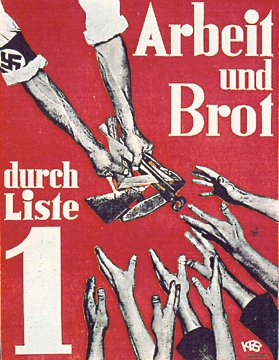
From 1920-1929, the Nazi party had been growing in influence & number, they'd staged the 1923 Munich "Beerhall" Putsch" where they'd tried to overthrow& seize the Weimar state which resulted in 16 Nazi's dying & prison sentence for Hitler (where he would go on to write Mein Kampf) By the time depression hit, unemployment rose drastically, people were losing faith in their country, this is where Hitler comes in... Hitler promised "Arbeit und Brot" ("Work & Bread"); basically the promise that if the Nazi's were elected unemployment figures would fall. Hitler made people believe he would make Germany great again by reversing the treaty of versailles making the right people accountable for their actions, he also promised Anschluss & Lebensraum; More living space for German people.
The public eventually started to believe Hitler was their only hope. As can be seen in the propaganda poster. "Unsere Letzte Hoffnung: Hitler" ("Our Last Hope: Hitler")
Hopefully this answered your question, if you have any others please don't hesitate to ask :)
Sources & Further Reading:
Paris 1919: Six Months That Changed the World ~ Holbrook. R & McMillan. M
The 1920s ~ Drowne. K & Huber. P
The Great Crash 1929 ~ Galbraith. K. J.
The Weimar Republic ~ Kolb. E
Weimar Germany: Promise and Tragedy ~ Weitz. D. E.
The Weimar Republic (Seminar Studies In History) ~ Hiden. J
The Coming of The Third Reich ~ Evans. R
Hitler ~ Kershaw. I