I'd like to imagine that even before very precise tools, we liked our buildings straight and square. How did humans measure and cut lumber in the middle ages to meet these needs?
Indeed, medievals liked their timber as square and smooth as we do.
I love this manuscript illustration, which comes from the Bedford Hours, a prayer book from ~1423 CE. It is supposed to depict the building of Noah's Ark, but it looks suspiciously like a timber-framed house. The artist clearly saw house construction and fudged it to be the Ark.
And for our purposes, the tools of house builders and shipwrights are the same: the Bedford Hours shows tools which we would recognize today: saws and adzes for cutting and rough straightening timber. You can see someone at the bottom drilling a hole, and someone drilling a peg-hole in the assembled timber-frame. Scattered on the ground are hammers, wood mallets, chisels, adzes and another type of saw: the frame or bow saw.
We see these tools again in another picture of a carpenter here. But this time he has badly injured himself while truing timber with an adze. This image is part of a set of painting by Antonio Vivarini from 1450; they illustrate the miraculous works of Saint Peter the Martyr. The description from the Metropolitan Museum in New York:
This painting belongs to a series of eight scenes that would have been arranged around an image or statue of Saint Peter Martyr (1205–1252). Here the saint ministers to a youth who had kicked his mother and cut off his leg in remorse. A genial storyteller, Antonio sets the scene in a carpenter’s shop.
The clever Vivarini has given us a picture of the medieval carpenter's shop: the frame/bow saw again, a long plane, the adze, and various timbers leaning against the workshop walls.
Returning to the first picture of the bedford hours: in the bottom left corner is a carpenter working a large plane - the long soled planes are meant to flatten long lengths of wood. The wood he is working on is so large that it rests on the ground, and it's wedged in logs for stability so the planing is straight and true.
Now, look at this guy working in the house itself. Hanging from his belt is a black object - an object which looks suspiciously like a windable chalk line reel for setting long, straight lines, something we still use today (if we can't afford a laser). Or it may very well be a windable cloth measuring tape.
You'll note that all the images are Christian motifs. Another one which provides us with lots of building techniques is the constructtion of the Tower of Babel. Thisone shows us a 12th century depiction of levels, plumb bobs, and squares.
Now, if the carpenter wanted a polished surface he had other tools for the job. Below is a copy of a post I did some time ago:
This is one of those weird bits of history that I have researched, going back to when my teenage interest in medieval history dovetailed with a passion for woodworking (see what I did there?).
Anyway, I recollect references to 3 types of 'sanding' of wood before the modern era: a sharkskin called dog shark or dog fish, certain silica-heavy rushes (stiff marsh grass) and leather or cloth impregnated with ground stone, perhaps carried with an oil.
As I said my 'research' was in libraries over 20 years ago and I remember finding it in a book about medieval building. I remember this because I was seriously stoked at digging something out of the stacks. Sure enough, tonight google found it for me in a reference to a reference. In this medieval terms reference book there is a word 'hundysfishskyn' in Middle English Dictionary from University of Michigan, and that points to the book I actually remember looking at: Building in England down to 1540: a documentary history by Louis Francis Salzman. Hundysfishskyn is houndfish or dogfish. Unfortunately Google doesn't seem have this book scanned in and available to look through. But I found another web reference to the text, take it for whatever it's worth to you:
>L.F. Salzman in Building in England down to 1540: A Documentary History (Oxford: Oxford Univ. Press, 1952) mentions "sanding" using rottenstone, scouring rush (aka equisetum, horsetail fern, shave grass, etc.), or dog-fish skin. On the latter, Salzman notes receipts for "hundysfishskyn for the carpenters" (Westminster, 1355) and "j pelle piscis canini pro operibus stall" (Windsor, 1351).
As it turns out Equisetum is known for scouring.
So that's a 14th century reference. But wait, there's more!
In the same obscure web site above, there is a reference to the book On Divers Arts: The Foremost Medieval Treatise on Painting, Glassmaking, and Metalwork by a certain Theophilus of the 11th century. This book is partially searchable and seems to turn up the reference to the same rush called shave grass for sanding wood; alas, Google does not preview anything but a snippet.
Incidentally, smooth polishing of fine wooden stringed instruments is still done the same today as it was in the baroque period: with rosen powder after shellac coats.
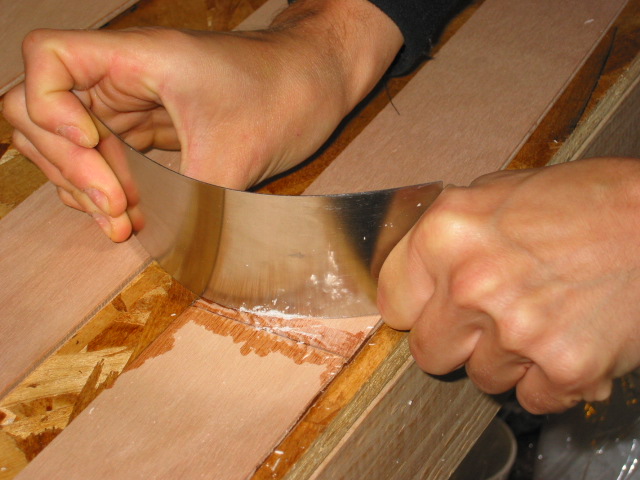
The above would all be final finishing. After hand planing surface imperfections can be removed with a cabinet scraper. If you've used a scraper before, you'll know the burr on the edge will give you a surface finer than sanding as it cuts the grain, not grind it down. Sanding 'fuzzes' the raw grain and so it's preferred for finishing coats that have stiffened the grain enough for the sandpaper to 'cut'. Scrapers are very old technology: basically a thin piece of steel with some flex. Some handplanes in museums carry confused labeling and are actually devices for holding the cabinet scraper: using a cabinet scraper for extended periods will burn your fingers. I have seen examples of cabinet scrapers dating back to the baroque period.
Here's a cool video on the topic.
https://www.youtube.com/watch?v=aI8VWjpKBlA&feature=youtu.be