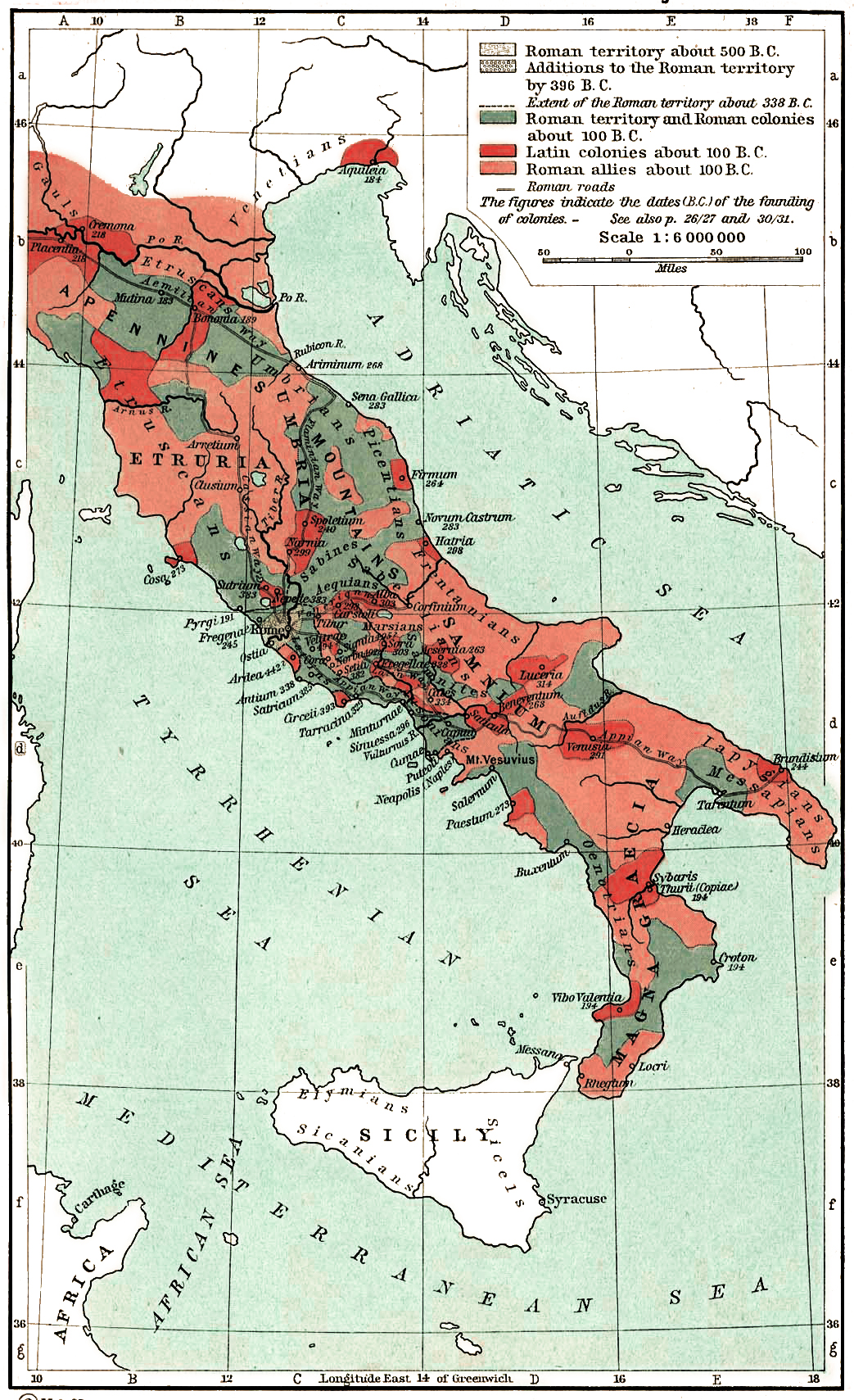
[Marcus Livius Drussus](https://en.wikipedia.org/wiki/Marcus_Livius_Drusus_(tribune) was a Roman tribune of the plebeians in 91 BC who was assassinated after proposing a controversial law which would have given citizenship to Rome's Italic allies (something like light pink in this map). This was the last straw for the Italics, who then started the [Social War](https://en.wikipedia.org/wiki/Social_War_(90%E2%80%9388_BC) with 100k troops already ready to go. This war was a major destabilizing event for the republic and led to Sulla's first civil war and some other very ugly precedents, which is why some see the Social War as the beginning of the republic's end.
So was this war avoidable? Before Drussus was assassinated, was there enough support from the Senate and/or the people to think general enfranchisement had any hope of passing into law before war broke out?
The tribunate of the younger Livius Drusus has indeed often been seen as the last point at which the republic might have been 'saved', frequently with the moralizing implication that the republic was something worth saving. I will not discuss this here. So, if we want to look at the chances of M. Livius Drusus to complete his reform projects, we need to look at three things:
The situation of the Roman Republic and it's allies and associates
The aims of M. Livius Drusus the younger and those of his opponents
The influence of Drusus' reforms on the social war
The Roman Republic on the eve of the social war
The Social War and his resolution (the after-effects of which could be felt still into augustean times) can and have often been seen as one of the last and defining acts in the development of the relationship between Italy and its new hegemonial power, the city of Rome. And it was not much more than the city of Rome, the most powerful city on the peninsula at least since the sack of Veii 396 BC, controlling the culturally heterogenic peninsula of Italy, full of peoples divided by the mountaneous terrain, speaking different languages (like Latin, Oscan, Umbrian, Etruscan, Greek), with different cultures and practices, through a network of bilateral alliances and treaties. However, when Augustus assumed power as 'first among equals', Italy was full of Roman citizens, Latin was the dominant language, and Rome the dominant economical, cultural and political centre.
Before the end of the war, due to this varied nature and the nature of Roman control, there were many different forms of citizenship that those under Roman power could have. On the one hand, there were the Roman citizens, those who could proudly boast civis romanus sum, and enjoy the legal and military protection that came with that as well as the economic opportunities. These citizens were mostly those of the city of Rome and its directly controlled territory, the ager Romanus, taken mostly in conquest from vanquished enemies; as well as the Roman colonies that were founded in conquered or near enemy territory to ensure control over these lands (the character of these colonies is made pretty clear by one of the colonies nicknames, Sutrium, which was called the 'shackles of Etruria' by Livius). A different category of Roman citizenship was the civitas sine suffragio, the Roman citizenship without the right to vote, which can be seen as more of a punishment since, f.e., they still had to provide troops without having any say in the political affairs.
Then you had the Allies and Colonies of Latin Law, which were those cities who didn't get the Roman Law after the Second Latin War 340-338 or colonies founded with Latin citizenship status. Those Latin citizens still had the ius conubium, so they could marry Roman citizens, the ius commercium which meant they could conclude legally valid contracts with Roman citizens and the ius migrationis, which meant they could get Roman citizenship upon moving to Rome. All of those were autonomous communities bound to Rome by bilateral treaties. They, too, had to provide soldiers.
On the other end of the spectrum were the allies (called socii) without Latin Law, which were all those autonomous communities and cities of Italy who were bound to Rome by bilateral treaties, which specified that they had to support Rome with troops in exchange for protection.
So Rome controlled Italy via direct control and alliances. Rome was at the centre of everything, the relevant political decisions were taken there, but the means of influence for those these decisions affected, even if they were Roman citizens far from Rome, were quite limited. This sytem had proved its strength during the Second Punic war, when Hannibal, despite being successful again and again in the field, and trying his best to diplomatically gain support of the Roman allies, apart from some isolated successes in the south of Italy, was unable to break apart the system of alliances and form one of his own against Italy. After the second Punic war had removed any serious contestant to Roman hegemony in the western mediterranean, there was no external power that could threaten this system of control.
However, the strong bilateral treaties that proved so successful in keeping Romes allies at her side during the Hannibalic war proved unflexible. Following the war, the burden of the allies increased, the campaigns grew longer and often brought few rewards (for example the long campaigns to subdue spain, which were wildly unpopular among the soldiers), and it seems that often the allies were given the more dangerous missions and took the higher losses. So towards the end of the second century BC, we have a situation that is growing increasingly uncomfortable for those Italians without Roman citizenship. They had to shoulder higher burdens with less say in the political decisions that concerned them, they had disadvantages in economical matters and some personal freedoms, and it seems that the agrarian reforms of Tiberius Gracchus began to threaten Latin and Italic private property as well; however at the time they were successful in their protests against the Roman encroachments on their land.
It may be that Tiberius Gracchus already was concerned with the question of citizenship for the Italians, but this seems unlikely. The consul Fulvius Flaccus proposed a law in 125 BC that promised citizenship, or the right of provocatio, to appeal to the Roman people for protection against actions of its magistrates, something which all Roman citizens possessed, to the Italians, in return for them giving up some of the ager romanus they occupied, hindering its distribution to Roman citizens; however, according to Appian, Flaccus was unable to overcome sentatorial resistance against his proposal. It is probable that the failure of Flaccus' proposal was the catalyst for the unsuccessful revolt of the city Fregellae, a latin colony, and it also seems likely that the Fregellians expected to be joind by more cities and colonies in their fight, which otherwise would have been - and proved to be, since the city was taken, levelled and turned into a village - suicide.
The brother of Tib. Gracchus, Caius, tried to take over where his brother had left off in 123, and, wishing to provide a stronger fundament introduced a bill which would have given the socii the Roman citizenship and so tried to win their support against the senate. Another one of his laws would have given the Latins and allies more protection against the actions of Roman magistrates. This was one of the main points of attack M. Livius Drusus, the Elder, Gracchus' colleague as tribune of the people, used in his opposition against C. Gracchus' reforms - if the allies were to be given more protection against the Roman magistrates, such as the right to provocatio, what would they need Roman citizenship for? As we know, the opposition proved successful, and C. Gracchus was murdered along with Fulvius Flaccus and about 3.000 of supporters.
These events did not improve the relationship between Rome and her allies. The Gracchian reforms, while their effects were for now averted, had shown that Rome might threaten the possessions of Latins and Italians again. The Latin and Italian aristocrats and leaders couldn't be sure that the Senate would defend them against overbearing Roman magistrates, and common citizens even less; they saw that true legal protection lay in the Roman citizenship. The actions of Marius exacerbated these problems. On the one hand, the settlement of veterans required the assignation of new land, which had to be taken from somewhere. On the other hand, Roman citizenship and thus the opportunity to serve in the citizen legions and receive land as a Roman citizen on release became more attractive. In the year 95, the lex Licinia Mucia de redigendis in suas civitates sociis ordered the return of those citizens that had unrightfully claimed Roman citizenships into their hometowns. Cicero describes this law not only as useless, but actively detrimental to the republic, and Diodorus recounts an episode where Poppaedius Silo, a Marsian and later leader in the following war, marched on Rome with 10.000 followers to demand Roman citizenship; and accordingly this law has been viewd as one of the reasons for the social war. Another possible interpretation is that this law was actually beneficial to the allies, since it returned lost workforce to the allied cities, and as such may have been to the benefit of the local aristocrats, which were often seen as the driving force behind the social war.