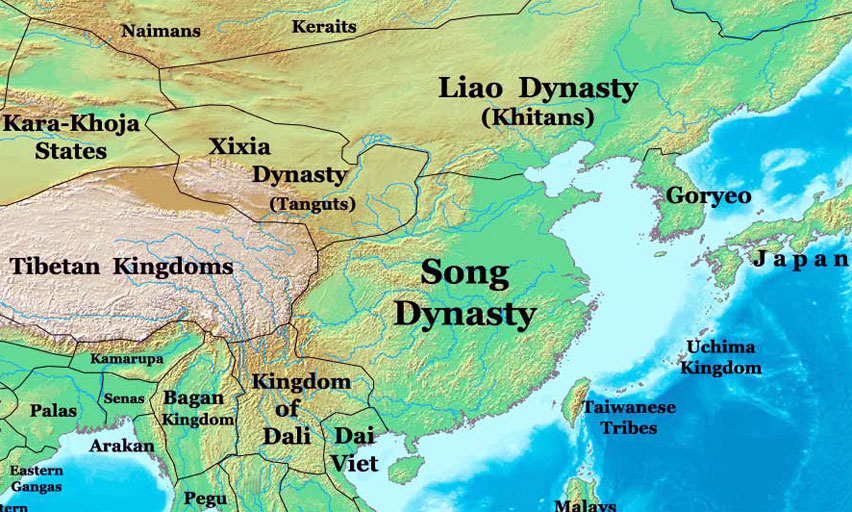
Before the Yuan and Ming Dynasty, China appeared to be constantly divided into multiple kingdoms...and then mostly reunified then disassembled just like the Chinese claim in their Dynastic cycle.
I know that northern groups like the Manchurians, Turks, and of course the Mongols would carve out parts of China for themselves and adopt their customs and administrative systems.
Were there any other cultural or ethnic groups that would take advantage of a favorable political situation and break their own state away from the Middle Kingdom? Or would most of these groups have been considered Chinese at the time?
From my perspective two of the most interesting non-Han Chinese ethnic groups were the Tangut and Khitan peoples, having ethnic ties to the Tibetans/Qiang and Mongols respectively. Both possessed kingdoms in the north simultaneously with the waning power of the Song dynasty. The Tangut state is especially interesting, referred to in full by its people as "The Great State of White and High", commonly known as Xi Xia or the Western Xia it existed formally from 1038 to 1227. In the 8th century these Tangut peoples were permitted to settle in Xia prefecture (modern day Shanxi) by the Tang court after exclusion from regions such as Tibet, on the Ordos desert border. As part of the agreement, the Tangut people helped quell major civil disorder in the Tang empire - including the Huang Chao rebellion in the late 800s.
Depending on the source, a Tangut leader either adopted or was granted the Tang dynastic name Li and became the duke of Xia. Essentially, in exchange for subservience and assistance the Tangut exercised mostly limitless autonomy. As the power of the Khitan in the North grew, the Song sought the Tangut as an ally to counter this burgeoning threat, eventually leading to the posthumous crowning of a powerful Tangut leader as King of Xia. However, subservience of the Tanguts was in the interests of both the Song and Khitan states and mixed relations followed at the threshold of the milennium, compounding by factional coups within the Tanguts and resulting in conflicted foreign policy. Tangut envoys under Li Jipeng surrendered to the Song in 982 and offered the core Tangut provinces in Shanxi in return for subsidies and titles befitting one of Chinese nobility.
This was seen as treason by many Tanguts and total humiliation, and in response Jipeng's cousin raised 20,000 troops to engage in provocation of Song forces along the border. This cousin subsequently recognised the growth in strength of the Khitan people of the North, and their state Khitan Lhao, and even offered subservience in preference to the Song to the Khitan. Meanwhile another aspect of the Tangut court continued negotiations with the Song. As with the Tangut relationship with the Song, their relationship with the Khitan was short lived - even with the Khitan ruler himself conferring the Tangut leader the title King of Xia after an arranged marriage with a Liao princess. At this time, Tangut power was solidified with expansions into modern day Outer Mongolia and Gansu, making up much of the territory of the Western Xia - however the peoples were still split in loyalties between Song-dependent Li Jipeng and his Khitan-dependent cousin, Li Jiqian. The son of the latter would go on to gain further territorial acquisitions to the West - which resulted in a formal declaration of the independence of the Xia dynasty in 1038.
Supported by annual subsidies from the Song in silk and silver [provided in preference to the huge expense of potentially conquering the Xia], the Western Xia court was able to stay in power for two centuries until the rise of the Mongols and their total annihilation.
For interest, the first modern discovery of Western Xia writings came in 1804, when a young Qing official called Zhang Shu was informed of an age-old artifact in Wuwei (known as Liangzhou), his home town. On return home he decided to investigate it with some friends - it stood bricked up within the grounds of a Buddhist monastery. Obtaining permission to demolish the brick casing, a grey slab emerged, described by Zhang Shu thusly:
We wiped it away and suddenly characters appeared and could all be recognised. Looking closer, however, we could not read a single character. . . I said that the back side must certainly have the translation, and so ordered that [the bricks at] the back side be cracked open, revealing its substance to be indeed a [Chinese] translation . . . My discovery of this stele has now made it available to the world for the first time.
This discovery of [then unknown to be] Tangut script garnered little recognition until a century later, when a Finnish colonel in the Russian army called Baron Carl Gustav returned to the stele and documented it with photographic evidence. Subsequent research into the script showed the Chinese translation to be different - stressing the importance of the native Han population [as opposed to the majesty of the Tanguts which the reverse professed]. Here it was shown the Tangut preference for referring to the state as "The Great State of White and High", the etymology of which is completely unknown. Various theories for this - referring to the abundance of salt in the region for example - have been proposed, but none as yet proven.
Regardless, Liangzhou became the Western Xia capital and their empire came to stretch some 1200 km from east to west, of near-imperial proportions. Along with this came the usual trappings of a sinicised dynasty, everything from a new dynastic name to a dress code, and an unusual hairstyle concocted to distance the Tangut from China proper. In accordance with Xia law, anyone who failed to adopt the new hairstyle within three days was threatened with death, and thus mass adoption was to be expected. According to historian Yu Ying-Shih, "The top part of the skull was shaved, leaving a fringe across the forehead and down the sides, framing the face." Along with this the Tangut court almost exclusively utilised Buddhist terminology and patronage in validation of the state, effectively making it a Buddhist empire.
The Tangut script was finished under Yuanhao Weiming and state-mandated for almost all purposes. Translations of key Buddhist scriptures was made, a legal code established, and an army of approximately 200,000 available to command by the Western Xia. War ensued with the Song whom denounced the Yuanhao Weiming's declaration of the Xia empire, in which the Khitan Liao eagerly participated to complicate matters. Whilst the Xia scored victories, inroads into Song China proved difficult. Eventually the compromise struck involved nominal Song suzerainty over the Western Xia, whilst within the state the Xia ruler was free to use any titles he pleased. Along with this came the aforementioned annual subsidy from the Song, and the Western Xia went on to outlast both the Khitan Liao state and the subsequent Jurchen Jin state before eradication by the Mongol invasion.
Sources:
China: A History - John Keay
The Age of Confucian Rule: The Song Transformation of China - Dieter Kuhn