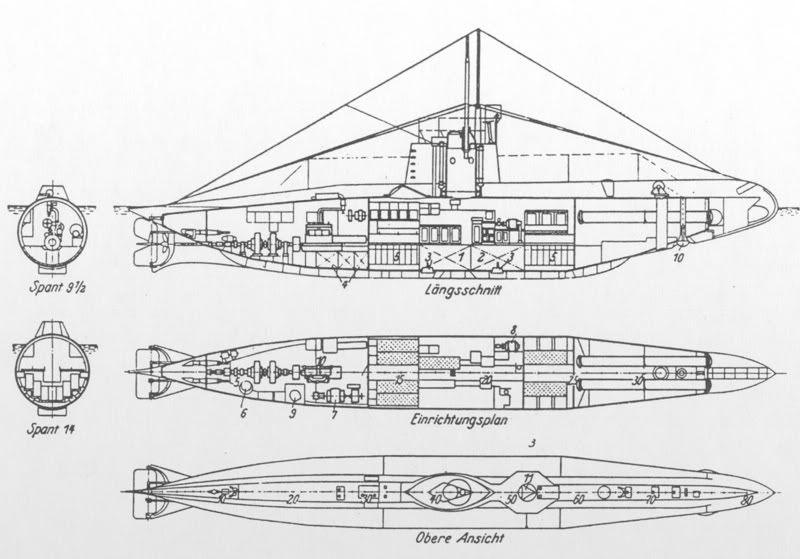
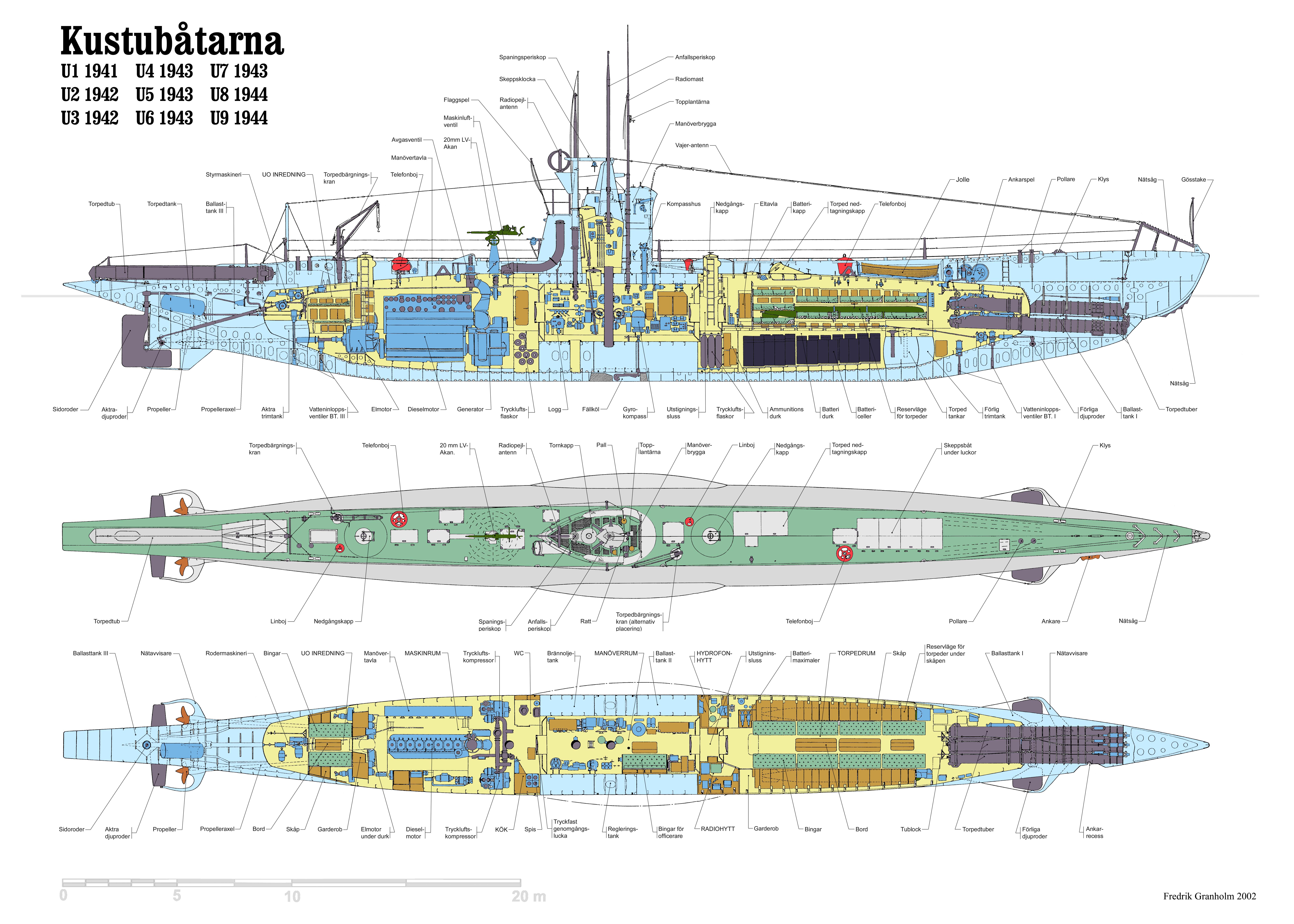
The change in German submarines in the interwar years was very much evolution instead of revolution. There have been a few periods of revolution in submarine technology, with periods of slow improvement in between:
As you can see the big revolutions happened at the turn of the century, during WWII, and from the mid-50s to the early-60s. From the Holland type submarines, there was a gradual evolution to larger submarines during WWI. For example, look at the lineage of submarines from ~1900 to the end of the war:
You can clearly see the smooth transition from the Holland-type to the more mature UB III design. Certainly there were innovations made, but no huge leaps like from an American WWII Fleet Boat to the nuclear powered USS Nautilus.
In the interwar years, little progress was made (as is generally true for other areas of military development during the period) due to economics and restrictions put in place by the Treaty of Versailles and other interwar arms treaties.
As a result, there wasn't a great deal of change between WWI U-boats and WWII U-boats, at least for the first half of the war. The late interwar years produced the Type II, which was the predecessor to the ubiquitous Type VII (the most widely produced and the subject of Das Boot) used extensively during WWII. Both were essentially just the late WWI U-boats made with modern construction techniques and small technical improvements. The story is the same with the larger, "cruiser" type U-boats like the WWII Type IX.
The big improvement during the interwar years was that the hulls could be welded instead of riveted, which increased diving depth enormously. The test depth of the UB III class was 50 m, whereas the Type VIIs could easily dive to 200 m, and in some cases went down to nearly 300 m. Sonar was introduced, which had a marginal use until the middle of WWII when U-boats were forced underwater by strong Allied air-cover.
The tactics of U-boats were born out of WWI experience and did not change greatly as the convoy system was implemented in both wars, leading to similar tactics. The WWII U-boats were coordinated via radio into wolf-packs which increased their effectiveness at the beginning of the war, whereas WWI U-boats were more "lone wolfs".
As the war ground on and the U-boats began losing the Battle of the Atlantic, they started being fitted with snorkels so they didn't have to surface to run their diesels and recharge their batteries and deck guns were removed get a bit more speed underwater. The culmination of German WWII U-boat design was the Type XXI, the first submarine to be built from the ground up to maximized submerged performance. Before, U-boats were essentially submersible torpedo boats, only diving when evading threats (they even did many of their torpedo attacks from the surface). Such was the revolution from the earlier WWII U-boats that you can hardly find any resemblance between the Type VII and Type XXI.
Sources
Submarine Design by Ulrich Gabler
Type VII U-boat by Robert C. Stern
They might have looked similar, but there were a number of improvements between the workhorse submarines of WW1 and WW2. Submarines in the first world war were principally powered by kerosene engines early on, and then diesel in the latter half. By WW2, diesel engine fuel efficiency, power, and reliability had vastly improved, and the same for the batteries and electric systems used for submerged propulsion. Another huge advance was hull strength and diving depths, with welding replacing rivets in the pressure hull. Hydrophone and sonar technology were much more advanced in WW2.
Development of the TDC (torpedo data computer). Contrary to what's seen in movies and video games, torpedoes had the range to be on the way to their targets for anywhere up to 15 minutes, depending on the type of torpedo, and weren't shot "from the hip". The TDC was an analogue fire control computer that calculated firing solutions and lead angles for torpedo shots, replacing various slide rules and paper/pencil calculations
Torpedoes in world war 1 were usually steam-driven. This remained generally true for the first few years of WW2, although wakeless electric torpedoes became the norm fairly soon in the German and US submarine forces. For example, the Germans quickly began to generally restrict the G7a steam-torpedo with it's G7e battery-powered counterpart for daylight attacks. Fuses were much more advanced during WW2 with the introduction of magnetic detonators, and while these had several big teething and doctrinal problems in both the major submarine forces early on, were very effective when they worked. Towards the end of the war, the Germans employed the FaT and LuT torpedoes which would run in ladder patterns along a target's path to increase chances of a hit, and both the Germans and Americans developed acoustic homing torpedoes.
Early on in WW2, tactics were strikingly similar to WW1, both when it came to the early period of neutrality laws and rules of engagement as well as the general process of later conducting unrestricted submarine warfare. The real driver of change was improved ASW defenses. In the Atlantic, German submarines were unable to effectively operate in wolf-packs after 1943 because of increased Allied air presence hampering submarine's movement and communication. In the Pacific, the US Navy had a bit of a freer hand, and were able to effectively use radar in their operations.