What would chairs, bedding, and cookware look like?
This will vary to a degree depending on what time period we are talking about, but I'll try and cover what is most typical of Pueblo households and points out some places of divergence. In particular I will only be talking about the time period after about AD500 which is when we can really start talking about identifiable "Pueblo" (or more properly, "Ancestral Puebloan") culture as opposed to a more general Southwestern culture.
Just as a general preface, but in order to effectively retain heat in the winter and stay cool in the summer, small (or no) windows and small doorways are extremely helpful. Thick adobe walls also very effectively retain heat or keep cool. That said, this does mean that the interiors of Pueblo homes would be very dark. Consequently, most daily activity would probably not actually take place inside the home, but rather outside of it under a ramada (for shade and protection from the elements) where lighting would be much better. Very often, access to interiors or rooms would only be through a ladder in the ceiling rather than a door in a wall, and rooftops of Pueblo buildings would probably be another important living space.
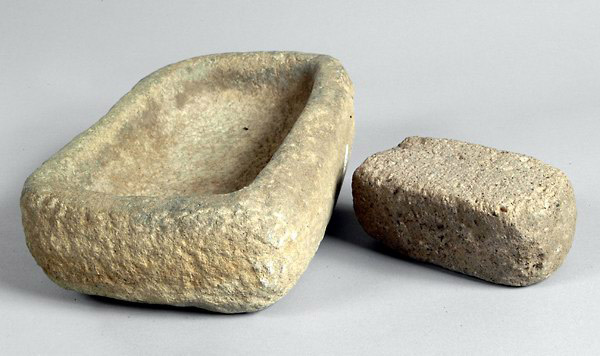
Food Preparation: Aside from cooking vessels (which I will address under pottery), you have an array of tools aimed at food preparation. Most significantly, just about every household would have a mano and metate to use for grinding corn into cornmeal. A mano and metate would both be made from coarse igneous stone (for a better grinding surface). Both elements take many forms, but generally the metate takes the shape of a shallow trough in which the corn would be ground while the mano (Spanish for "hand") would take the form of an oblong and flattened stone used to actually grind the corn inside the metate. For example, this mano and metate. Grinding corn would typically be the task of the women in the household and was very strenuous work (as you can imagine seeing the size of the mano in that picture and the effort needed to grind enough corn for an entire household).
Additionally, since Pueblo people had few domesticated animals (mainly turkeys and dogs), an important source of protein was hunting. Rabbits would have been an easily accesible form of protein (especially given they tend to live in your agricultural fields) and would have been a mainstay. That said, wild game was also exploited, especially deer and various birds. Consequently, most Pueblo households either owned, or had access to through family relations, a bow and stone-tipped arrows to use in hunting (as well as for warfare).
Clothing/Textiles: Cotton textiles were very important and quite common in Pueblo households. Everyday dress would probably consist of a long, tunic-like garment cinched at the waist with a belt. This would suit both men and women, but the cut and style of the garment would often be different. Depending on the weather/season and the particular group and activity, the men might go bare-chested with only a lower wrap. Footwear consisted of sandals, usually woven from yucca fiber. For instance, this archaeological example. There is evidence of cotton socks and leather footwear that was probably used in colder months, especially for traveling through snow.
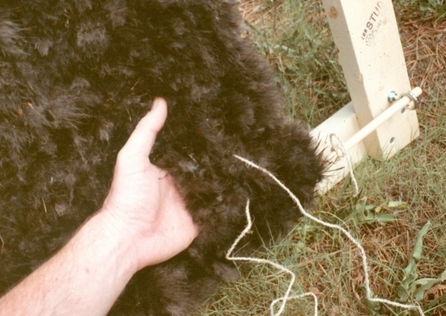
There would be no furniture like chairs in a Pueblo household, as everyone would sit on the floors, probably on a set of blankets. Cotton blankets would be used both as seating and for bedding material. Turkey-feather blankets would also be an important household item (though also an important ceremonial item), and there is considerable evidence that turkeys were largely kept as domesticates for access to feathers rather than meat. A reconstruction of such a blanket.
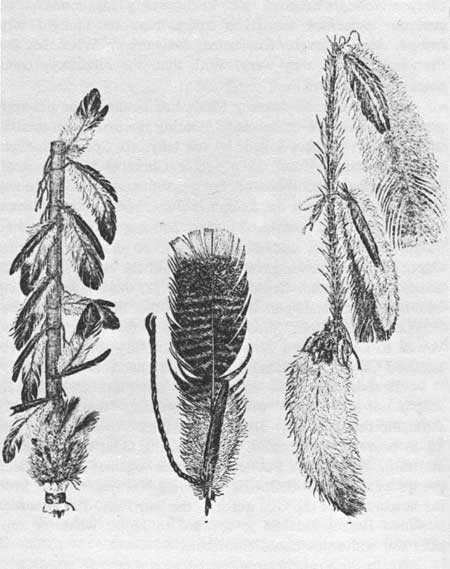
Not an article of clothing, but related to use of feathers, prayer sticks were a very common element of Pueblo religion. They generally consist of a stick with feathers tied to it in a certain pattern. The patterning of the feathers as well as the specific bird the feathers would come from dictated the purpose of the prayer stick. For example, this illustration of prayer sticks from Jemez Pueblo. These are not a strictly domestic item, but they might find their way into a household for specific purposes in the same way you might find a cross in a Christian home just the same as you would find a cross in a church or in public somewhere.
Pottery: Probably one of the most prolific domestic items in many Pueblo households there is quite an array of ceramics used in daily life (as well in ceremonial situations). Two primary forms were used, being jars and bowls. Within the category of jars there are wide-mouthed jars and ollas, which have a restricted neck. Additionally, there are "seed pots" which are jars without any neck and were used for exactly what they sound like - storing seeds (primarily corn, bean, and squash).
A whole category of ceramics archaeologists call broadly "utilityware" would be the primary cooking vessels in a Pueblo household. In most areas these utility wares take the form of "Gray Wares" which are exactly what they sound like: pottery made from gray-to-brown firing clays. Very often they are decorated with some variation on a texturing design like this indented corrugated olla. This type of pottery would most often be used for cooking over a fire (stews being a very common type of meal) or for storing water, especially in the close-necked ollas.