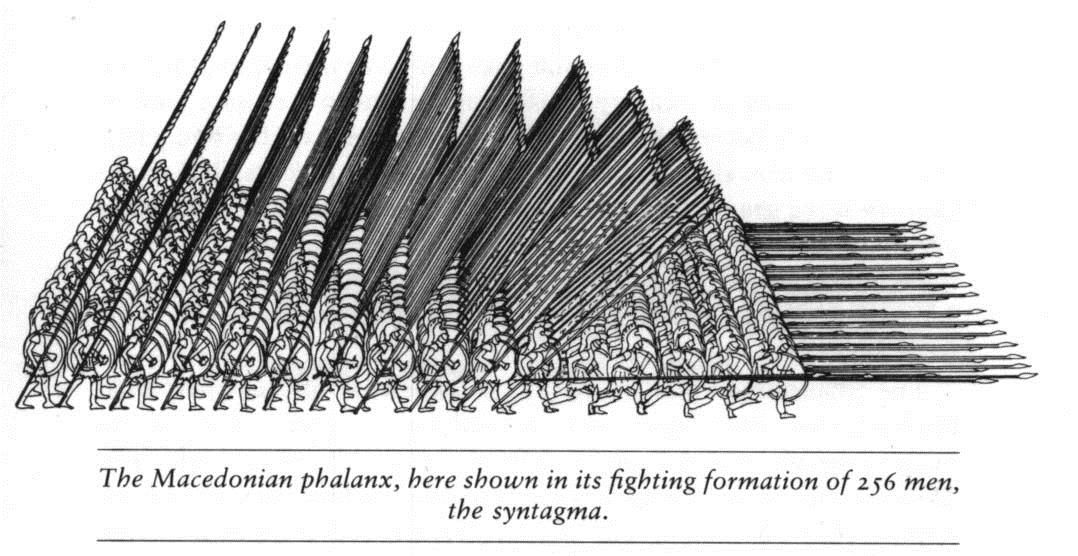
To begin with, Macedonians generally didn't fight as Hoplites, but as Phalangites. This is a distinction that comes from the fact that the Greek Phalanx and Macedonian Phalanx are two distinct methods of fighting.
The Greeks are probably what you're more familiar with, wielding spears maybe two or three meters in length, fighting as a densely packed mass of men who pushed with their shields while stabbing with their spears.
The Macedonians primarily used a much longer spear, really a pike, called the Sarissa. This weapon was usually much longer than the traditional Greek spear, I want to say around 6 meters in length but I'm sure lengths could vary. This would have been the formation that Alexander the Great used, while the Greek Phalanx is more what you might imagine the Spartans at Thermopylae using.
The advantage of the Macedonian Phalanx was that since their spears were so long, you could have the spears of men three or four ranks back pointing forwards, creating a dense wall of spear points that it was almost suicide to attack head-on, because any soldier would have to pass through around six meters worth of thrusting spear heads just to get to grips with the enemy.
The problem with the Macedonian Phalanx, which existed to a lesser extent with the Greek Phalanx, is that the densely packed men aren't very maneuverable and, while strong from the front, could be disrupted by terrain or flanking attacks with calamitous results.
Off the top of my head, there are four major conflicts where the Romans would have faced significant amounts of soldiers armed 'in the Macedonian fashion'. These are the Pyrrhic War, the Macedonian Wars, the Roman-Seleucid War, and the Mithridatic Wars. Together these represent something like twelve major battles, and for the most part the Romans won, although their first two battles against Pyrrhus of Epirus and his Macedonian Phalanx were very closely fought (and provides us the term 'Pyrrhic Victory', which means a victory won at a ruinous cost).
Generally speaking, the Romans could not break the Phalanx in a frontal assault, nor should they be expected to. Typically something would happen that would tip the scales in Rome's favor - at the Battle of Cynoscephalae the Macedonians had problems with their deployment. At Pydna the Macedonians at first seemed to be winning the day while the Romans ineffectively tried to hack off their spear points, but they pushed the Romans back into uneven ground, where their formations had difficulty staying together and were overwhelmed. The Seleucids had either War Elephants or Scythed Chariots or both that were ineffectively deployed, routed, and then sent careening back into their own lines to disrupt their phalanx before their flanks were routed. Similar things happened to Mithridates in his wars against Rome.
One last point. It would be wrong to imagine armies of men just throwing themselves on the Pikes of the Macedonians because of course it's imprudent to do so. Rather, the Macedonians could use the force of their spear wall to bully and push the enemy army, and make them give ground. Where they really came into their own, however, was when a commander deployed 'hammer and anvil tactics', where the Pikemen are the anvil, and strong cavalry forces are the hammer that batters an enemy army into the wall of pikes.
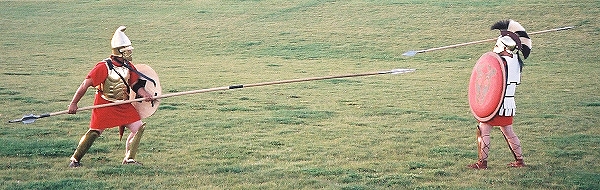
Briefly, here are some images to clarify the differences between a Macedonian Phalanx, and a Phalangite, versus a Greek Phalanx, and a Hoplite.
These are Greek Hoplites https://thelosttreasurechest.files.wordpress.com/2011/06/6024slp6.jpg in formation
This is an illustration of a Macedonian Phalanx http://livedoor.4.blogimg.jp/nwknews/imgs/c/b/cb20805d.jpg
And here is a re-enactment of a Hoplite facing off against a Phalangite. In reality these soldiers weren't meant to fight outside of formation, but it gives you good perspective on how the men were armed differently, particularly in terms of their spears. http://slinging.org/forum/yabbfiles/Attachments/Jones_hoplite_vs_pezhetairoi_sm.jpg
If you need any clarifications or have follow up questions I'm happy to answer.
Hypothetically speaking. If Pyrus of Epirus had not been killed would that have changed the outcome of the Macedonian Wars? From my understanding he is considered one of the greatest generals in history.
Great information in this topic.