http://www.allabouthistory.org/ancient-roman-gladiators-faq.htm
This doesn't strike me as a reputable source, but it did seem interesting so I'm posting it here.
You've got it backwards, Nero didn't ban women from the arena he allowed them to compete. Both Cassius Dio and Tacitus mention Nero's use of women in the arena, and Petronius, writing during the reign of Nero, has a brief mention in the Satyricon of a female fighter in the arena fighting as an "essedaria," that is a charioteer. Martial also mentions women in the arena, including one woman (probably an actress rather than a fighter) dressed as Venus, and Cassius Dio later mentions that women participated in beast-hunts during Titus' games in dedication of the Flavian Amphitheater (better known as the Colosseum). The mentions of women in the arena are usually in the context of emperors having well-born citizens participate in the games--Nero in particular is attacked by Suetonius, Tacitus, and Cassius Dio for his strange delight in making senators and equestrians fight in the arena. Despite the Hollywood stereotype of slave gladiators, many professional fighters (not to be confused with the condemned criminals or captives that fought at large spectacles like Claudius' naumachia on the Fucine Lake or at Seneca's midday games), probably about half according to Michael Grant, were free, though usually of low repute. Men of noble stock might appear in the arena as well, although I hesitate to call them "gladiators," as they were not professionals by any means. During Caesar's triumph in 46 two men of senatorial standing, Furius Leptinus (descended from a praetor) and Quintus Calpenus (a former senator who had apparently been disgraced), fought to the death, apparently voluntarily. Augustus passed several bans on the appearance of senators, equestrians, and their sons in the arena, and freeborn women (and men) below a certain age were forbidden from appearing on stage during plays, a ban which was lifted because it did absolutely nothing. Tacitus' remark on women appearing in the arena under Nero is noticeable terse, even for Tacitus, but Cassius Dio reports that during Nero's games men and women of senatorial and equestrian standing were impressed into performing in the orchestra, on stage in tragedies, pantomimes, and comedies, chariot-racing, and even as gladiators and beast-hunters. Technically Cassius Dio does not specify whether the men or the women or both were involved in the arena specifically, but Tacitus says that it was both. An effective ban on women appearing in the arena did not appear until Septimius Severus banned women of any kind from participating in single combat, over and out.
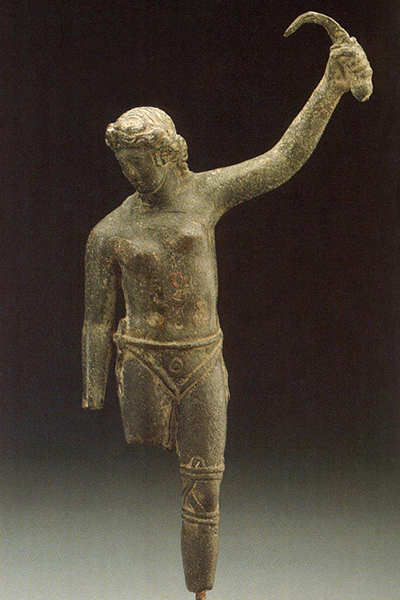
Female combatants in the arena must have been very rare, though. Gladiator has no feminine form, and the usual gladiatrix used in publications to describe female fighters is an invention of modern scholarship. Usually these women are just described as feminae or mulieres. This is not surprising, particularly since most of the mentions of female fighters are of aristocratic women--senators and equestrians fighting in the arena were not gladiators proper, in that they were not trained professionals, and they are rarely referred to using that word. Juvenal, however, seems to conceive of the existence of professional freeborn female fighters, not just the aristocrats, actresses, and captives that Nero and Titus had on stage. The girl he describes training for the arena in Satire 6 is distinctly professional, so how exactly this worked is not totally clear--Juvenal describes her not as a femina, but as a mulier, which can have (especially in Juvenal) a disparaging quality to it, implying low class. Even these professional freeborn gladiators must have been pretty uncommon though, since we're still faced with the fact that Latin had no word to describe them. There's also, despite the large quantity of artistic depictions of gladiatorial combat and fighting in the arena, a distinct lack of visual evidence for female gladiators. The only certain depiction is this one from the 2nd Century, A.D., which names the fighters as Amazon and Achillia, referring no doubt to the story of Achilles' slaying of Penthesilea. The Greek indicates that they have been ἀπελύθησαν, that is granted a missio, the reprieve that a gladiator might be given from a particular fight, and though they are depicted as being heavily-armored, with greaves and armored sleeves they wear no helmets and appear to be bare-breasted. Little bit odd--also, if they've been given a missio what the fuck are they doing in a combat pose, about to go right at it? Presumably what's meant here is that both women were considered evenly-matched and were unable to defeat each other, and that the fight was eventually declared a draw and they were sent away by missio, which more normally refers to the sparing of a defeated fighter--ἀπελύθησαν is feminine plural, so definitely refers to both of them. There's also a little bronze figurine that's usually identified as a woman holding a strigil who some scholars have suggested actually represents a female fighter raising a sica above her head--certainly her bizarre dress and her triumphant pose would suggest a fighter more than a woman with a strigil, but I dunno, that looks kinda strange for a sica. But apart from that one certain depiction and one possible one, that's all we have as far as visual representations go