On November 11, 1918 an armistice was signed between the Entente Powers of World War I and Germany, ending over four years of bloodshed on the Western Front. Hostilities would continue in other regions, but for many soldiers the Great War had finally come to an end.
To commemorate this historic occasion Osprey Publishing and /r/AskHistorians are teaming up to bring you another competition (Our previous Pacific War Contest can be found here). As with previous Megthreads and AMAs we have held, all top level posts are questions in their own right, and there is no restriction on who can answer here. Every question and answer regarding World War I posted on this thread will be entered with prizes available for the most interesting question, the best answer (both determined by the fine folks at Osprey), and a pot-luck prize for one lucky user chosen randomly from all askers and answerers. Please do keep in mind that all /r/AskHistorians rules remain in effect, so posting for the sake of posting will only result in removal of the post and possibly a warning as well.
Each winner will receive a copy of Germany Ascendant, the latest book from Prit Buttar looking at the ferocious offensives on the Eastern Front during 1915. Click here to take a look!
The competition will end on Friday at midnight Eastern US time.
Be sure to check out more publications from Osprey Publishing at their website, as well as through Facebook and Twitter.
^^All ^^top ^^posts ^^are ^^to ^^be ^^questions ^^relating ^^to ^^the ^^First ^^World ^^War, ^^so ^^if ^^you ^^need ^^clarification ^^on ^^anything, ^^or ^^have ^^a ^^META ^^question, ^^please ^^respond ^^to ^^this ^^post.
I know I have a Russian flair... but...
Often we hear of the Eastern Front being a mess, and often we don't hear much about the gallantry of the Russian Army when compared to the Western Front with battles such as Somme, Vimy Ridge, and Passchendaele.
Was there any noteworthy battles on the Eastern Front that should be held in the same regard as the aforementioned?
With the knowledge of armistace, did officers actively try to stop fighting to ensure their men's survival? I know several died in the hours before the official armistace, but it is odd that they died within hours (and I think within minutes( if the cease fire.
A French friend told me once that France's egalitarian policy meant that participation of different social classes in WW1 was broader and balanced than that of Germany. Therefore, the impact of WW1 (read: casualties) was felt more broadly across different vocations and social classes of France, than it did of Germany.
How true is this claim?
"Is Auschwitz possible without the Somme, without Verdun?"
I've stated this question a little differently than I normally do my questions here on AH, in that I'm looking to stimulate some debate, rather than garner a targeted answer.
A little background, this question is a paraphrased sentiment that World War I historian Jay Winter has offered on several occasions, both in writing and in person, as he did at two presentations he gave at my University in commemoration of the Centennial last year. Essenitally, Winter argues the following:
The number killed is so extraordinary that it indicates a certain kind of numbing of sensibilities, a change in the legitimacy of states to promote mass death as a normal phenomenon. Without the Somme and Verdun, there wouldn't have been Auschwitz. Bodies stacked like matchsticks — soldiers saw that in the First World War.
So, to those of you who study cultural representation and the Great War in memory, do you agree or disagree?
Quote taken from Winter interview with the LA Times, found here.
"Allied Commanders and Generals holding fabulous balls, parties, and dinners" is a common popular culture trope. How true is this caricature and were there cultural differences between the high command of different Allied powers?
How much of a contribution did Italy provide the allies with during the course of the war? I understand that the fighting in the alps was especially brutal and horrid, and that the Italian Army bore the majority of casualties against the Austrians and Germans. How taxing was the opening of another front on the Austrian army?
Also, after the war many Italians felt that Italy was denied its rightful spoils of the victory. This "hollow victory" led to the belief that the Italian nation was cheated by her allies, and led to a resentment that arguably led to the creation of fascism and the rise of Mussolini. Was Italy sold down the river after the war? How justified was Italian anger?
Why is there "formal remembrance" for World War I but no "formal remembrance" 2 minutes silence for World War II?
Today is Armistice Day when the Allies and Germany signed a cease-fire to end World War I at 11:00.
There is a 2 minutes silence to remember the soldiers who fought during WW1 because of the peace treaty.
Why isn't there similar formal 2-minute silence for soldiers who died for World War II after it ended?
There is remembrance for World War II but why is there less "coverage" compared to World War I?
What I mean by "formal remembrance" is in the UK, people wear poppies. Also, public officials such as the Royal Family and politicians and soldiers who fought in previous wars go to memorial site and mark their respect for the soldiers who fought during WW1
With the centenary, WWI studies have been undergoing a bit of a renaissance. We’re seeing some nice new contributions to the field. So, my question is: in your opinion, what have been the most interesting shifts you've noticed in the historiography? Read anything recently, either monographs or articles, that broke new ground or uprooted previous assumptions?
How did the experience of the Russian Army in the Brusilov Offensive compare to that of other armies going on the offensive in 1916, such as the British at the Somme, or the Germans at Verdun?
During WW1, the Royal Navy carried out several operations on the rivers and lakes of Iraq and Southern Africa. Did any other navy carry out such riverine operations?
What were Italy's strategic objectives during the war? How did they play into their military operations?
I'm curious that with the U.S. entering the side of the Allies in 1917 almost a year after the Easter Uprising in Dublin, how recent Irish immigrants and Irish Americans felt about the U.S. allying themselves with a country they felt was occupying and brutally suppressing independence movements in Ireland. I remember hearing in passing in undergrad that many Irish immigrants and Irish Americans felt torn or betrayed by the U.S. allying themselves with the British, despite the revelation of the Zimmerman Telegram and Germany's campaign of unrestricted submarine warfare.
My question is, did the U.S. Government encounter much resistance or reluctance on the part of recent Irish immigrants and Irish Americans towards allying with Britain and Allied Powers against the Central Powers? And if so, what efforts (propaganda, subversion, etc) did the U.S. undertake to ensure that Irish hostility towards their British Allies did not undermine the U.S. and Allied war effort?
Prior to WW1, the US had never been directly involved in a land war in continental Europe. What was the perception of the Central Powers, and the Allies, on the likelihood of US involvement in the war? Was the political impact of Lusitania's sinking a big surprise to the then-belligerents?
What was going on in the Eastern Mediterranean during the First World War? Were the Ottomans at all able to contest British naval dominance?
On Nov. 4, 1915, the Japanese freighter Yasakuni Maru was sunk by a German submarine in the Mediterranean Sea near Gibraltar. While I'm familiar with Japanese involvement in WWI in the Pacific, I'm not as familiar with it in Europe. As a member of the Allies, how did Japan contribute to the war in Europe? Did it deploy soldiers there? Did it ship supplies there?
Why was the British military so dismissive of the "Easterners" who wanted to push somewhere other than the western front after Gallipoli when, A: the offensive efforts of the "Westerners" were equally if not more disastrous and B: the Easterners included key political support from Lloyd George and Churchill?
Meta Discussion and Off Topic Chatter Post. Restrict it to here please.
Hello, I have a question relating to the germany navy and I am not having luck with the search function.
Why did the Germany navy stay in port for the entire war? From everything I have read, the germany ships were on par with the British and some German classes were better armoured than their British equivalents. They also seem to have had some good commanders.
Was it just because they were outnumbered? If so, were the Germans trying to prevent the propoganda nightmare of a defeat?
Side Note Questions
Did the Germans ever consider using their subs with the main fleet during a attack?
Per /u/Georgy_K_Zhukov's suggestion, I'm going to repost a question here that I asked late last night. It's only half WWI related (other half is WWII), but any answer helps:
In reading about the German invasions of France in 1914 and Russia in 1941, I often come across anecdotal assertions of the Germans seeing the Eiffel Tower in the distance as they got close to Paris, or, in the case of WWII, the advance German reconnaissance groups seeing "the golden domes of the Kremlin" off in the distance in Moscow.
Is there any legitimate, scholarly evidence of these events occurring? Like a soldier's diary, or memoirs, or something?
In what ways did the fear of Japan or the Yellow Peril affect portrayals of Japan, an erstwhile ally of Britan and France, during the war? Specifically within the countries with which Japan was allied?
WW1 is widely viewed as a conflict that was a veeery long time coming, and/or inevitable given the tensions of continental Europe at the time.
Did the belligerent nations engage in military espionage and intelligence leading up to WW1? How valuable were these activities, and who was considered the best in espionage and intelligence?
Once it became clear that the army group deployed on the Western Front wasn't going to win a decisive victory and rush east to meet the Russian steamroller, how did the Germans intend to win on the Eastern Front? What were their military objectives, and how did they plan to achieve them?
What was fighting like in German Africa? We never hear about it. What were the conditions? How did the Germans even get supplies there in the blockade?
How did Austria-Hungary end the war? Did they sign an armistice due to military defeat, or internal tension as with Germany, or even both?
What sort of rations did soldiers in the trenches eat? What sort of systems were in place for supplying those rations? I know a bit about the British rations, but not much about anyone else's.
I remember hearing that the United States didn't sign the armistice treaty. If that's true, Why didn't they and what did they sign/declare to end their part in the war?
How much action did an average soldier see throughout the whole war?
Like were they there for the whole battle, or saw a few hours of action, and then replaced with different troops
How did the French army adjust during 1915 after their casualties during the battles of the Frontiers?
What role did the Austro-Hungarian Navy play in the war? Were they reduced to a similar "Fleet-in-Being" role that the Kaiserliche Marine was reduced to post-Jutland? How much resources were the Entente forced to devote to dealing with their existence?
Compared to the other major participants in WWI, the Austro-Hungarian Empire had the difficult task of fielding a fighting force composed of different armies i.e. The Common Army, the Hungarian Honvédség, and the Austrian Landwehr, not to mention the navy and air services. These organizations were further composed of different ethnic groups and languages which posed a real problem for communication which probably was the source of a lot of confusion on the battlefield.
My question is, how did the Austro-Hungarian Empire manage to organize the diverse nature of their population into combat-effective troops? As the war went dragged on and attrition claimed officers and soldiers who were multilingual, how did they reconcile this? And finally, I was watching The Great War YouTube series and I learned that the Austro-Hungarian military did not employ a rotational deployment for their soldiers, in contrast to the other major participants in WWI. How did this affect the troops' morale and effectiveness in terrible conditions when faced with the fact that they were more or less permanently stationed on the front lines without any hope of being reprieved and rotated to the rear lines? Thank you.
Given the very massive casualties suffered by all parties, why didn't an armistice come to fruition sooner? One would think that with hundreds of thousands dead in a very short time would have made someone seriously try and end the war sooner.
Hope I'm not too late to ask a question.
How did experiences shift for the Central Powers POW's in the UK following armistice? Did they enjoy greater freedoms after the end of fighting? Did this differ between enlisted men and officers?
The inspiration for the questions is a bit of family apocrypha. My great-grandfather was an Army Doctor during the war. At the end of the war he struck up a friendship with a captured U-boat captain, going so far as to have him babysit his children. Supposedly there is a photo of my great-aunt sitting on the knee of this captain, Karl Dönitz, future president of the Third Reich.
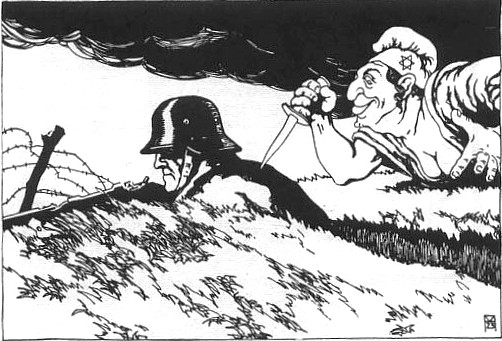
I came across this image a while ago while reading about the "stabbed in the back" myth. I noticed that it was from Austria and it got me wondering if this myth (or a similar one) about what caused defeat prevailed in other Central Powers after WWI?
A pair of questions,
What exactly was air supremacy good for in World War 1? Was it just for aerial reconnaissance and artillery spotting? My impression was that bombers were crude relativity ineffective machines at the time, certainly not on par with the destructive powers of artillery. It seems like perhaps a disproportionate amount of effort was poured into airplanes for any given return.
Also was there much use of airplanes on the Eastern front? I can't think of any famous Russian planes from the time period, and surely all the famous air battles were fought on the Western front.
I've been reading a bit about Russia's entry into the war lately, of the books I've been reading they seem to disagree over how Russian Minister of War Vladimir Sukhomlinov is viewed by history. Is there a historical consensus over how helpful/hurtful he was towards the Russian planning and preparation?