As a Jewish axe man (guitar of course) myself, I'd like to think I don't have to have flowing blonde locks to call myself one. But seriously, I'm interested in the history of the axe as a weapon.
Axes are a common tool across the world for cutting/shaping wood. Stone axes have been found across world from the Neolithic period. There are bronze axes that have been found in China. Minoan culture on the Greek island of Crete had a two-bit axe called a labrys (where the word labyrinth comes from) which was symbolic and used for religious ceremonies.
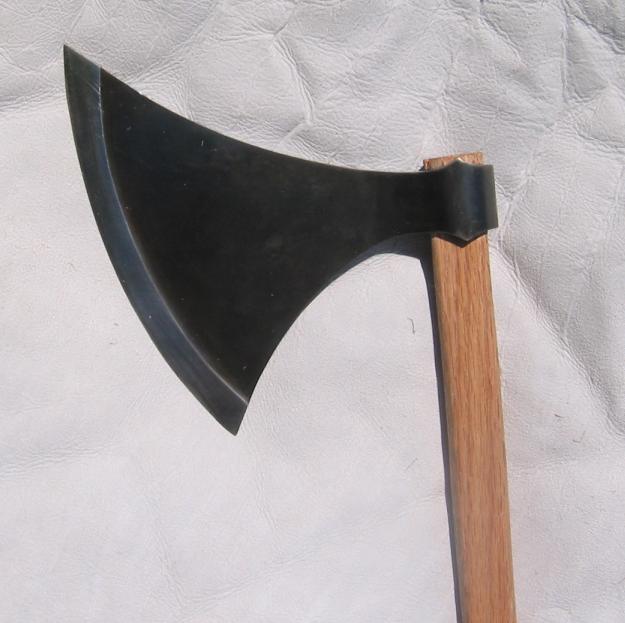
I can't go into where, when and how with axes of other cultures but I can explain axe culture in Scandinavia: The axe is very iconic to the Norse peoples because their lives were so tied to timber due to the large amount of trees in Scandinavia, especially in Norway and Sweden. Axes became prominent as a status symbol and an object of war with the Battle-Axe culture that existed 2900–2400 BCE with about 3000 stone axes found as grave goods in Scandinavia. When iron production and manufacture of items from the material became technologically viable, axes were a common item that almost every person had as it is an important tool for cutting down trees, hewing the wood straight, rough shaping before chisels and knives are used, chopping fire wood, etc. Their use for war was one of cost (the Norse men during the Viking period were rather poor which is why they raped and pillaged) and convenience and only in the later period of the Viking Age did you see thinner profiled axes that were meant for war (Wood cutting axes have a wedge profile to help separate the fibers, war axes are thin like a knife or sword), most axes were tool. Now while the Norse can't be credited with inventing the axe they did invent 2 designs that are iconic. The first is the skeggøx or bearded axe, the axe's "beard" is an extended part of the bit that is made to give a broader edge while saving on material and weight-added. The "beard" also made it nice for fighting during the Early Medieval battles where armies met at a shield wall as it effectively acted as a hook that could pull back shields opening up the shield-wall. The other axe is the breiðøx or broad-axe which had a broad edge with a "horn" pointing up and down. This axe was put on a long haft and used with two hands. This axe was used only for war and was a weapon of status like a sword. These axes were mainly found in the later period and actually had a long life in Medieval Europe being used in England until the 14th century.
It would not be fair to say that the axe is unique to the Norse culture but it is a very iconic part.
http://mek.oszk.hu/00000/00057/html/08.htm#9
Hungarian source, but I can translate if someone wishes to know the contents.
Basically what it says that first Hungarians to arrive in the Carpathian basin had used an axe called "fokos", which is basically an axe that has a spike on the other side example. This axe was used as late as the 18th century by the Eszterházy Grenadier regiment.
Furthermore, axes were common tools peasants, and thus levied soldiers could have access to as both weapons and tools. Generally, combat axes wouldn't be splitting axes as those are too heavy and thick. A good weapon axe has a thin head and a long handle.