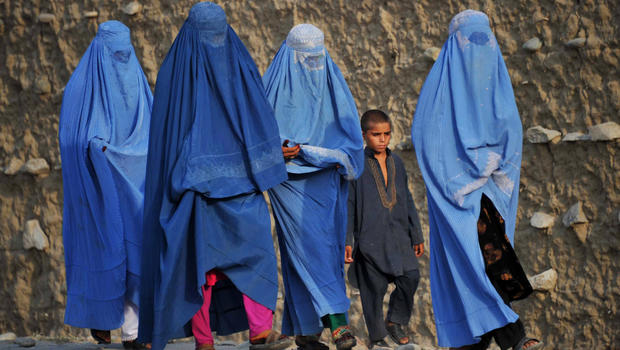
To my knowledge, the answer is unclear. It seems like veils (face-coverings) were present from the earliest periods of Islam, but that veiling was not required. However, debates about whether or not it is required seem to date to relatively early period.
The relevant passages in the Quran are not very specific. You have things like:
O Prophet! Tell thy wives and thy daughters and the women of the believers to draw their cloaks close round them. That will be better, so that they may be recognized and not harassed. Allah is ever Forgiving, Merciful.
and
Say to the believing men that they should lower their gaze and guard their modesty: that will make for greater purity for them: And Allah is well acquainted with all that they do. And say that the believing women that they should lower their gaze and guard their modesty that they should not display their beauty and ornaments except what (must ordinarily) appear thereof; that they should draw their veils over their bosoms and not display their beauty except to their husbands, their fathers, their husband's fathers, their sons, their husbands' sons, their brothers or their brothers' sons, or their sisters' sons, or their women, or the slaves whom their right hands possess, or male servants free of physical needs, or small children who have no sense of the shame of sex; and that they should not strike their feet in order to draw attention to their hidden ornaments. 'And O ye Believers! turn ye all together towards Allah, that ye may attain Bliss.'
What does it mean to draw your cloaks close? What does it mean to cover your bosom and hide your beauty? Especially when discussing ahadith, it's also unclear in tradition what's required and what's merely commendable/praiseworthy; what's necessary for everyday wear and what's obligatory for prayer and other special circumstances. Hiding your bosom, for instance, has been generally understood--as far as I know--in all periods to include hair and neck.
One of the problems is writers very often describe clothes as modest, or commend modesty, without actually describing the details of the garments. This is a pretty universal problem for historians, and generally cultural historians then turn to pictorial depictions (Egyptian wall paintings are roughly how we know how early Hebrews dressed). Unfortunately for cultural historians of early Islam, there are no visual depictions to fall back on in this period. I know of no detailed descriptions from Muslim or non-Muslim sources of typical women's clothing in the earliest centuries (we suffer from a general lack of written sources for this period).
Sunni Islam has four madhdhabs (schools of Islamic jurisprudence), but their opinions are not evenly divided on the issue of veiling (all require some form of modest dress). Some opinions say veiling (covering one's face, rather than just hair, around unrelated men) is unambiguously not required, whereas others say that it unambiguously is required because the face counts as arwah, nakedness. I believe in several of the schools you can find opinions saying veiling is obligatory and some saying it is not, though some tend to come down more clearly on one side or the other. I'm not sure quite the timeline of arguments in each school--that's likely an area that deserves more study (though it may have already been studied, I'm not very learned on the history of fiqh).
However, as I mentioned above, veiling does seem to be a very old practice. Not only does the debate between the schools seem to indicate it was a widespread practice (but not a universal one), pre-Islamic Christian Roman writer Tertullian apparently describes a pre-cursor:
Arabia's heathen females will be your judges, who cover not only the head, but the face also, so entirely, that they are content, with one eye free, to enjoy rather half the light than to prostitute the entire face.
Details of Tertullian's life aren't known, but I would guess this is second-hand knowledge rather than first-hand experience. And he's definitely using it as an example to make a point to Roman, Christian women about modesty, so it may be an exaggerated example. Still, this and the fiqh debates point to this being a very old custom. However, its lack of universal recognition among the different fiqh traditions seems to suggest that the veil specifically was not obligatory in the earliest period. Veilling could have still been seen as a praise-worthy tradition in the earliest period. One of the interesting things is how little the details of modest dress are covered in either the Quran or Hadith. This source says that,
Of the thousands of reports included in the canonical hadith collections, only one can be said to address explicitly the requirement of women’s covering. This hadith is reported by the ninth-century hadith compiler Abu Dawud (d. 888).
Book 32, Number 4092
This hadith is narrated by Aisha (the youngest wife of the Prophet) and reports an incident involving an encounter between the Prophet and Asma who is the daughter of Abu Bakr, the Prophet’s closest friend and first Caliph at the death of the Prophet:
Asma, daughter of Abu Bakr, entered upon the Apostle of Allah (peace_be_upon_him) wearing thin clothes. The Apostle of Allah (peace_be_upon_him) turned his attention from her. He said: O Asma’, when a woman reaches the age of menstruation, it does not suit her that she displays her parts of body except this and this, and he pointed to her face and hands.
Note, here, that the face is specifically uncovered. That's the only hadith that makes covering so explicitly obligatory, but other ahadith make it clear that covering one's face--at least in some situations--was a praiseworthy act, or at least an act that was preformed by praiseworthy people. In Salih Bukhari (considered the most trustworthy hadith collection), Volume 6, Book 60, Number 282, we find:
Narrated Safiya bint Shaiba:
'Aisha used to say: "When (the Verse): "They should draw their veils over their necks and bosoms," was revealed, (the ladies) cut their waist sheets at the edges and covered their faces with the cut pieces."
There are other places where similar face veiling is mentioned, but if I recall correctly, all or at least more of these examples in hadith specifically involve the prophets' family, and none involve an explicit requirement.
We also have evidence that some women were unveiled, such as this hadith from Volume 8, Book 74, Number 247 of Sahih Bukhara:
Narrated 'Abdullah bin 'Abbas:
Al-Fadl bin 'Abbas rode behind the Prophet as his companion rider on the back portion of his she camel on the Day of Nahr (slaughtering of sacrifice, 10th Dhul-Hijja) and Al-Fadl was a handsome man. The Prophet stopped to give the people verdicts. In the meantime, a beautiful woman From the tribe of Khath'am came, asking the verdict of Allah's Apostle. Al-Fadl started looking at her as her beauty attracted him. The Prophet looked behind while Al-Fadl was looking at her; so the Prophet held out his hand backwards and caught the chin of Al-Fadl and turned his face (to the owner sides in order that he should not gaze at her). She said, "O Allah's Apostle! The obligation of Performing Hajj enjoined by Allah on His worshipers, has become due (compulsory) on my father who is an old man and who cannot sit firmly on the riding animal. Will it be sufficient that I perform Hajj on his behalf?" He said, "Yes." (emphasis added)
From there it seems like it was not required to cover one's face.
Islamic historians also give us mixed evidence. Remember the line from above from the Quran?
O Prophet! Tell thy wives and thy daughters and the women of the believers to draw their cloaks close round them.
There are Tafsir (Quranic commentaries) that include commentaries on that line. The earliest is Tanwir al-Miqbas, though unfortunately it was only collected and standardized much later so is considered suspect by many scholars. Still, the commentary on this verse is:
(O Prophet! Tell thy wives and thy daughters and the women of the believers to draw their cloaks close round them) to cover their necks and bosoms ((when they go abroad). That will be better, that so they may be recognised) as free women (and not annoyed) and not be harmed by the fornicators. (Allah is ever Forgiving) He forgives what they have done in the past, (Merciful) He shows mercy on them regarding that which they will do in the future.
Which specifies neck and bosom, but not face.
However, Tafsir al-Tabiri, the second oldest and most respected tafsir gives the comment on this line:
Ibn Abbas(RA) narrated regarding (Allah’s) order [O Prophet! Tell thy wives and thy daughters and the women of the believers to draw their cloaks close round them…] that Allah commanded the believing women, when they went out of their houses for some need, to cover their faces from above their heads with the Jilbab, leaving only one eye showing. (note: this is from an online resource--I haven't looked this up in a translation of Tafsir al Tabiri myself).
Indicating from an early point that there were arguments that this should be an obligatory behavior.
So, in sum, veiling seems to be an old tradition, quite possibly dating even back to pre-Islamic times, but it likely wasn't seen as obligatory for believing women in the time of the Prophet Muhammad. However, debates about whether or not it was obligatory seem to emerge relatively early.
As a small side note, burqa is widely used in the West for all full-body coverings and veils, but actually refers to a specific kind of strikingly sky-blue garment only found in Afghanistan.