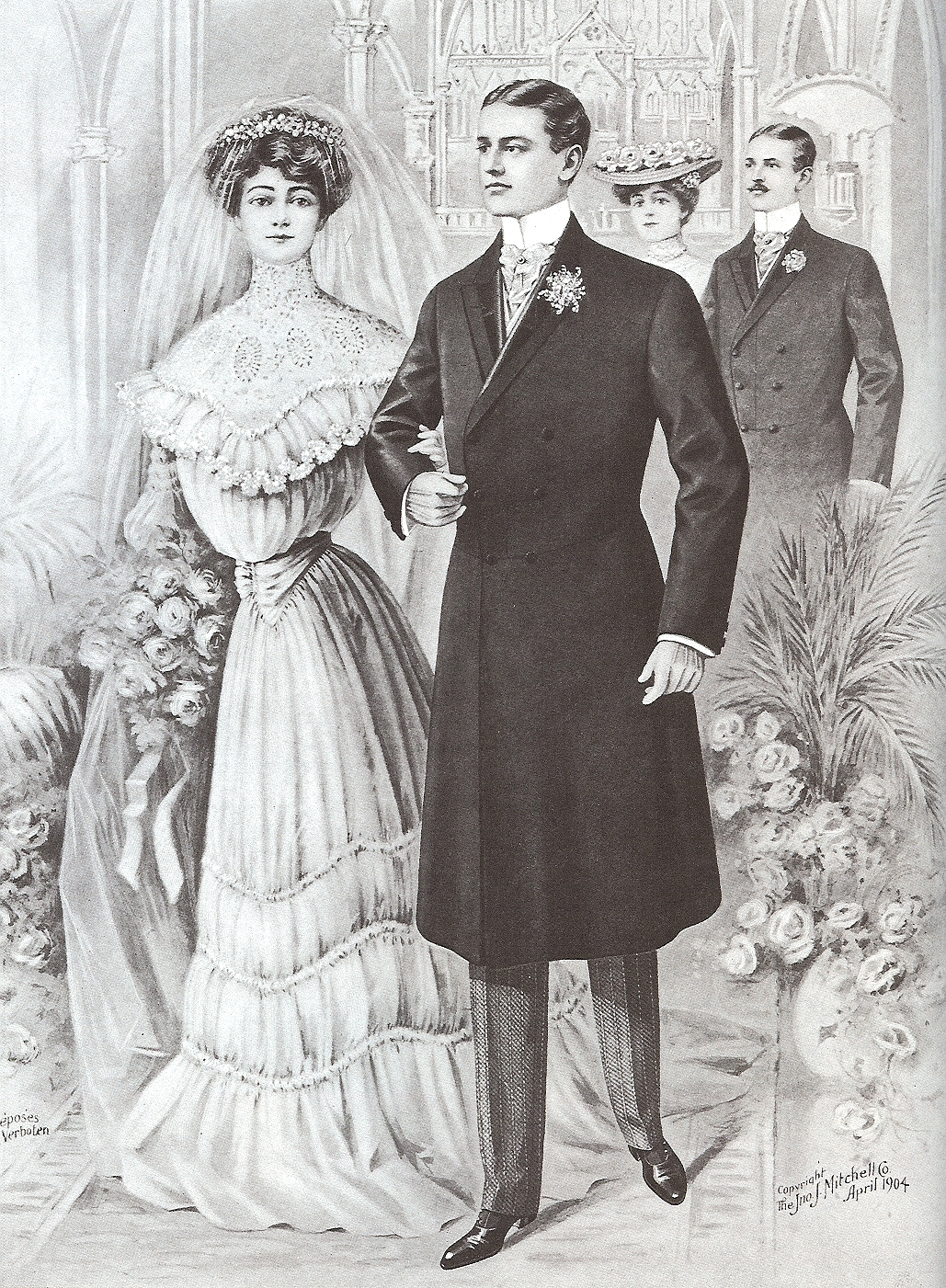
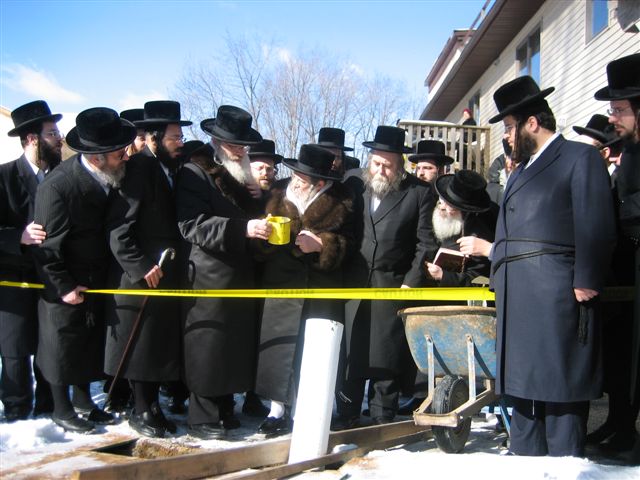
It always seemed so arbitrary to me.
It would be arbitrary, perhaps, if they had stopped their clocks at 1900 - but this isn't really the case. Neither Hasidim nor Amish wear clothes that are accurate to any historical period, they just keep to certain rules (especially those of modesty) that look very old-fashioned.
Amish (and Mennonite and Quaker) plain dress is a long-standing tradition that was notable even in the early 19th century - this is a Quaker woman's dress from that time, highly unfashionable. Can you see a kind of resemblance? Even before 1900, plain dress didn't follow the fashionable lines of puffed sleeves, very high waistlines, bustles, trains, etc. Donald Kraybill in The Riddle of Amish Culture gives a very good rundown of the rules of plain dress for men and women and the rationale behind them, which is mainly to show in-group status and solidarity to others (although there's a lot of variation within the tradition that isn't as obvious to outsiders) and to keep members of the faith from indulging in forbidden ornamentation and immodesty. This tradition wasn't made up in the 1970s to take the Amish (et al.) back to a specific earlier period, but accumulated and progressed over time: things like fall-front trousers and using straight pins as fastenings go back to the 18th century. (Jennifer Heath, in The Veil, discusses how it's difficult to pinpoint where various parts of the tradition come from - some of it, like the cap styles, come from European folk dress traditions, for example.)
A Cultural History of Jewish Dress, by Eric Silverman, is very helpful for looking at traditional Orthodox dress, which is again based in centuries of sociality rather than a deliberate decision to dress like it's 1900. Dress prescriptions for Jews go back to the Torah, and certain of these rules are ones that are still followed to this day; like the Amish, outsiders have noticed "old-fashioned" or "odd" dress habits since before 1900. I really recommend the book, I would only be restating it all if I tried to be more specific. Jews of Brooklyn also has a section, "Suits and Souls", that may be of interest.
The simple answer is that simply freezing in time is not what's happening with either attire.
First, the Amish. Obviously, there are some elements of their dress that we think of as being "old-timey", because they are. But it's more complicated than simply hitting pause on fashion. The Amish don't use buttons on clothes (or rather, many of them don't), which was never a particular fashion. The clothing in general is more plain than would be considered fashionable in many eras in the past, which is intentional. A major tenet of Amish religious life is to maintain simplicity and plainness, to keep life free from unnecessary complication. The fact that dress has retained now-obsolete styles is a reflection of that, not an intentional choice.
Now to move on to the group I know somewhat more about, Orthodox Jews. There's no Orthodox Jewish fashion pause button from a particular era, either. Probably the most common Orthodox Jewish dress (for Orthodox Jews who maintain a particular dress besides general modesty standards) for men is a black suit, a white shirt, and a black hat (and maybe a tie, depending on affiliation). Apart from the hat, it's basically modern formal attire. The dress style is constrained, but not particularly obsolete in a general sense.
There are sects that do maintain a dress that can be quite different from modern attire, which often do include elements from earlier eras in a more widespread way. But they're still more complex than simply an earlier era. This guy is wearing a frock coat--frock coats or similarly styled jackets are a distinct part of Orthodox dress, but that example of non-Jewish formalwear is obviously quite different than Orthodox Jewish dress--the shirt, the accessories, the hat, etc all quite different. Really, besides the jacket itself, it's completely different. And some of the other elements, like shtreimels (a type of big fur hat), don't (as far as I know) match up with the outerwear in any particular past style (i.e. there are past styles with long jackets, and with fur hats, and with black hats, but not all of these things). I don't think this guy is wearing clothing describable in any way except "late 20th/early 21st century Hassidic Jewish garb". Same with these guys, or especially this guy. And of course, some of the elements are not related to style at all, such as the beards or the sidelocks (which are not universal either in the way you're thinking).
So, what is the origin of it? It is definitely true that some elements of it are old. But for those, it's part of maintaining a traditional lifestyle. Wearing these clothes is a way of publicly identifying with your religion. Not just in a general sense--the minute details of how all these clothes are worn indicates to knowledgeable people what sort of sect the wearers adhere to beyond what the casual observer might note. For adherents wearing a long jacket and a black hat is simply part of being part of their religious group, not a particular choice to wear fashion from a specific era. Part of the reason for this is modesty, part of it is a desire to wear formal attire during prayer (with "formal" being defined in a distinct way that incorporates elements from past conceptions of formal dress, but is not a direct usage of it), but most of it is simply part of identifying with a sect.
And of course, that's all been about men's apparel. Women's apparel is quite different in the Jewish world--it is not as closely tied with sect, there are as many minutae which identify a woman with her sect as there are a man with his. For men's clothing modesty is a consequence of the dress, but for women's dress it is a more primary concern. Perhaps here too it's a bit clearer that the style of dress is not from any particular past era.
Just to illustrate that these two patterns of dress don't represent a common past point in style, Amish men wear colored shirts and suspenders, while Orthodox Jewish men generally wear white shirts and belts.