I read, on a thread here in AskHistorians, that Disraeli once retorted to someone giving him grief for his Jewish heritage that whereas the ancient ancestors of Protestant Englishmen were "savages" running around on an "unknown island", his ancestors were "priests in the Temple of Solomon." I would think that this wouldn't be such a grave insult as it seems on its face, otherwise he would have sunk his political career?
Also, I recall that Gibbons once compared the heathen Britons to the Maori. He went on about how the ancestors of the English were once equally "rude" as the Maori, who likewise were native to an isolated island, and likewise had to be civilized by an invading empire. Therefore, he concluded, it was not inconceivable that in the future there might be a "John Locke of the South." I found this interesting in light of how in other passages he went on and on about the alleged inferiority of black Africans, even taking pains to minimize the achievements of the Upper Nile civilizations.
How did those Protestant Englishmen view the fact that their ancestors weren't so far along on the civilization scale as the Romans that came along and Romanized them? In particular, I wonder how they viewed this fact during Disraeli's time, the height of the British Empire.
Did they view this fact with amused irony? Or did they try to revise history a bit, making the Britons seem more developed culturally and materially than the Romans recorded? Or did they focus on the "noble savage" aspect, going on about how the ancient Britons were fierce, honorbound warriors? Did they emphasize how far they had risen in comparison to how far the Greeks and Italians had fallen?
Was it a sore spot, a point of pride, or an irrelevance?
tl;dr - King Arthur and Beowulf.
The 19th century gives us empire and industry, but intertwined with those are two cultural movements: nationalism and antiquarianism. In the European triad of England-France-Germany in particular (also Russia), those two strands unite into a romanticized, Romantic medievalism. Gothic literature, Grimm's fairy tales, a social redefinition-revival of "chivalry". And in Europe, going back to the Middle Ages for the roots of the modern nation.
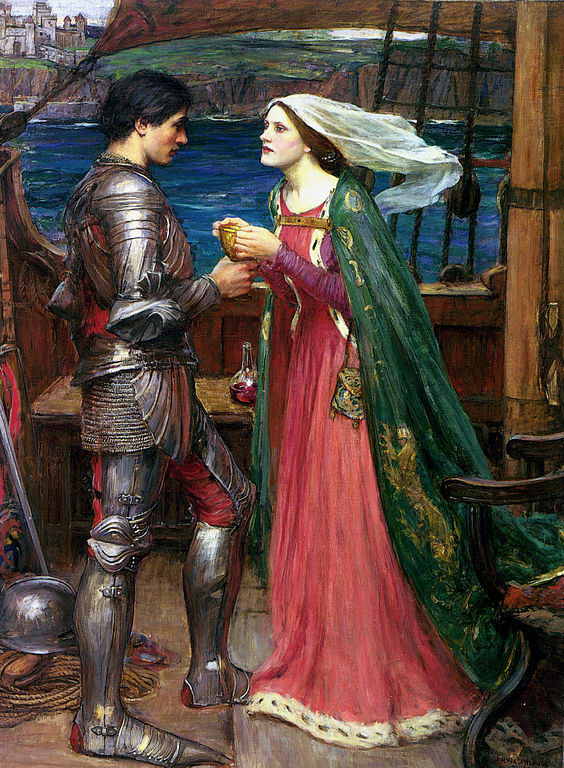
The England had it good. While the Germans bickered over whether the versions of the fairy tales the Grimm brothers published were "too English French," the English themselves could politically emphasize their Magna Carta. Emotionally and culturally, they had King Arthur. (Never mind how many of the great medieval Arthurian authors were French. And also note that the Arthur legend ties his and thus England's roots back even farther than Rome, all the way to the heroic diaspora after Troy.) You may know the paintings of John William Waterhouse or Edmund Blair Leighton, for example.
But that only gets us so far, specifically, to the post-Norman Conquest era. The English were well aware of their prior history. And fortunately for them, the Beowulf manuscript had been discovered in 1818.
Again, never mind that Beowulf himself was a Geat and the epic is set in the land of the Ring-Danes. The poem itself is in Anglo-Saxon: Old English. It was the proof Britons needs of their heroic and educated (the linguistic roots more so than literary, here), pre-Norman, pre-Roman past. And indeed, throughout the 19th century Beowulf was prized in large part as a linguistic source and link to the past. Tolkein in the early 20th century was rather important in staking a claim for its poetic grandeur as a work of literature.
I can't comment on basically anything else in your question, OP, but in the 19th and early 20th centuries, the Middle Ages were extremely significant for political and cultural nationalism/nation-defining in an age of industrialization and imperialism in Europe.
There were major figures from the Anglo-Saxon past that were crucial sites of national pride. I would argue that Beowulf was much less important during this time than the figure of King Alfred.
Alfred was important throughout the Middle Ages, as texts like The Proverbs of Alfred and artifacts like the statue in Winchester (ancient seat of English kings) built in 1899 attest. He was never forgotten, and his military resolve, intellectual and educational contributions, and judicial wisdom were great sources of pride for the English of the 19th century. He was seen as a true precursor to the English monarchy and the first true English king.
You can read all about the crucial importance of Alfred the Great for the Victorians here: Parker, Joanne. England's Darling: The Victorian Cult of King Alfred the Great. Manchester UP.
Also, you might look at Lord Tennyson's writing and the works of the Pre-Raphaelites for a good indication of their views on the medieval past, which was heavily influenced by a fantastical view of a civilized past. Tennyson wrote an epic based on Arthurian legend called the Idylls of the King and translated some Old English battle poems as well, like the "Battle of Brunanburgh" and the "Battle of Maldon," two poems about the English heroically fighting against Viking invaders. The vision of the past was less that of savages, and more that of true precursors to English religion (Anglicanism) and politics (the monarchy).
To your comments about what Disraeli and Gibbon had to say about England - there was certainly an understanding that England was once an isolated island on the edge of the world inhabited by savages. This view had its roots in the writing of Tacitus and other Roman historians, and also formed the basis of Bede's framing of the island before the coming of the Anglo-Saxons in his Ecclesiastical History of the English People. For Bede, the narrative was that the Romans came and imposed their civilization on the celtic tribes that inhabited the island. The Romans then left, and only the remnants of their civilization remained - the celtic population was left with fragments of Roman civilization. When the Anglo-Saxons came and conquered them, Bede presents this as a form of justice for celtic failures. While there were certainly Anglo-Saxon tribes that might have been called "barbarians" and they lived on the island for about 200 years before Augustine brought Christianity to England, this time was easily elided into a historical narrative that connected to the presence of Roman civilization. This was a historical narrative that began with Roman histories, was translated into a historical view of the island connected to English religion and education, was picked back up by Alfred and his successors, remained as a touchstone even during hundreds of years of Anglo-French dominance, was resuscitated by 16th century scholars looking for precedents for the Anglican Church and the English monarchy, and was carried into the 19th century for Victorians who were, again, looking to the past to justify their world view.
This way, the education, politics, and religion of England had their precedents and justification in early England, which was often viewed as a nascent but true form of English culture.
I think OP was stressing Disraeli's reference to pre-Roman Britain, not pre-Norman or Early Medieval Britain. That is, that Celtic Britain was a savage wasteland compared to Hellenistic and Roman Judea, which was a place of civilization and refinement.
But I don't think 19th century British intellectuals or politicians viewed themselves as the inheritors of a Celtic ancestral line. The purge of Celtic tribes and their eventual confinement to geographic and cultural outliers re-centered "Britishness" on that of the Anglo-Saxons and other post-Roman kingdoms. The wild Celts were another race entirely and their savage ways could be dismissed as the unfamiliar "others" who were supplanted by good English gentlefolk.
Disraeli was right in that Semites could trace their ancestry to a civilized Judea which flourished during a time that Britain was a muddy backwater. But his proud British colleagues didn't consider themselves related in any way to those mad Celts. No! They were descendants of Romanized Britain. A place of nobility and bucolic charm and all that stuff.
He went on about how the ancestors of the English were once equally "rude" as the Maori, who likewise were native to an isolated island, and likewise had to be civilized by an invading empire
A follow-up, could someone explain where Gibbon said this?
There is the curious use of Celts by Richard Hakluyt, a proponent ( and investor) of the Virginia Colony. In 1585 he tried to paint a kinder picture of the Virginia Indians by putting a hypothetical Pictish Queen in his book. The message was; see , we were once like this..