I believe to be a true historian career-wise, you need to have either a master's or PhD, right? Well, there's no way I can get one at this point. I love history, but I do not love writing papers so much. Visiting historical sites and reading everything I can get my hands on? Definitely! I have been going back and forth on what I want to do with my life for quite a while, hence the multiple degrees. I chose to get into computer science because there is so much out there as far as jobs and oh so little available in history. I think what I need to do is find some sort of middle ground. My main interests in history are American (earlier stuff, before we became super industrialized - I mainly love the transitioning period, when things just started getting technical) and Victorian England. What could someone who has a love of history and has computer skills do?
Personally, and I'll have to defer to some of my /r/linguistics cross-over colleagues here, I think the greatest collaborations computer science and history can make is in terms of languages. I have acquaintances who were ex-computer programmers who've been pivotal in creating databases for ancient languages.
My job has already been made 1,000x easier by the existence of online dictionaries, parsing engines, and searchable PDFs. However, these tend to only be most useful for modern Romance languages. Ancient languages tend to lag behind significantly. Google translate can barely handle German, it certainly can't handle Latin, Ancient Greek, or Classical Chinese. Anything that can be done to improve this situation, would improve the accessibility of research.
It would also require creativity on the part of a programmer to think of ways to approach language translation, since as we all know, Google Translate doesn't actually parse, but attempts a translation based off existing multilingual documents. Still a creative idea nonetheless.
If however, you're daunted by the linguistic side of things, a lot could be done on the optical recognition side. There are so many ancient documents that are on the verge of being lost forever because of their deterioration. If this could be remedied by new and innovative ways of imaging, or character/symbol recognition, then a massive benefit can be had for history.
However, as I'm sure anyone else would point out, all of these things require a high level of skill even within computer science. They might even be Masters Degree Computer Science turf, especially where new ideas haven't previously been tried before. But, if your goal is to help history with your computer science, then you will always need to work just as hard (if not harder) as if you were only pursuing the other.
To answer your first question — all "professor" positions in history at universities require PhDs. If that is what you mean by "true historian," yes — it will require further education. And will involve writing a lot of papers. (The more you write, the easier it gets.)
There are many areas and many projects where history and computer skills come together. (I know this because before I got my PhD, most of my jobs involved my combining the two — the number of people with experience in both skill sets is limited.) Finding a project that could use you will depend on your geographic area, but if you are living near universities, try to see if they have anyone there doing "digital history" or "digital humanities" or projects that might be amenable to your skill set. Then get in touch with whomever is running one of those projects — they may or may not have a position, but they also will know others doing work of that sort in the area. This is the sort of thing that is not always well-advertised and doesn't always have a standardized name to search for.
Without further education, your role in higher education is going to be something like a technician or an assistant, though depending on the project and your skills, your role may or may not be larger.
If you are thinking about furthering your education, you might look into the programs that specialize in this sort of thing. Within the discipline of history there is a lot of interest in hybridization of computer and historical skills. It ranges from the sort of stuff I do (visualization and simulation and digital publication) to people doing corpus analysis to people doing a lot of advanced bibliometric analysis. (There is a group at ASU, for example, doing work on computational history of science, to give you an idea of how technical some of this stuff gets.)
But to return again to your big question — how can you contribute to the field of history? The field of history as an academic discipline is, like all academic disciplines, pretty walled off from those who are not in graduate school or have advanced degrees. There is not much room in its framework for people outside the academy, much less without the degrees. There may be room as technicians and assistants, which could be a way to develop further skills and see whether you wanted to continue along these lines, but to contribute at a higher level you will probably need to think about graduate school.
A huge amount of historical data needs crunching--but there are also a lot of GIS applications in history, and that's just if you want to be self-directed (which can be hard to get money for, I know). But as /u/bitparity points out, creating tools may be quite lucrative if you go to work for an organization that does that sort of thing (not necessarily Google, but they've hired one of my dual-major grads to handle text imaging functions).
Digital humanities is a quickly growing area which straddles CS and arts/humanities, and there's funding galore going around for PhD students at the moment.
Is big data a thing in history? Would it be possible to collate texts and scan for common passages or keywords? Of course, translation would be great but i would think developing a big data approach to history would be fundamentally interesting if complicated.
Consider one could create an algorithm, at least initially, that can go and find, say, passages that might match authorship. I believe these exist but it would be neat to scan anonymous works and see if they correlate to known authors. It's the sort of thing that would probably be dismissed as being "very hard" but in the context that if it hasn't been done yet in history per se it would allow some pretty low hanging fruit to be plucked.
Data. Leverage your programming skills to scour though large data sets and uncover anomalies, patterns, and/or build statistical models. You might be able to identify something very interesting that is just waiting to be found.
Check out the Roy Rosenzweig Center for History and New Media at George Mason University. They are the types of folks you're looking for, and I believe they have both academic history and non-academic positions in their center (actually a lot more of the latter). If not, they would be the type of place you'd want to start with, as they could certainly point you in the right direction.
Also: ThatCamp. I'm not as familiar with them, but I know they have a lot of cross over with RRCHNM. Good luck.
Did you get your history degree then think "oh shit, I want a job." Then go back and get a comp sci?
Because that's what I did.
As it has been mentioned: Look into text parsing and analyzing.
I would start with playing around with the NLTK for python. It's an incredible powerful tool for analyzing large amounts of text. It's not hard to learn, but you CS background will help you with building and organizing the different scripts you'll need.
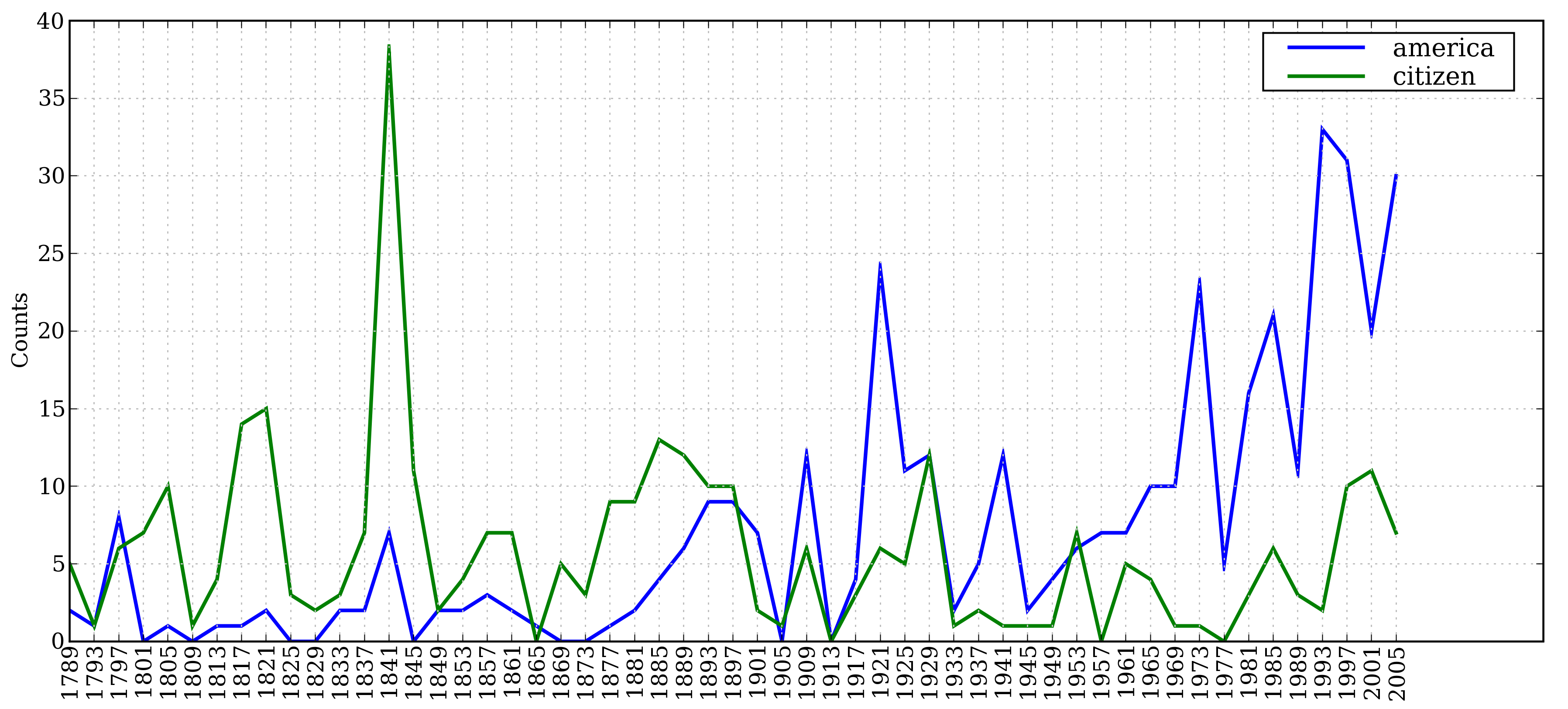
Proquest Historical Newspapers gives you access to an huge "everyday" text archives. You can then use the NLTK to plot when certain terms became popular, how the use of word A correlates with X and how word B and C always show up together. When did the newspapers write about "freedom", when about "security"? Are those to words linked? Is there a correlation between, say, the use of the word "hope" and unemployment statistics?
This, for example, shows the words "citizen" and "american" in the inaugural addresses of the American presidents. [Example from here] Now put on your historian hat and explain it.
Historic Preservationist here. I am currently doing a serious job search and have found a lot of postings for archivists. You need a strong understanding and appreciation for history and a high level of computer savvy. I'm happy to answer any questions.
You could become an internet historian. I know it is far from the period you are interested in, but with websites changing or disappearing constantly the information they contain is changed or lost as well. Preserving this information could be invaluable to future researchers.
Computer science student here. I'm not a historian, but my research group does some work that I think is relevant and I was having a similar discussion with a friend who studies history. Without giving too much away (don't want to be identified on the off chance there is another person from the group on reddit), there's quite a few applications in addition to the translation and imaging ones already given.
I know a couple of researchers who were working on ways to take a group of works that may have been written by a number of authors and determining which works were written by author A, author B, etc. They were also working to adapt their approach to ancient languages. This might be interesting if applied to, say, the Bible, where many sections supposedly written by one author are actually written by many.
Another researcher was working to with a database of publicly accessible records between executives in a certain industry dating back decades. He was doing some cool data visualization and specialized search tools that would help his thesis. For example, he could use the tool to visualize when a certain phrase became prominent in discussions among executives.
Other things off the top of my head: optical character recognition (pdfs are of limited help if you can't search them), search tools (pagerank doesn't really make sense for things without many links documents), databases (how do we effectively combine, store, and access millions of documents), AI (e.g. IBM Watson), natural language processing (search or other applications), etc.
I have a BA in public history & comparative religion and had always hoped to become a museum curator, especially after spending 3 years working in the special collections library's digital lab and curating my own exhibit my senior year. I had always pursued computing/programming as a hobby and ended up working in tech. I got an engineering master's ten years later and currently do nothing related to historiography whatsoever.
There are tons of opportunities in the areas of both digitization (written/printed materials, art & artifacts) and digital presentation (Google Art Project, many up-and-coming VR platforms, not to mention what the big museums do themselves).
To give you an idea, this is the project I helped supervise while I was in college: http://www.whitmanarchive.org/