during the Queen Anne's War, were there still any settlements? Did the Royal Navy still dock their ships there? Was there any other activity there? Thank you if you are able to provide good answers.
Well first of all for reference, Wikipedia actually has quite a useful source for us! If you look at the article on Port Royal, you'll find a copy of this map. Unfortunately, Wikipedia being Wikipedia, they don't actually seem to realise they have a useful source because there's absolutely zero commentary attached to it. The map is from 1785 - from an edition of The Gentleman's Magazine, which existed from the early 18th to the early 20th century - and purports to show what Port Royal looked like before the earthquake and tsunami. The sketched lines around of the buildings and streets, if I remember rightly, indicate the severity of the flooding and destruction.
The city was totally devastated, essentially. About two-thirds of the town was drowned in water as high as forty feet and most of the buildings that were not submerged ended up unfit for Human beings to inhabit. About 2,000 people were killed, two of the city's forts were destroyed (I think James and Carlisle because I'm pretty sure Charles and Rupert are still standing), and HMS Swan's wreck did considerable damage to parts of the city as it was carried with the waves. It took weeks to restore proper order to the town and in that time many hundreds more people perished as the victims of disease, hunger and illness, and occasionally of violence from looters and pillagers. Most of these deaths did not occur in Port Royal but rather in modern-day Kingston, where supplies and shelter were woefully inadequate for weeks. Well more than half of the city's population died as a direct result of the earthquake; a combination of aftershocks and severe instability on the seafront proved an effective deterrent to efforts at immediate resettlement.
Unfortunately, talking about what Port Royal was like post-1692 is a little difficult because the earthquake was not the only tragedy to befall Port Royal. Initial efforts at resettlement were deterred by fears that the site had been permanently made unsuitable for habitation by the earthquake and reconstruction would require significant investment. There were efforts to rebuild the city - several, in fact. The first of these ended in disaster when a series of warehouse fires consumed most of the houses in the town in 1703. Then in 1712, there is reason to believe a passing hurricane caused sigificant localised flooding. Ten years later in 1722 - on the exact same day of the year as the 1712 hurricane no less - another hurricane caused severe storm surges that destroyed much property and claimed hundreds of lives. Another storm in 1726 may have inflicted further damage. So between 1692 and 1726, Port Royal was devastated at least three times by natural disaster and probably suffered serious flooding on two other occasions. Talking about what the city was like in any intimate detail in the aftermath then of the 1692 earthquake is difficult for that reason.
In terms of the city's general significance though, it never came close to being an important settlement in the way it had used to be. Essentially immediately, economic and political activity shifted to Kingston. Port Royal had been on the path to economic decline before 1692 - it wasn't really well-suited to the emerging plantation economy, and it has been argued that its merchants had been particularly reluctant to embrace it (see Buisseret and Pawson's book Port Royal, Jamaica). Kingston was much better situated geographically for the needs of the planters and successive waves of disaster befalling Port Royal ruled out any possibility for a meaningful return to prominence. It did remain a post of naval importance and significance to the British; there was definitely some kind of naval activity there during the mid point of the War of the Spanish Succession (Queen Anne's War). However, it only appears to have become a significant naval outpost after 1735 and especially after 1744 (EDIT: with the completion of dockyard facilities there), decades after the end of the war - so I don't know how significant it really was before then. I also know efforts were made at some point to relocate naval activities elsewhere without success, but I can't for the life of me remember when right now. It continued to have naval significance until 1905 when its dockyards closed.
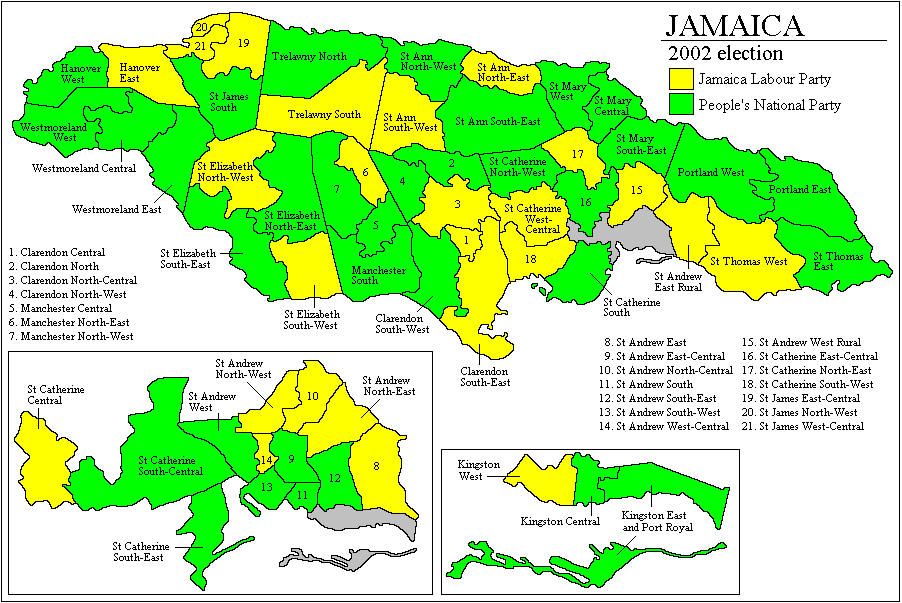
It still exists to this day, it should be noted - but if you take a look at this electoral map of Jamaica in 2002, you'll notice it shares a Member of Parliament with the easternmost chunk of Kingston, which it has done since the first parliamentary election in 1944. I think about 2,000 - 3,000 people live there today in Jamaica - to qualify for its own Member of Parliament (and Jamaica has one of the most representative parliaments in the western world in terms of number of voters per district representative), the former city would need about 40,000 people, and a lot of the people who do live there aren't permanent residents. For decades now it's been little more than a fishing village; fewer than 500 men and women were registered to vote in Port Royal in the first post-WWII general election.